
Oct 4, 2026Applications
Tin Plating for Electronics & Bus Bars
Tin plating protects solderability and conductivity on electronics and bus bars. See where it fits, the process basics and the lines that run it.
Tin plating deposits a soft, solderable, conductive layer on copper — the default finish for leads, connectors, contacts and bus bars. About a 6-minute read.
Speed, thickness control and the pure-tin-versus-alloy decision decide whether the line runs cleanly.
Written by Mia Shang · Engineering reviewed by Li Wang · Published 2 October 2026 · Updated 2 October 2026
Where Tin Plating Fits in Electronics
Typical tin-plated electronics hardware includes component leads and lead frames, connector contacts and pins, bus bars and terminal strips, and stamped/formed current-carrying parts. Tin does three jobs at once: it solders readily (wetted by solder), it resists oxidation enough to keep contact surfaces usable in storage, and it conducts well for its cost — which is why it dominates current-carrying joints and press-fit connections.
Two industry decisions shape every tin specification:
- Pure tin vs tin alloys. Pure matte tin is the common electronics default, but pure tin can grow whiskers under stress — a known reliability topic in fine-pitch electronics, managed by specification (matte vs bright deposits, underplate choices, reflow or alloyed tin where the spec calls for it). Tin-lead and other tin alloys remain in legacy and specialty niches. The governing document is the part specification, not habit.
- Underplates. A nickel underplate between copper and tin is common where diffusion and durability matter (e.g., on connectors), and it changes the line's tank sequence — decide it with the chemistry supplier before the line is laid out.
The Process, Briefly
Tin plating runs the standard electroplating process: degreasing, acid pickling/activation, tin plating in an acid bath (methanesulfonate-type chemistries are common in the industry), then rinsing and drying. Deposition speed and deposit character follow current density and bath chemistry; matte and bright finishes come from different bath systems, and the finish affects solderability behaviour.
For strip and lead-frame work the same chemistry runs at much higher speed on continuous lines: reel-to-reel plating with selective plating fixtures deposits tin only where the design needs it, at line speeds manual racking cannot approach.
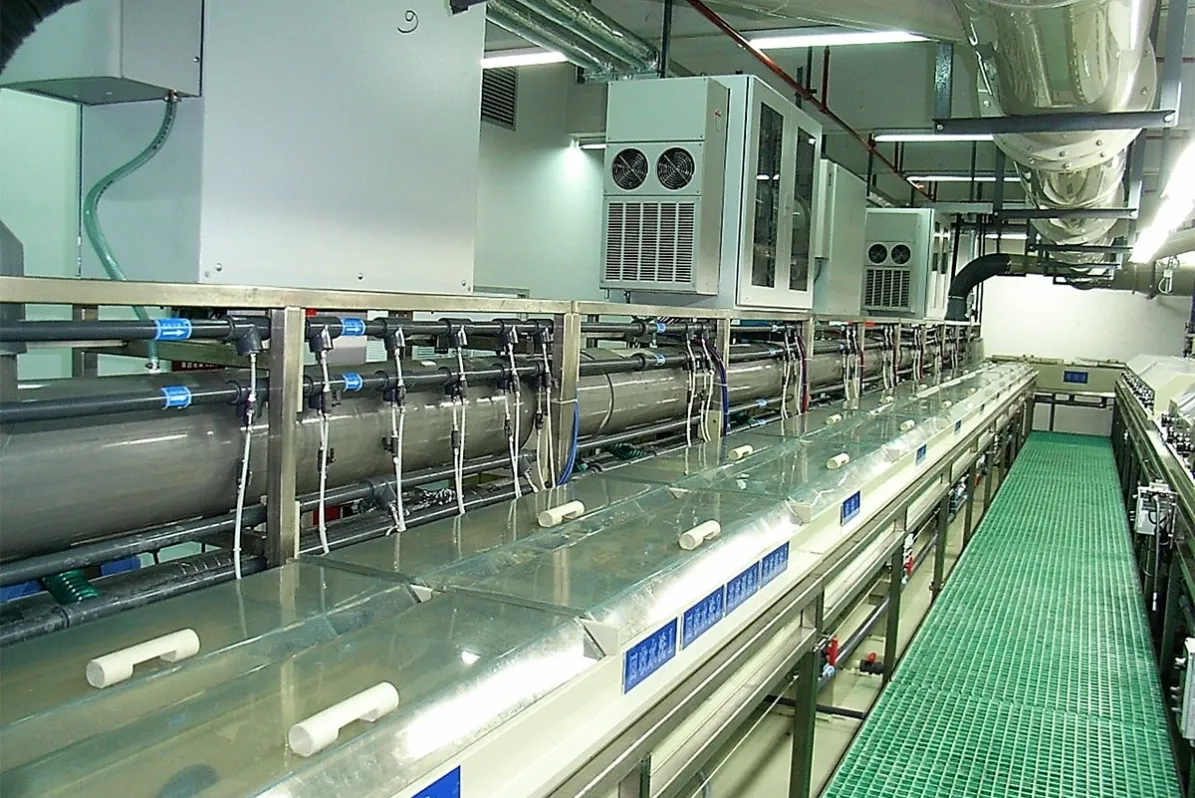
How Lines Run Tin Plating
Tin plating lines come in three practical formats:
- Barrel lines for bulk small parts (screws, terminals, small stamps) — the economical default for tolerant hardware.
- Rack lines for bus bars, busbar assemblies and larger current-carrying parts — tin thickness at specified locations matters on current paths, and racks deliver it.
- Reel-to-reel continuous lines for strip, lead frames and stamped electronics parts — the high-speed format where selective tin plating and inline thickness control justify the capital.
All three are standard plating line formats — the tin chemistry slots into the same pre-treatment/plating/rinse skeleton, with agitation, filtration and temperature control sized for the bath system.
Standards and Evidence Boundary
- ASTM B545 — electrodeposited tin coatings; the model specification for tin thickness classes by service condition.
- IEC 60068 / JEDEC whisker guidance — the industry's reference framework for tin whisker risk management in electronics; follow the component spec level you sell into.
- Chemistry supplier datasheets — bath system (matte/bright, MSA-type), current density windows and additive control are defined there.
Evidence boundary: this article states industry-general facts about tin plating. Whisker mitigation choices, thickness classes and bath windows come from your specifications and chemistry supplier — not from this page, and no process is universally "whisker-free".
FAQ
Why is tin plated on copper bus bars at all — isn't copper conductive enough?
Copper is, but exposed copper oxidizes and loses contact quality over time. Tin preserves solderability and keeps contact resistance low while conducting current adequately — the combination is why tin-plated copper bus bars are the industry default.
Does tin plating stop tin whiskers completely?
No process eliminates whisker risk universally. Matte deposits, nickel underplates, reflow treatments and alloyed chemistries manage the risk, and the governing specification defines what is acceptable. Treat any "whisker-free" claim with caution.
What thickness of tin do electronics parts need?
It follows the specification and service condition — solderability-critical surfaces and corrosion-exposed surfaces carry different classes. Judge thickness from the drawing and the applicable standard, not from a generic number.
Related Reading
- Pillar guide: What Is Electroplating? — the plating landscape tin belongs to.
- Adjacent decision: The Electroplating Process, Step by Step — the sequence a tin line runs.
- Next step: browse plating lines — barrel, rack and reel-to-reel formats for tin applications.
Diagnostic CTA: What to Send Us — and What You Get Back
Send your tin-plated part families through our RFQ form — strip or bulk, dimensions, base material, thickness spec and throughput. ES-PRO returns: a recommended line format (barrel / rack / reel-to-reel), the tank sequence with rectification and handling scope, a quotation, and an explicit list of open questions — we state what is missing rather than assuming it.
References & Authorities
- ASTM B545 — Electrodeposited coatings of tin — ASTM International.
- IEC 60068 — Environmental testing — International Electrotechnical Commission (IEC).
- JEDEC JESD201 — Environmental acceptance requirements for tin whisker susceptibility — JEDEC Solid State Technology Association.
- Chemistry supplier datasheets — bath system (matte/bright, MSA-type), current density windows and additive control are defined by the chemistry supplier.
- Industry associations — e.g., NASF (National Association for Surface Finishing, US) and IMF (Institute of Materials Finishing, UK) publish supplementary guidance and training for the surface-finishing industry.
Standards are cited for identification; always use the current edition from the issuing body. Process parameters are governed by the datasheets for the specific chemistry.