
Oct 4, 2026Applications
Silver Plating for Electronics: Uses and Equipment
Silver plating gives electronics the best conductivity per micron. See where it beats ENIG and tin, the tarnish management it needs, and the equipment that runs it.
Silver is the best conductor you can plate: lowest contact resistance per micron — priced by the gram and protected from tarnish by process discipline. About a 6-minute read.
Written by Ivy Deng · Engineering reviewed by Ben Yuan · Published 4 October 2026 · Updated 4 October 2026
Silver plating occupies a narrow but decisive niche in electronics: wherever contact resistance, high current or RF performance is the specification — and the budget tolerates a precious metal. This article maps where silver wins, what it demands, and what equipment runs it well.
Where Silver Wins
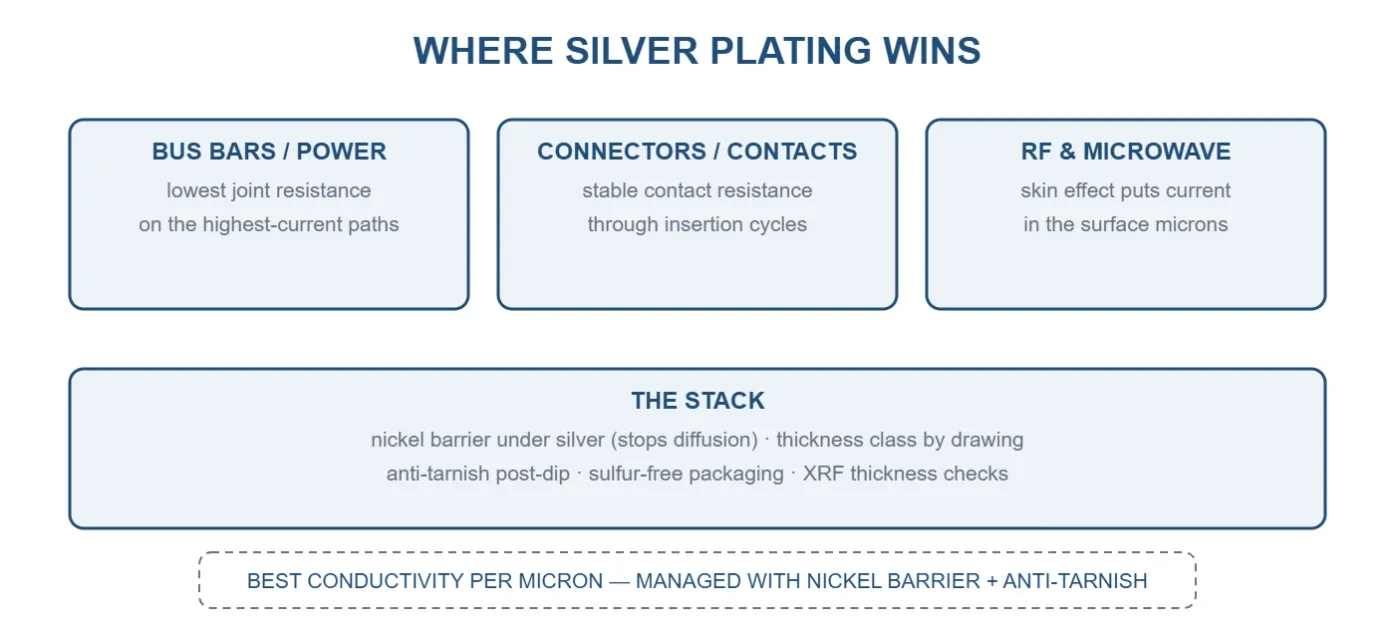
- Bus bars and power contacts — silver on copper bus bars minimizes joint resistance on the highest-current paths; the classic electrical application alongside tin plating for bus bars in lower-current roles.
- Connector pins and contacts — low and stable contact resistance through insertion cycles, often over a nickel underlayer as a diffusion barrier.
- RF and microwave components — skin effect puts the current in the surface microns; silver's conductivity is directly measurable in signal performance.
- PCB final finish (immersion silver) — a solderable, flat, wire-bondable finish governed by IPC-4553, sitting alongside ENIG/ENEPIG in the finish family covered in ENIG and ENEPIG.
What Silver Demands
- Tarnish management — silver reacts with sulfur compounds; anti-tarnish post-treatments, packaging discipline and solderability testing keep the surface spec-compliant through logistics.
- Underlayers — a nickel barrier under silver prevents copper diffusion; strike layers manage adhesion on difficult bases. The layer stack is part of the spec (engineering silver coatings are defined in ASTM B700).
- Thickness control — precious-metal cost makes thickness a cost line: XRF measurement (the method in coating thickness testing) is standard practice — thickness classes come from the drawing.
- Process discipline — silver baths are sensitive to contamination; filtration, analytics and drag-out control protect both quality and metal losses.
Equipment That Runs Silver
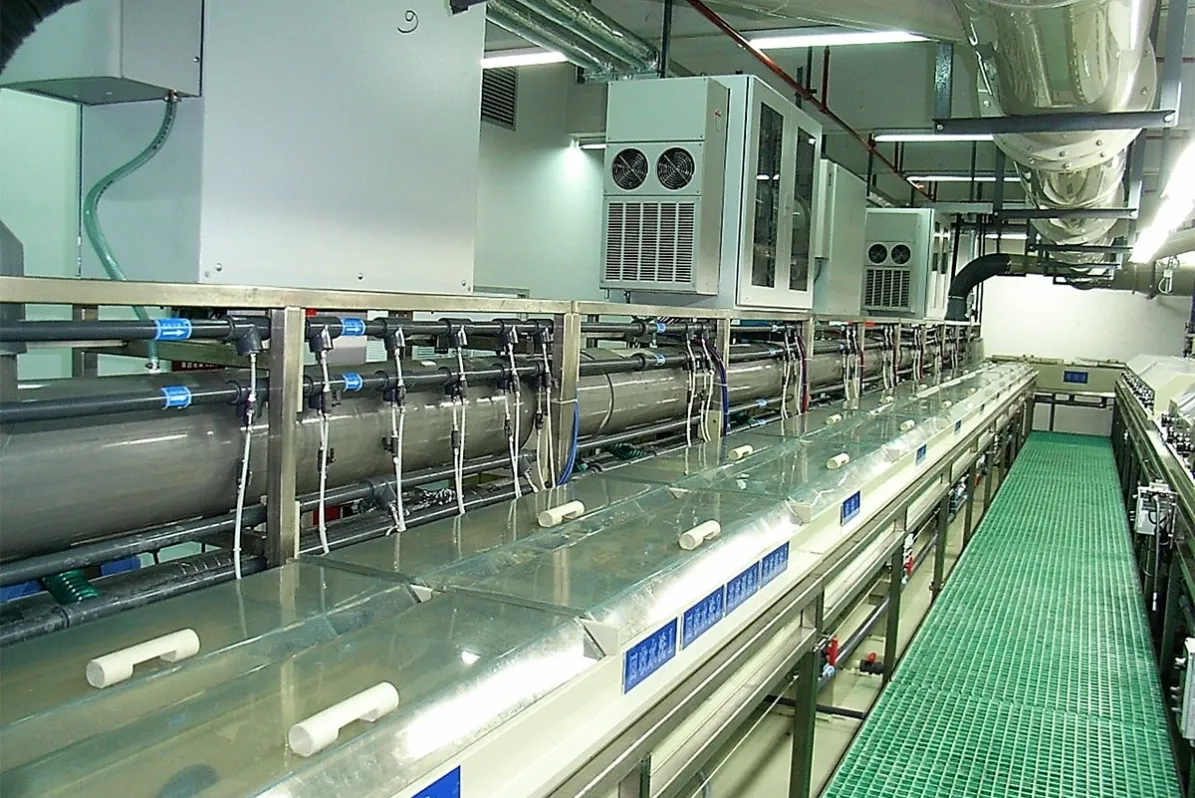
- Rack lines for bus bars and connector housings — controlled current density across contact points, nickel underlayer cell, silver cell, anti-tarnish dip, counterflow rinses.
- Reel-to-reel lines for strip, leads and contacts — continuous plating with selectivity (spot or stripe plating) so silver lands only where the contact needs it; the platform is shown in plating lines.
- VCP lines for panel-level PCB work in the PCB production context.
- Peripheral discipline — rectifiers with stable output, filtration, and bath analysis cadence sized for precious-metal accountability.
Field Workflow: Qualify Silver in Five Questions
- ☐ Contact resistance or current spec the part must hold
- ☐ Substrate and underlayer stack (nickel barrier? copper strike?)
- ☐ Thickness class and measurement points
- ☐ Tarnish/solderability requirements through logistics
- ☐ Format: rack, reel-to-reel or PCB panel
Standards and Evidence Boundary
- ASTM B700 — standard specification for electrodeposited coatings of silver for engineering use — ASTM International.
- IPC-4553 — performance specification for immersion silver plating for printed circuit boards — IPC.
- IPC-4552 — performance specification for ENIG plating (the comparison finish) — IPC.
Evidence boundary: this article compares finishes at industry-general level. Thickness, tarnish and solderability acceptance criteria come from your drawings and the applicable specifications — not from this page.
FAQ
Silver vs ENIG — when does each win?
Immersion silver gives a flat, solderable, wire-bondable finish at lower cost than gold; ENIG brings aluminium-wire-bond heritage and long shelf stability. The assembly process and logistics window decide.
Why nickel under silver?
Nickel blocks copper-silver diffusion and stabilizes contact resistance through the part's life. Skipping it trades reliability for pennies.
How is tarnish prevented in storage?
Anti-tarnish dips and sulfur-free packaging materials, plus FIFO logistics. Tarnish is manageable — but it is a process discipline, not an accident of chemistry.
Is silver plating only for high-end products?
Wherever current density or contact resistance is specified — power distribution, RF, precision connectors — it earns its cost. Bulk low-current contacts usually stay with tin.
Related Reading
- Adjacent decision: Tin Plating for Electronics & Bus Bars — the workhorse alternative.
- Finish family: ENEPIG vs ENIG: PCB Surface Finishes Compared — where immersion silver sits.
- Next step: browse plating lines including reel-to-reel configurations.
Diagnostic CTA: What to Send Us — and What You Get Back
Send three inputs through our RFQ form:
- The parts and their contact/current/resistance specs
- Substrate and stack requirements (underlayers)
- Format and volume — rack or reel, parts per shift
ES-PRO returns: a line configuration with selectivity and thickness-control design, an equipment list, a quotation, and an explicit list of open questions — we state what is missing rather than assuming it.
References & Authorities
- ASTM B700 — Standard specification for electrodeposited coatings of silver for engineering use — ASTM International.
- IPC-4553 — Performance specification for immersion silver plating for printed circuit boards — IPC.
- IPC-4552 — Performance specification for electroless nickel/immersion gold (ENIG) plating for printed circuit boards — IPC.
- Chemistry supplier datasheets — bath systems, additives and operating windows for the specific silver chemistry (issued by the chemistry supplier).
- Industry associations — e.g., NASF (National Association for Surface Finishing, US) and IMF (Institute of Materials Finishing, UK) publish supplementary guidance and training for the surface-finishing industry.
- Standards are cited for identification; always use the current edition from the issuing body. Process parameters are governed by the datasheets for the specific chemistry.