
Oct 4, 2026Applications
Cadmium Plating: Aerospace Uses and Modern Alternatives
Cadmium plating still spec'd in aerospace for sacrificial corrosion and lubricity. See where it holds, the health and environment constraints, and the alternatives.
Cadmium survives in aerospace specs for one reason: sacrificial corrosion plus lubricity in one thin deposit — but its toxicity is reshaping where it may run. About a 6-minute read.
Written by Jason Han · Engineering reviewed by Eayon · Published 4 October 2026 · Updated 4 October 2026
Cadmium plating is the surface treatment engineers love to inherit and hate to specify. On fasteners and connectors in aerospace and defense work it still appears on drawings — and every shop that meets it needs to understand both why it holds and what replaces it.
Why Cadmium Held Its Ground
Cadmium on steel gives a rare combination in one step:
- Sacrificial corrosion — cadmium corrodes preferentially to steel, protecting scratches and edges
- Low galvanic risk with aluminium — critical on airframes where steel fasteners meet aluminium structure
- Lubricity — low friction and good torque-tension behavior on threads
- Ductility — survives the deformation of threaded fasteners without cracking
That bundle is why standards like ASTM B766 (electrodeposited cadmium, classified by thickness classes such as Cd 25/12/8/5) remain active, and why corrosion performance is demonstrated in salt spray per ASTM B117.
The Constraint: Health and Environment
Cadmium is toxic and persistent. Plating shops face strict controls on fume, waste and worker exposure; end products face substance restrictions in many markets. The practical consequences for a line:
- Closed handling: containment, scrubbing and wastewater treatment sized for cadmium chemistry
- Effluent streams segregated and treated before discharge
- Documentation discipline — cadmium work is audited, not assumed
This is not a coating a shop takes on casually: the line design, ventilation and water-treatment scope differ from ordinary plating.
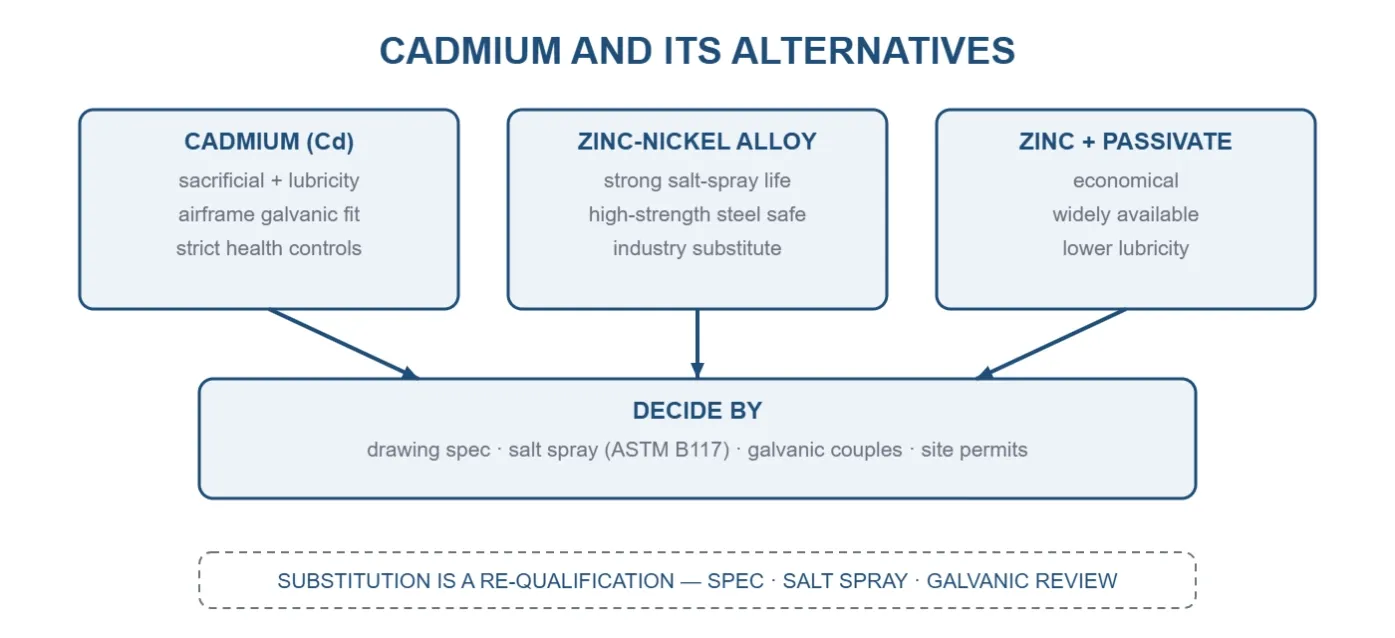
The Alternatives
Alternative | What it offers | Where it loses to cadmium |
|---|---|---|
Zinc-nickel alloy (+ passivate) | Strong salt-spray life, good on high-strength steel, industry-accepted substitute | Slightly higher friction than cadmium on threads; galvanic behavior differs |
Zinc with trivalent passivate | Economical, widely available | Lower lubricity; galvanic couple with aluminium less favorable |
Aluminum coatings (thermal/diffusion) | No cadmium, aerospace-accepted in places | Process cost and equipment differ entirely |
The substitute decision is not free: it is re-qualification against the drawing, salt-spray evidence and — on airframes — galvanic compatibility review. That is a program decision, not a chemistry swap.
The Line Perspective
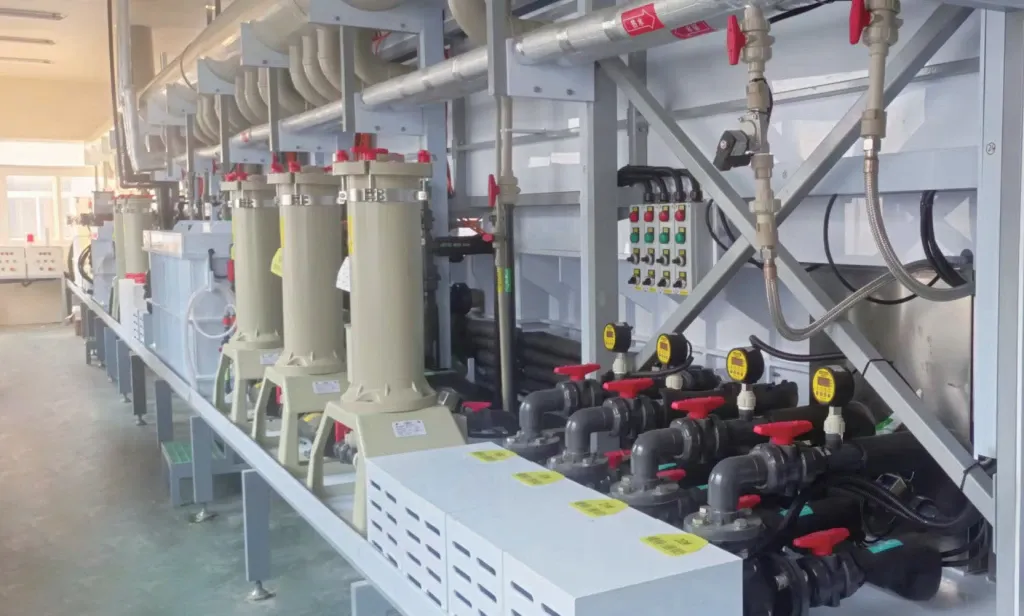
A cadmium-capable line is a plating line with a containment and treatment package: dedicated tanks, fume handling, segregated rinse streams and wastewater treatment sized for the chemistry. The plating lines platform covers the tank sequence and control; the verification side (thickness classes, salt spray) is the same discipline described in coating thickness testing. The corrosion baseline for the substitutes is covered in zinc plating.
Field Workflow: Decide Cadmium vs Substitute
- ☐ Does the drawing still call cadmium — and may it be substituted (check the spec change notes)?
- ☐ Substrate strength class — embrittlement relief requirements?
- ☐ Galvanic couples in service — steel against aluminium?
- ☐ Threaded parts — torque-tension requirements documented?
- ☐ Local environmental permits — is cadmium plating even permitted at your site?
Standards and Evidence Boundary
- ASTM B766 — standard specification for electrodeposited coatings of cadmium (thickness classes) — ASTM International.
- ASTM B117 — standard practice for operating salt spray (fog) apparatus — the test method behind corrosion demonstrations — ASTM International.
- Customer and airframer specifications — the qualification boundary for substitutions; they govern over generic guidance.
Evidence boundary: this article compares cadmium and alternatives at industry-general level. Substitution decisions, qualification testing and permit scope come from your customer specification, the applicable standards and your local authority — not from this page.
FAQ
Is cadmium plating banned?
Restricted in many consumer and commercial markets, and strictly controlled where permitted — but not globally banned; aerospace and defense drawings still carry it. Whether it may be run at a given site is a permit question.
What is the closest drop-in substitute?
Zinc-nickel alloy systems are the industry-standard substitute for most corrosion jobs, with re-qualification. "Drop-in" without testing is not a claim any supplier should make.
Why does lubricity matter so much on fasteners?
Torque translates into clamp load through friction; cadmium's low, stable friction gives predictable preload. Substitutes need lubricants or geometry allowances to match it.
Can an existing zinc line be converted to zinc-nickel?
Often the tank sequence adapts, but chemistry, anodes and control change, and wastewater handling must match the new alloy — an engineering review, not a bath swap.
Related Reading
- Adjacent decision: Zinc Plating: Rust Protection, Process & Line Equipment — the substitute family's baseline.
- QC: How Coating Thickness Is Tested: XRF & Eddy Current — verifying the class you qualify.
- Next step: browse plating lines and talk through the containment scope.
Diagnostic CTA: What to Send Us — and What You Get Back
Send three inputs through our RFQ form:
- The drawings/coatings in question — cadmium classes or substitute candidates
- Substrate strength classes and service environment
- Site constraints — hall, permits, wastewater scope
ES-PRO returns: a line configuration for the chosen system (including the containment and treatment scope), an equipment list, a quotation, and an explicit list of open questions — we state what is missing rather than assuming it.
References & Authorities
- ASTM B766 — Standard specification for electrodeposited coatings of cadmium — ASTM International.
- ASTM B117 — Standard practice for operating salt spray (fog) apparatus — ASTM International.
- Chemistry supplier datasheets — bath systems, containment and operating windows for the specific chemistry (issued by the chemistry supplier).
- Industry associations — e.g., NASF (National Association for Surface Finishing, US) and IMF (Institute of Materials Finishing, UK) publish supplementary guidance and training for the surface-finishing industry.
- Standards are cited for identification; always use the current edition from the issuing body. Process parameters are governed by the datasheets for the specific chemistry.