Oct 1, 2026
What Is Electroplating? Definition, Uses & Process
Electroplating is the electrochemical deposition of a metal coating on a part. Learn how it works, the common plating types, and what a plating line includes.
A practical introduction for plant engineers and purchasing teams — what electroplating is, what it achieves, and what a production line actually includes. About a 7-minute read.
Written by Simon Wong · Engineering reviewed by Ben Yuan · Published 30 September 2026 · Updated 1 October 2026
Electroplating is an electrochemical process that deposits a thin layer of metal — such as nickel, zinc, copper or tin — onto the surface of a conductive part. Manufacturers use it to prevent corrosion, resist wear, improve electrical conductivity and achieve a consistent, high-value finish. In industry, electroplating is done in purpose-built plating lines, not by hand.
What Is Electroplating, Exactly?
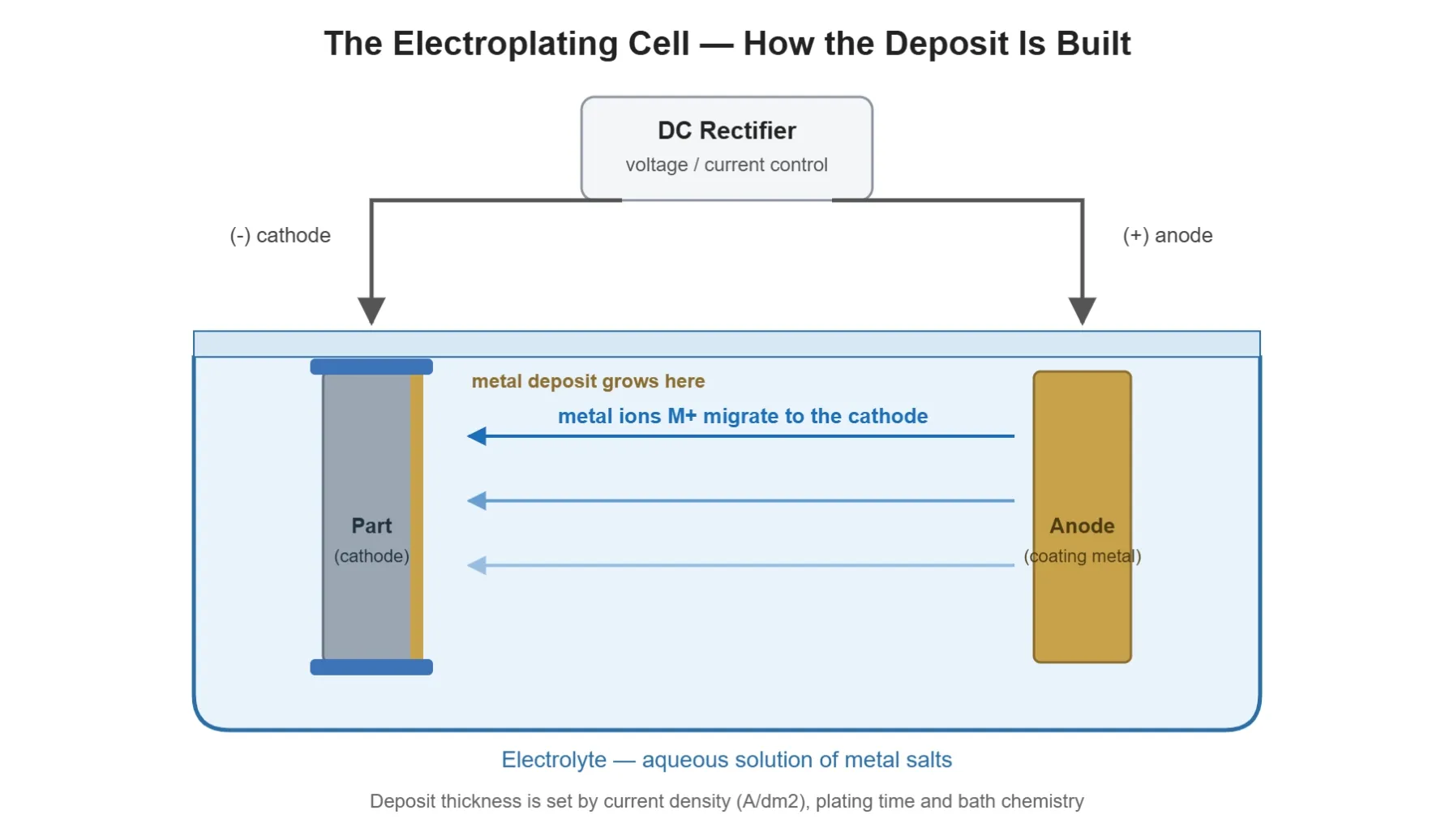
Electroplating (also called electrodeposition) uses electric current to move metal onto a surface. The part to be coated is immersed in a liquid called the electrolyte and connected to the negative terminal of a DC power supply, making it the cathode. The coating metal — either as solid anodes or as dissolved salts in the bath — supplies positively charged metal ions.
When current flows, those metal ions are reduced at the part's surface and deposit atom by atom, building a coherent metallic layer. The thickness of that layer is controlled by three practical levers: current density, plating time and bath chemistry. This is what separates industrial coating from painting — the coating is a true metallurgical layer, chemically bonded to the substrate, not a film stuck on top of it.
Why Manufacturers Plate Parts
Plating is one of the most cost-effective ways to give a base metal properties it doesn't have. Five reasons dominate in industry:
- Corrosion protection. Zinc and zinc-alloy coatings sacrifice themselves to protect the steel underneath — the standard answer for fasteners, brackets and chassis components exposed to moisture and road salt.
- Wear resistance. Hard coatings such as hard chrome extend the service life of surfaces that slide, roll or rub: hydraulic rods, mould cavities, rolls and shafts.
- Electrical performance. Copper, silver and tin plating provide conductivity, solderability and reliable contact resistance for connectors, busbars and electronic components.
- Appearance and value. Decorative nickel-chrome finishes turn plain steel or plastic into a bright, premium-looking product surface.
- Dimension build-up. Worn or undersized parts can be plated back to spec — a repair route that is often far cheaper than replacement.
Common Plating Types: Reference Table
Metal | Typical industrial use | Common bath chemistry | Typical thickness range* |
|---|---|---|---|
Zinc | Sacrificial corrosion protection for steel fasteners and brackets | Alkaline or acid chloride | 5–25 µm |
Nickel | Corrosion/wear barrier; undercoat for decorative chrome; electroless nickel for complex shapes | Sulfate-based (Watts type) | 5–40 µm |
Copper | Adhesion undercoat, conductivity, electronics and PCB fabrication | Acid sulfate | 3–30 µm |
Tin | Solderability, food-contact safety, electronics | Acid sulfate / methane sulfonate | 3–15 µm |
Silver | Electrical contacts, conductors, high-reliability components | Cyanide and non-cyanide systems | 2–10 µm |
Chrome | Hard chrome for wear surfaces; thin decorative chrome topcoat | Chromic acid (hexavalent); trivalent for decorative | 10–100 µm+ (hard) |
* Guideline commercial ranges for orientation only — the specifying document is always the applicable standard (see below) and your chemistry supplier's datasheet.
The "right" metal depends on the duty the part sees — corrosion, wear, electrical function or appearance — and often two or three coatings are stacked (copper under nickel under chrome, for example) to get properties a single layer can't deliver.
Field Calculation: How Long Does One Plating Stage Take?
A reusable rule of thumb for planning and sanity-checking supplier quotations comes from Faraday's law. Plating time in hours:
t = (d × ρ) / (j × ECE × η × 100)
where d = target thickness (µm), ρ = coating metal density (g/cm³), j = current density (A/dm²), ECE = electrochemical equivalent (g/(A·h), from the chemistry datasheet), η = cathode efficiency (0–1).
Worked example — nickel, 20 µm target: ρ ≈ 8.9 g/cm³, ECE ≈ 1.095 g/(A·h) for Ni²⁺, η ≈ 0.95, j = 4 A/dm². Then t ≈ (20 × 8.9) / (4 × 1.095 × 0.95 × 100) ≈ 0.43 h — about 26 minutes in the plating tank.
Checklist before trusting any such estimate:
- ECE and efficiency taken from your bath's datasheet, not generic values
- Current density is realistic for the part geometry (high-current-density edges plate faster)
- Tank time excludes racking, transfers, rinsing and drying
- Thickness is the minimum local value the standard requires, not the average
Industrial Electroplating vs Hobby or Manual Plating
The chemistry is the same; everything around it is not. Hobby and manual bench plating works for small, low-stakes batches. Industrial production differs in four ways:
- Scale. Production tanks hold hundreds of litres or more, with rectifiers sized to deliver stable current across full racks of parts.
- Repeatability. Bath temperature, concentration, current density and dwell time are controlled and logged, so the thousandth part matches the first — a requirement in automotive and electronics supply chains.
- Throughput. Automated transport (hoists, conveyorized or continuous systems) moves loads through the sequence on a fixed takt instead of by hand.
- Environment and compliance. Rinsing water, spent chemistry and fumes are captured and treated as part of the line, not as an afterthought.
Inside an Industrial Plating Line
A production line is a sequence of stations, each doing one job:
- Pre-treatment. Degreasing (soak, ultrasonic or electrolytic), acid pickling and activation remove oil, oxides and scale. Adhesion is won or lost here.
- Plating section. One or more plating tanks with rectifiers, solution filtration, agitation and temperature control doing the actual deposition.
- Post-treatment. Neutralizing, passivating or anti-tarnish dips that fix the coating's final properties and appearance.
- Rinsing and drying. Multi-stage counterflow rinses stop chemistry carry-over; hot-air drying prevents water spots.
- Water and environment. Wastewater treatment, DI-water supply, fume scrubbers and cooling — the utilities that keep the line legal and stable.
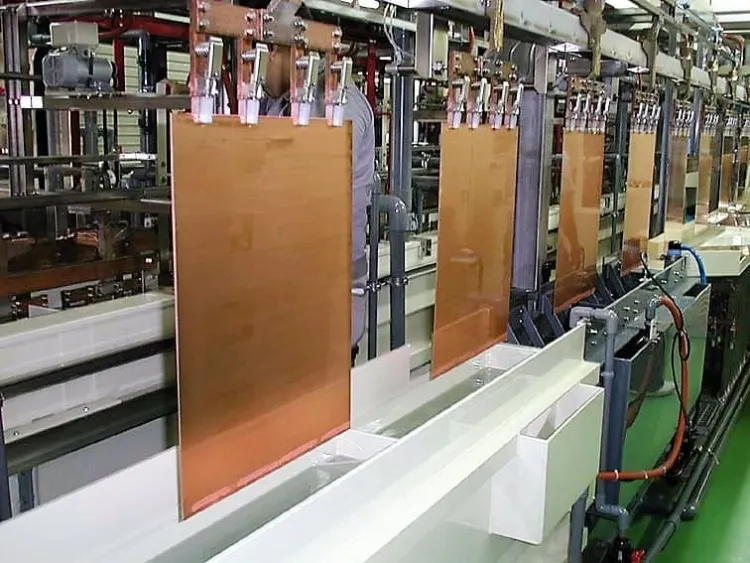
Besides the tanks themselves, a line depends on supporting equipment — plating rectifiers, filtration pumps, chillers, RO/DI water systems and wastewater treatment — which is why lines are usually sourced as a matched system. Browse the full range of industrial plating equipment on our products hub.
Standards and Evidence Boundary
For buyers who need to reference specifications in RFQs and drawings, these are the primary documents commonly cited (always specify against the current edition):
- ISO 2080 — Electroplating and related processes: vocabulary. The shared language for process terms.
- ASTM B633 — Electrodeposited coatings of zinc on iron and steel, with defined thickness classes for different service conditions. The baseline spec for fastener and bracket zinc plating.
- ISO 1456 — Electrodeposited coatings of nickel plus chromium systems, graded by service condition. The reference for decorative nickel-chrome.
- ASTM B568 — X-ray spectrometry for measuring coating thickness, the common QC method behind "µm" numbers on inspection reports.
- EU REACH — Hexavalent chromium processes sit under authorization and restriction pressure in the EU, which drives the shift to trivalent chrome chemistry. Applicability depends on your market and product sector.
Evidence boundary: this article states only industry-general facts and textbook constants (for example, nickel's ECE and density). Coating performance claims, chemistry parameters and compliance statements always come from the applicable standard and the chemistry supplier's datasheet for your specific bath — ES-PRO does not generalize them.
FAQ: What Buyers Ask First
What is the difference between electroplating and electroless plating?
Electroplating needs an external DC current; electroless plating deposits metal through a chemical reaction with no current, giving uniform thickness inside holes and on complex geometry. As a rule: electrolytic for speed and operating cost at volume; electroless nickel when uniform coverage of hard-to-reach surfaces matters most.
What metals can be electroplated?
The common industrial coatings are nickel, zinc, copper, tin, silver and chrome, applied to steel, stainless steel, brass and copper alloys. Even non-conductive parts such as plastics can be plated after an etching-and-activation sequence makes their surface conductive.
How thick is an electroplated coating?
See the reference table above: from a few microns for electronics and decorative work to tens of microns — and more for hard chrome — where corrosion, wear or build-up demands it. The specifying number always comes from the applicable standard for your product.
How long does electroplating take?
Use the field calculation above: a 20 µm nickel deposit, for example, needs roughly 26 minutes of tank time at 4 A/dm². Add pre-treatment, rinsing and drying for the full line cycle — the whole sequence is explained in the electroplating process step by step.
Related Reading
- Pillar guide: The Electroplating Process, Step by Step — every stage from degreasing to wastewater, in sequence.
- Adjacent decision: How to Set Up a Metal Plating Line — the five decisions and equipment checklist before you buy.
- Next step: browse plating, cleaning and peripheral equipment to see what each line type includes.
Diagnostic CTA: What to Send Us — and What You Get Back
To move from this overview to a concrete solution, send us five inputs through our RFQ form:
- Substrate and alloy, plus maximum part dimensions and weight per load
- Coating system (metal and thickness/standard) — or the performance target if chemistry is open
- Capacity target: parts per hour or per shift
- Automation preference — manual, semi-automatic, fully automatic, or "advise us"
- Site constraints: hall dimensions, available utilities, local discharge rules
ES-PRO returns: a preliminary line concept (tank sequence and automation level), an equipment list with the supporting rectification, filtration and water-treatment scope, a quotation, and an explicit list of any open questions — we state what is missing rather than assuming it.