Plating Process
Titanium Surface Preparation Equipment
Titanium's natural oxide layer is one of the most stable in engineering — which makes titanium an excellent structural material and an extremely difficult plating substrate. No conventional pre-treatm

Titanium's natural oxide layer is one of the most stable in engineering — which makes titanium an excellent structural material and an extremely difficult plating substrate. No conventional pre-treatment sequence removes the oxide reliably enough for adhesion. This guide covers the specialised pre-treatment sequence and the equipment scope for plating titanium.
Technical planning document — confirm chemistry parameters with a specialist titanium finishing supplier, as standard plating pre-treatments do not work on titanium.
Why titanium resists plating
Titanium's passive oxide layer (TiO₂) reforms within milliseconds of any surface preparation step. Acid pickling, alkaline cleaning, mechanical abrasion — none of these prevent the oxide from reforming before the part reaches the plating tank. The oxide is chemically stable, thin and tightly bonded, and it blocks the electroplated coating from reaching the metal substrate.
Challenge | Why it happens | Consequence if ignored |
|---|---|---|
Instant oxide reformation | TiO₂ layer self-heals on exposure to air or water | Adhesion failure — coating deposits on oxide, not metal |
Hydride layer formation | Some activation chemistries form titanium hydride on the surface | Brittleness and delamination under mechanical stress |
Hydrogen absorption | Titanium absorbs hydrogen from acid pickling | Embrittlement of the substrate, especially in aerospace applications |
The pre-treatment sequence that works
Step | Chemistry | Function |
|---|---|---|
1 · Mechanical preparation | Vapour blasting or fine abrasive blasting | Removes gross oxide and provides a mechanical key for the coating |
2 · Alkaline cleaning | Mild alkaline cleaner at 60–70°C | Removes oil and organic contamination |
3 · Acid pickling | Hydrofluoric-nitric acid mixture (HF-HNO₃) | Removes the oxide layer — HF attacks TiO₂ while HNO₃ prevents hydrogen absorption |
4 · Activation | Proprietary titanium activation chemistry or Wood's nickel strike | Prevents oxide reformation during transfer to the plating tank |
5 · Nickel strike | Wood's nickel strike (nickel chloride + HCl) or electroless nickel | First electroplated layer deposited before the oxide can reform |
6 · Conventional plating | Any standard plating chemistry on top of the nickel strike | Standard plating on top of the nickel interlayer |
Steps 3 through 5 must happen without interruption — any delay between activation and the nickel strike allows the oxide to reform. An automated hoist with a programmed short-cycle sequence is the most reliable way to achieve the required speed.
The equipment scope
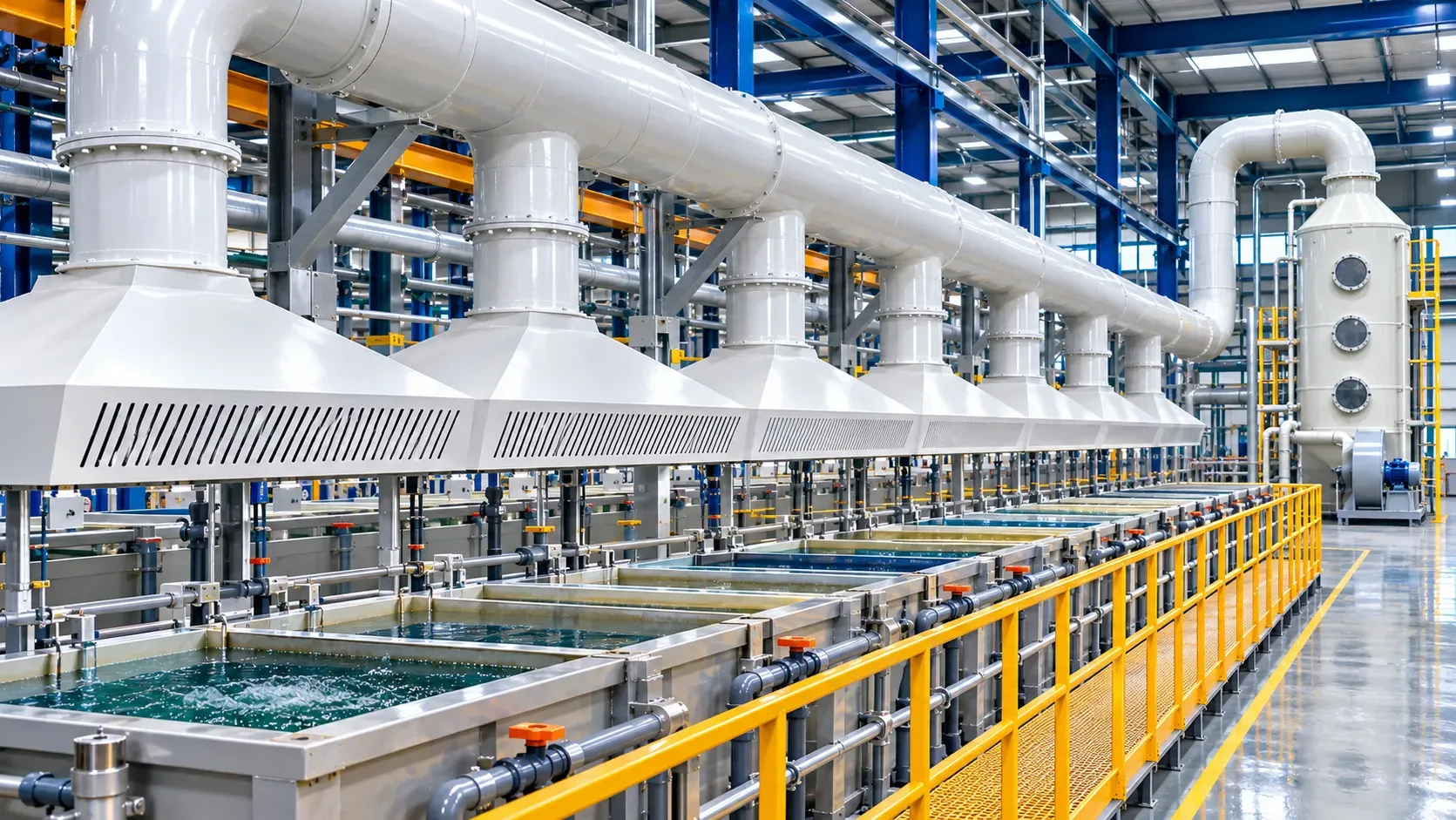
- All tanks in PP or PVDF. The HF-containing chemistry attacks glass and most metals — PP and PVDF are the standard tank materials.
- Dedicated HF ventilation. Hydrofluoric acid fumes require dedicated extraction in compatible material with calcium gluconate gel on site as a safety requirement.
- Programmable hoist with short-cycle capability. The sequence from pickling to nickel strike must be timed precisely — manual transfer is too slow for reliable adhesion.
- Rinse stages between every step. Carry-over between titanium chemistry steps causes contamination and quality failures.
- Waste treatment for fluoride. Fluoride-containing rinse water requires calcium-based precipitation before discharge.
Key takeaways
- Titanium's oxide layer reforms within milliseconds — conventional pre-treatment cannot prevent it.
- The HF-HNO₃ pickle removes oxide while the nitric prevents hydrogen absorption.
- The sequence from pickling through nickel strike must run without interruption — automate the transfer.
- Wood's nickel strike or electroless nickel is the first deposit layer that bonds to titanium.
- Fluoride waste treatment is part of the effluent scope.
Your next five steps
- Confirm the titanium alloy — Ti-6Al-4V, CP titanium and other alloys respond differently to the pickle chemistry.
- Obtain the titanium-specific pre-treatment chemistry from a specialist supplier.
- Design the tank sequence for the full pre-treatment chain with automated short-cycle transfer.
- Specify PP or PVDF tanks and HF-compatible extraction and ventilation.
- Plan the fluoride-containing waste treatment in the effluent scope.
FAQ
Can we use standard acid pickling on titanium?
No — standard HCl or H₂SO₄ pickling does not remove the TiO₂ oxide layer effectively. The HF-HNO₃ mixture is the standard pickle for titanium.
Is Wood's nickel strike the only option for the first layer?
Electroless nickel and proprietary titanium activation systems are alternatives. Wood's nickel strike is the most widely documented and understood method.
Is titanium plating safe to operate?
The HF chemistry is hazardous — full PPE, calcium gluconate gel on site, dedicated ventilation and strict handling protocols are mandatory. The equipment scope must include safety provisions.
Image note: AI-generated editorial photography illustrates equipment or workpiece contexts; it is not an ES-PRO installation, customer reference or evidence of coating performance.