Plating Process
Plating Line Ventilation Design Equipment
Ventilation is the equipment that protects your building, your workers and your permit. A plating line without proper fume extraction corrodes the building structure, creates worker health claims and
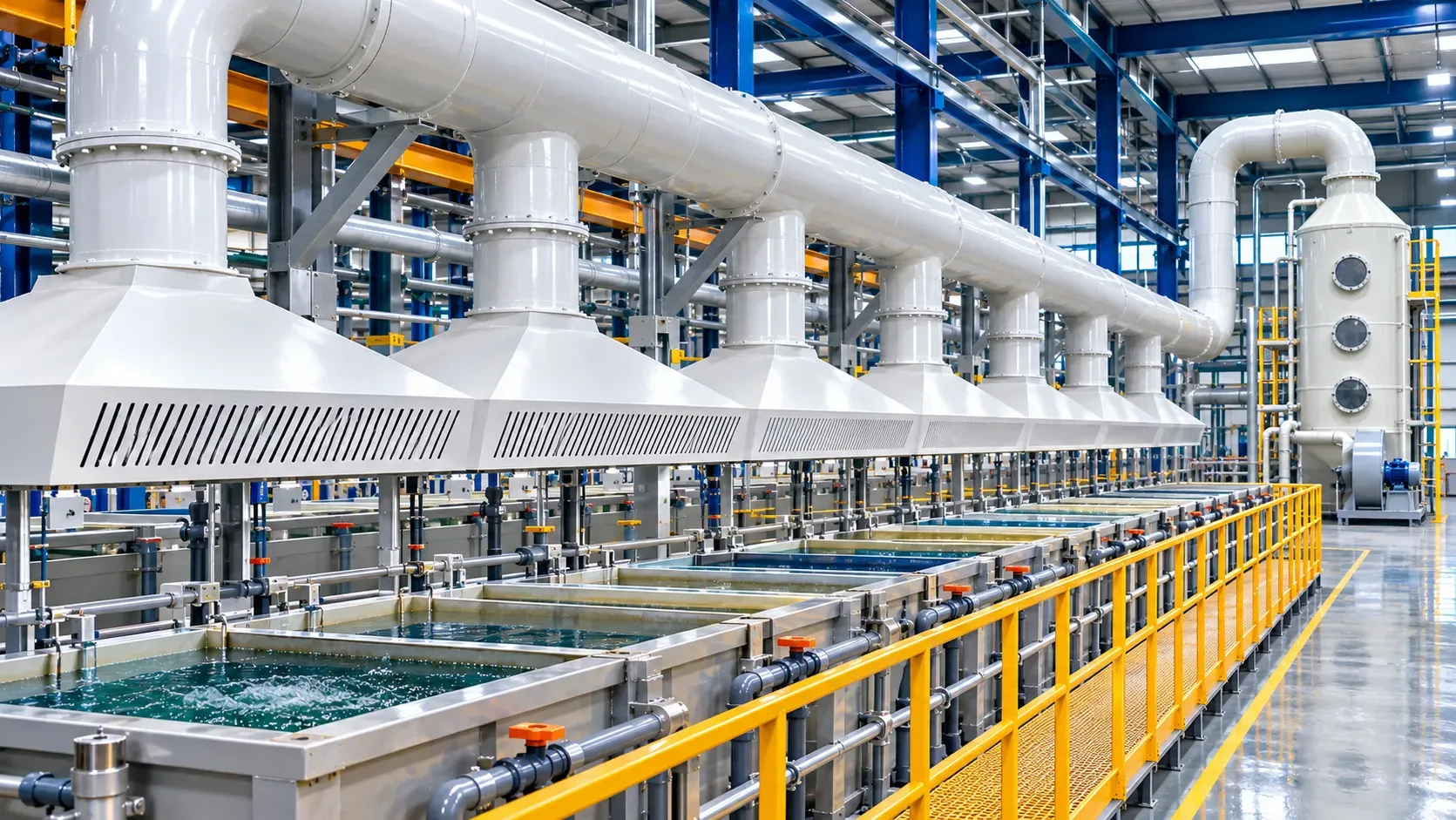
Ventilation is the equipment that protects your building, your workers and your permit. A plating line without proper fume extraction corrodes the building structure, creates worker health claims and fails every environmental inspection. This guide covers the extraction types, sizing logic and the specification points that make a ventilation system work.
Technical planning document — confirm airflow calculations with a ventilation engineer.
The extraction types
Type | How it works | Best for | Capture efficiency |
|---|---|---|---|
Lateral (slot) exhaust | Slots along one or both tank edges pull air sideways across the tank opening | Open surface tanks — pickling, plating, electrocleaning | 70–90% depending on tank width and air velocity |
Overhead hood (canopy) | Hood above the tank pulls fumes upward | Hot tanks with thermal rising fumes | 50–70% — cross-draughts reduce effectiveness |
Enclosed tank with door | Tank covered with a sliding or hinged lid connected to extraction | Chrome plating, hot pickling — high-hazard processes | 95%+ when closed |
Push-pull system | Air pushed from one side, pulled from the other — creates an air curtain | Wide tanks where lateral exhaust alone is insufficient | 85–95% |
Lateral slot exhaust is the most common configuration for plating tanks. Enclosed tanks with doors are mandatory for hexavalent chrome plating in most jurisdictions.
Sizing the extraction
Parameter | Typical value | What it controls |
|---|---|---|
Capture velocity | 0.3–0.5 m/s at the tank surface | The air speed needed to pull fumes into the extraction slot |
Airflow per tank | 1500–4000 m³/h depending on tank width and solution temperature | The total volume of air moved |
Slot velocity | 5–10 m/s in the extraction slot | The air speed inside the slot opening itself |
Duct velocity | 10–15 m/s in the ductwork | Prevents condensation and particle settling in the duct |
The capture velocity must overcome cross-draughts from doors, windows and other equipment. A tank near a doorway needs higher capture velocity than one in a sheltered corner.
The scrubber: mandatory for certain processes
Process | Fume type | Scrubber requirement |
|---|---|---|
Hexavalent chrome plating | Chromic acid mist — carcinogenic | Mandatory: mesh-pad or packed-bed scrubber; emission limit enforced |
Pickling (HCl) | Hydrogen chloride gas | Mandatory in most jurisdictions: packed-bed scrubber |
Pickling (H₂SO₄) | Sulfuric acid mist | Mandatory above threshold concentrations |
Cyanide plating | Alkaline mist with cyanide droplets | Packed-bed scrubber — cyanide mist is toxic |
Alkaline cleaning | Mild alkaline mist | Standard extraction usually sufficient |
The scrubber itself is a packed column where the fume passes through a wetted packing material that absorbs the contaminant. The scrubber liquid (typically water or dilute alkali) is recirculated and periodically discharged to the effluent treatment plant.
Key takeaways
- Lateral slot exhaust is the standard configuration for open plating tanks.
- Chrome plating requires enclosed tanks with door extraction plus a scrubber — mandatory.
- Capture velocity of 0.3–0.5 m/s at the tank surface is the sizing criterion.
- PP or fibreglass ducting — metal ducts corrode from acid fumes within months.
- Scrubber liquid discharges to the effluent treatment plant — include it in the treatment scope.
Your next five steps
- Identify which tanks produce hazardous fumes: chrome, HCl pickling, cyanide, hot sulfuric.
- Specify the extraction type per tank: lateral, enclosed or push-pull.
- Size the airflow based on tank dimensions and the capture velocity requirement.
- Specify scrubbers for chrome, HCl and cyanide tanks.
- Design the ductwork in corrosion-resistant material (PP, fibreglass).
FAQ
Can one extraction system serve multiple tanks?
Yes — a central extraction system with branches to each tank works if the airflow is balanced. A ventilation engineer should balance the system so each tank gets its design airflow.
How do we know if the extraction is working?
Smoke test: release a smoke pencil near the tank surface and verify the smoke moves into the extraction slot. If smoke drifts away, the capture velocity is insufficient.
Does the scrubber need its own permit?
The scrubber is part of the extraction system and is covered by the site's environmental permit. The scrubber discharge to the effluent treatment plant is part of the wastewater permit.
Image note: AI-generated editorial photography illustrates equipment or workpiece contexts; it is not an ES-PRO installation, customer reference or evidence of coating performance.