
Automation Control Engineering
Plan PLC sequence control, interlocks and production-data interfaces for plating equipment. Define the machine and acceptance boundary for an ES-PRO proposal.
In brief: Plating-line automation control engineering defines how equipment sequences, interlocks, alarms and production data work together. It is a project-specific control scope, not a fixed PLC model or a promise of unattended operation.
Send a project inquiry — mention "Automation Control Engineering for Plating Lines" in the message. To attach drawings or reports, use the equipment-specific email checklist below.
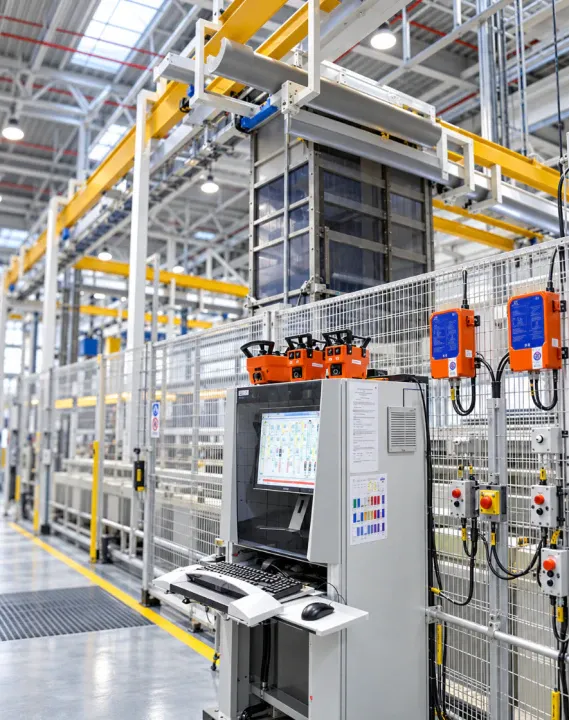
Illustrative image: the PLC-area image provides visual context only; it does not identify a delivered cabinet, controller version or installed ES-PRO system. View the image.
Describe the line sequence before the controller
The ES-PRO control catalog names PLC-based motion or sequence control, safety interlocks and production-data interaction. To turn that scope into an engineering brief, draw the route from loading through each process station to unloading. Identify recipe changes, operator interventions, skipped stages and the response when a tank, hoist, power supply or transfer device is unavailable.
Give the controls supplier a mode table: automatic, manual/jog, maintenance, restart and emergency stop. For each mode, record permitted movement and required access. The project safety engineer should define the required risk assessment and safety functions; an “interlock” label alone does not establish safe operation or a standards claim.
Agree hardware and system interfaces
Request an I/O list and interface boundary for drives, sensors, rectifiers, temperature control, dosing, extraction, water treatment and upstream/downstream handling equipment. Include communications protocol, signal ownership, network connection and recovery behavior. Where a plant MES or historian is involved, list the exact data items and who owns the integration and cybersecurity review.
The proposal should identify the PLC, HMI and cabinet scope; wiring and field devices; software licenses; documentation; spares; and commissioning responsibilities. Do not assume that production traceability, recipe validation or remote support are included just because the catalog mentions data interaction.
Set the commissioning evidence
Ask for a functional description, alarm and cause-effect list, electrical drawings, software backup procedure and factory-acceptance test. Use representative faults: a missed carrier, unavailable tank, interrupted utility or communication loss. Agree how each is detected, how the sequence stops, what the operator sees and how recovery is documented. Confirm site acceptance with the actual plating line layout and equipment interfaces.
Request a control proposal
Send the line process flow, equipment list, proposed operating modes, site electrical standard, integration points and data requirements. If the mechanical line is not yet selected, ask for an assumption register so controls can be repriced when its interfaces are known. The photograph and catalog text do not verify a particular control architecture or performance level.
Email the control-scope brief. The project inquiry form also accepts the brief; name this equipment family.