Specify a titanium anode basket as a complete assembly: compatible basket material, metal fill, hooks and busbar contacts, bag, position and maintenance access. A basket's outside dimensions do not establish its current rating or the deposit distribution. Use the inspection card below to connect each observed condition to a hardware decision and a documented recheck.
Scope and limits: anode baskets and bags
- Insoluble anode processes: some baths run dimensionally stable anodes deliberately; baskets for soluble metal do not apply, and the mixed circuit must be engineered rather than improvised.
- Bath families where titanium is unsuitable: match the basket material to the approved chemistry; a nickel-bath habit does not transfer.
- Fixing a distribution problem with more baskets alone: current distribution is a system question — geometry, agitation and contacts together; record the actual solution-movement condition beside the load and contact observations.
- Changing a specified bag without review: omitting a bag or changing its fabric alters particle retention and solution access. Confirm the actual process requirement rather than assuming every bath uses the same bag.
Why baskets, and what does the basket decide?
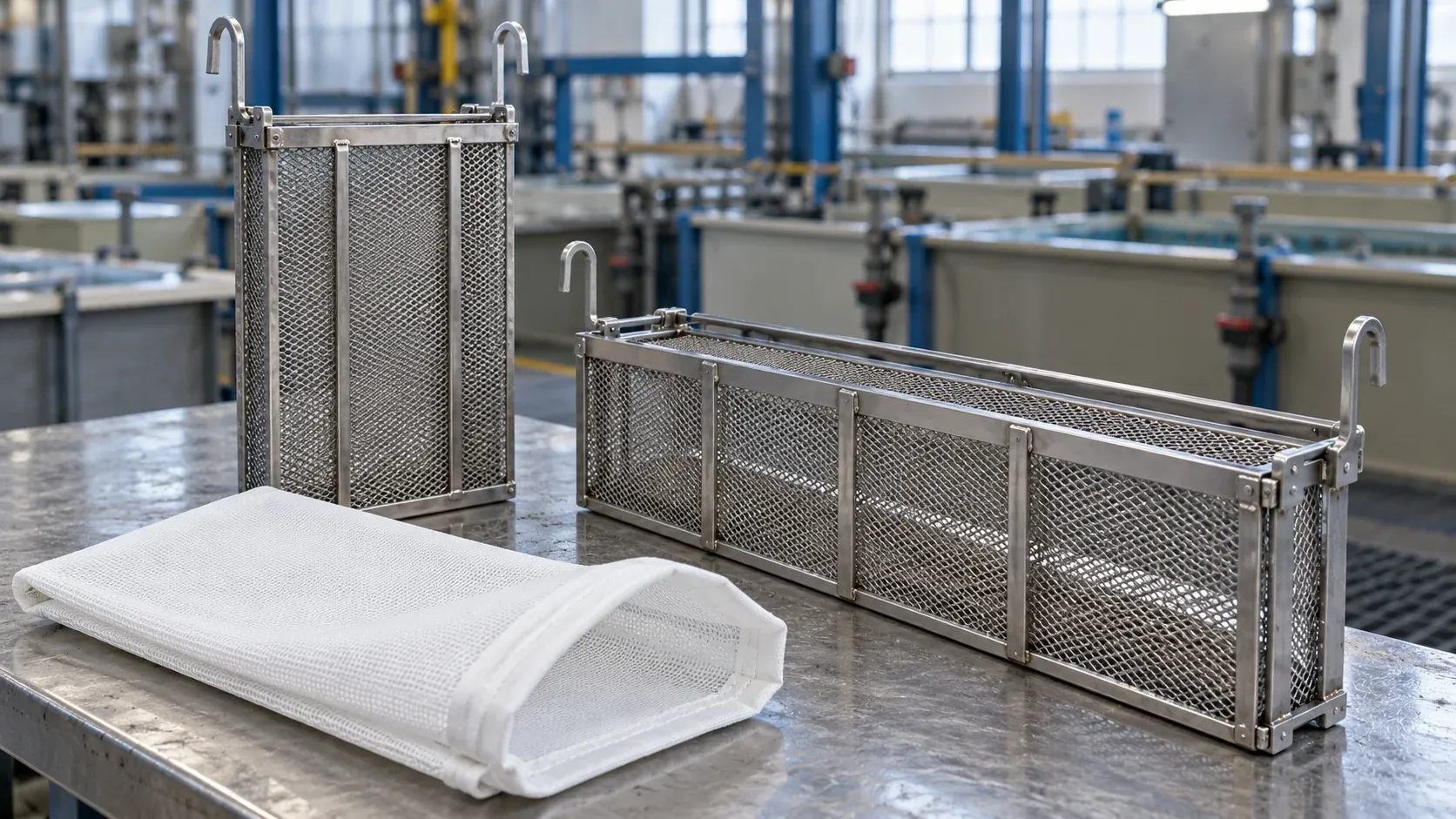
Baskets solve three problems where the chemistry permits soluble-anode operation. They hold the anode metal so it can be replenished — under the approved replenishment and isolation procedure; they hold a replenishable metal-piece charge; actual dissolution and distribution depend on fill, packing, contact, bath conditions and solution movement; and they let the anode arrangement be shaped to the tank — long panels, conforming profiles, or partial widths for current-density control.
What the basket itself decides:
- Material: titanium baskets are established hardware in nickel plating, as discussed in the Nickel Institute handbook, chapter 4. That does not approve an unspecified acid bath or nickel strike. Confirm the exact chemistry and operating/idle conditions. Corrosion compatibility and the assembly's documented electrical-contact/current limit are separate checks.
- Dimensions and fill: basket envelope and mesh contain the metal, while metal form, packing and fill affect electrical contact and solution access. Projected basket area is not the same as effective soluble-anode area or a certified current rating; A basket run low exposes contact and shifts current distribution — one possible cause of an unexplained thickness change, and a standing inspection item.
- Positioning: basket spacing and setback from the cathode shape current distribution across the parts. The equipment buyer guide helps place the anode and cathode arrangements within the same line and handling boundary.
What do nickel-anode bags retain?
Anode bags retain the insoluble residues and fine particles generated as the anode dissolves, keeping them inside the anode bag instead of circulating to the cathode — where they can contaminate the deposit. The dissolved metal ions themselves pass through the bag into the solution; the bag is a particle barrier, not a chemistry filter. Bag discipline is maintenance: inspect for tears, confirm the correct fabric for the bath, and replace on a defined basis rather than on failure. A degraded bag is one possible contributor when roughness or particulates appear in the deposit, which is why bag condition belongs on the line's preventive checklist and in the equipment brief's spares list.
How do physical configuration choices change the inquiry?
Use the Nickel Institute construction discussion and Figure 6, pp.19–20 as nickel-system context. The table below is a project screening aid, not a dimensional standard or a universal preference for one shape.
| Configuration choice | Compare on the actual drawing | What changes before ordering |
|---|---|---|
| Round, rectangular or conforming form | Tank envelope, working position and immersion, cathode clearance and removal path | Shortlist a form that fits the required arrangement; shape alone does not establish current capacity or uniform deposition. |
| Mesh/openings and metal pieces | Opening dimensions and units, approved metal form/piece range and retention of small remnants | Confirm containment and solution access together; do not select mesh from outside basket dimensions alone. |
| Bag fit and closure | Supplied fabric specification, wetted fit, seam/closure arrangement and removal access | Assess fit, retained fines and obstruction; there is no universal extra-width allowance for every fabric and bath. |
| Hooks and busbar interface | Contact profile, bar shape, supports/welds, connection clearance and documented current conditions | Check the complete offered assembly and its mating bar; a matching hook shape is not a current-rating approval. |
Which evidence separates basket, bag and bath problems?
The Nickel Institute handbook, chapter 4 discusses basket filling, contacts, fines and bags in nickel systems. That is nickel-specific engineering background, not approval of a material or fabric for another electrolyte. Its published maintenance discussion is a useful reason to record these items separately:
| Observation | Compare before assigning a cause | Hardware or maintenance decision |
|---|---|---|
| Roughness appears after bag replacement | Bag identity, seams/fit, tears, conditioning record, filter/bath and incoming-part records | Verify the supplied bag and handling; do not assume the basket material or rectifier is the cause. |
| One region becomes thinner | Same part/rack location, basket fill and immersion, contact observations, bath analysis and current records | Recheck distribution and the specific assembly before changing basket quantity. |
| Basket is full but performance changes | Metal form and packing, retained fines/sludge, bag obstruction and contact condition | A visually full basket does not establish an unobstructed current/solution path. |
Hypothetical contact-loss illustration, not a limit or test procedure: at 50 A, a recorded 0.02 V contact drop corresponds to 1 W of electrical loss; a 0.12 V drop at the same current corresponds to 6 W, using power = current × voltage drop. Neither value is an acceptance threshold. The example explains why a contact observation belongs beside current and load identity, rather than using rectifier voltage alone. Measurement method, safe access and permitted conditions must be defined by the responsible qualified person; no live probing or deliberate fault is instructed here.
What does the hooking and connection design decide?
Current enters the basket through the hook or contact strip, and that connection carries the anode current for its tank section. Contact resistance, heating and supply-state problems — oxide build-up, salt creep and mechanical wear among the causes — can reduce effective anode operation and shift current distribution; whether a given area's deposit change traces to the contact is determined by inspection and measurement, not assumed from the mechanism. Specifying the contact — clamp design, cleaning access, replacement interval — is part of specifying the circuit, not an installation detail.
| Circuit element | What to specify | What the proposal should clarify |
|---|---|---|
| Baskets | Material, dimensions, quantity per tank | Documented assembly current limit, temperature/installation conditions, metal-form and fill guidance |
| Bags | Fabric, size, replacement schedule | Included spares and inspection access |
| Contacts | Hook or clamp design, cleaning method | Resistance management and service tools |
| Refill | Metal type, refill procedure, approved refill and isolation procedure | Included handling equipment |
| Distribution | Basket positions, setback, conforming profiles | Current-density expectation per part family |
| Monitoring | Voltage observation, contact inspection cadence | Included instruments and records |
Record metal form and replenishment separately from the hardware that holds it. If circulation has also changed, the pump and solution-transfer guide helps define which circuit-state observations belong in the investigation.
Anode basket and bag inspection card
Use this as a blank project worksheet. Enter actual requirements and observations; the blanks are not process limits or completed production results.
- Bath and circuit
- Record for this projectBath/process ID, chemistry/concentration and temperature envelope, soluble metal/form, approved materials and source document: ____
- How this changes the decisionSeparates compatible soluble-anode service from insoluble-anode or unverified chemistry; defines the evidence needed before reusing baskets.
- Basket and load envelope
- Record for this projectBasket drawing/revision; dimensions/immersion/spacing/mesh/metal-piece/clearance with units (mm or in); filled mass with units (kg or lb): ____
- How this changes the decisionControls fit, particle containment, safe handling and solution access; overall size alone does not establish current capacity.
- Electrical assembly
- Record for this projectHook/contact/busbar IDs, documented assembly current limits and conditions, intended duty and current-sharing assessment: ____
- How this changes the decisionChecks the whole current path, including connections; do not assume equal current per basket or derive a rating from rectifier nameplate alone.
- Bag specification
- Record for this projectFabric identity and compatibility reference, dimensions/seams/closure, fit, conditioning, inspection/replacement basis and spare ID: ____
- How this changes the decisionControls retention and access without making the bag a dissolved-impurity filter; a fabric substitution requires review.
- Observed condition
- Record for this projectBasket fill/immersion, metal form and fines/sludge, contact condition, bag tears or obstruction, observation method/date/load ID: ____
- How this changes the decisionDistinguishes visible condition from a confirmed cause and makes changes traceable to a particular assembly and load.
- Replenishment and service
- Record for this projectApproved isolation/refill/cleaning procedure, filled mass, lifting or removal provision, drain-down and maintenance access: ____
- How this changes the decisionDefines handling and downtime interfaces; no assumption that refill can be performed with the equipment energized.
- Demonstration and acceptance
- Record for this projectAgreed representative load/current envelope, specified observations and part-thickness map, limits/source, before/after record, witness and disposition: ____
- How this changes the decisionStates which evidence accepts fit and operation; an attractive deposit or one reading does not establish every operating state.
- Supply and ownership
- Record for this projectTank quantity and duty cycle, new/retained baskets/busbars, bag and contact spares, cleaning/replacement owner, recheck action and sign-off: ____
- How this changes the decisionSeparates one-time hardware from consumables and assigned maintenance duties, avoiding an incomplete basket-only quote.
Copy this project worksheet
Select the text in the read-only field and copy it into your RFQ document or project notes. Complete the requirements, owner and status for each item.
Questions You May Have:
How often should baskets be refilled?
Against the actual consumption of the process and the basket's fill volume — and note that bath metal analysis and what remains inside a basket are different measurements. Use the approved replenishment and isolation procedure; the article does not authorize handling or refilling energized equipment. Use the documented fill and replenishment limits for the basket and metal form, and retain the inspection record.
What actually causes thin areas near the tank ends?
Several contributors are possible — contact resistance at the end baskets, fill level, bag condition, and part position among them. Work a checklist: anode material and form, chemistry compatibility, immersion and fill, contact condition, bag material and permeability, inspection records. Compare against measurements before changing hardware, and include the rectifier in that comparison rather than starting from it.
Are bags and baskets one purchase?
They age on different bases: baskets serve over the long term with inspection, bags are consumables with a defined replacement basis. Specify spares for both and put bag inspection on the preventive schedule — neither has an assumed lifetime.
Can existing baskets be reused on a new line?
Provide the original drawing and documented current-limit conditions if available, proposed duty, and photographs or records of mesh, welds, reinforcement, distortion and contacts. Check bath compatibility, mating busbar and dimensional fit as well. Damage or missing rating evidence calls for an assessment; this article supplies no universal discard limit or automatic approval to reuse.
Get Proposal and Demo
Introduce your line project with company, name, email and project country. Technical fields are optional. Use project notes for a short basket/bag summary; send the completed inspection card by sales email. Provide the bath families, tank dimensions and current requirements when available, and ask which anode-circuit scope and spares the assessment includes.
Details can follow by sales email, or chat on WhatsApp. The quotation scope guide helps compare which anode duties each offer includes.
Technical references
- Nickel Institute — Nickel Plating Handbook (2014), chapter 4, pp.19–23 — nickel-system basket, contact and bag practice; it does not establish compatibility with every chemistry.
- The Role of Titanium in Anodizing and Electroplating — International Titanium Association archive: a 1973 technical paper on basket/contact construction and anode bags. It supplies historical engineering context; present-day chemistry compatibility and equipment limits require the actual system documentation.
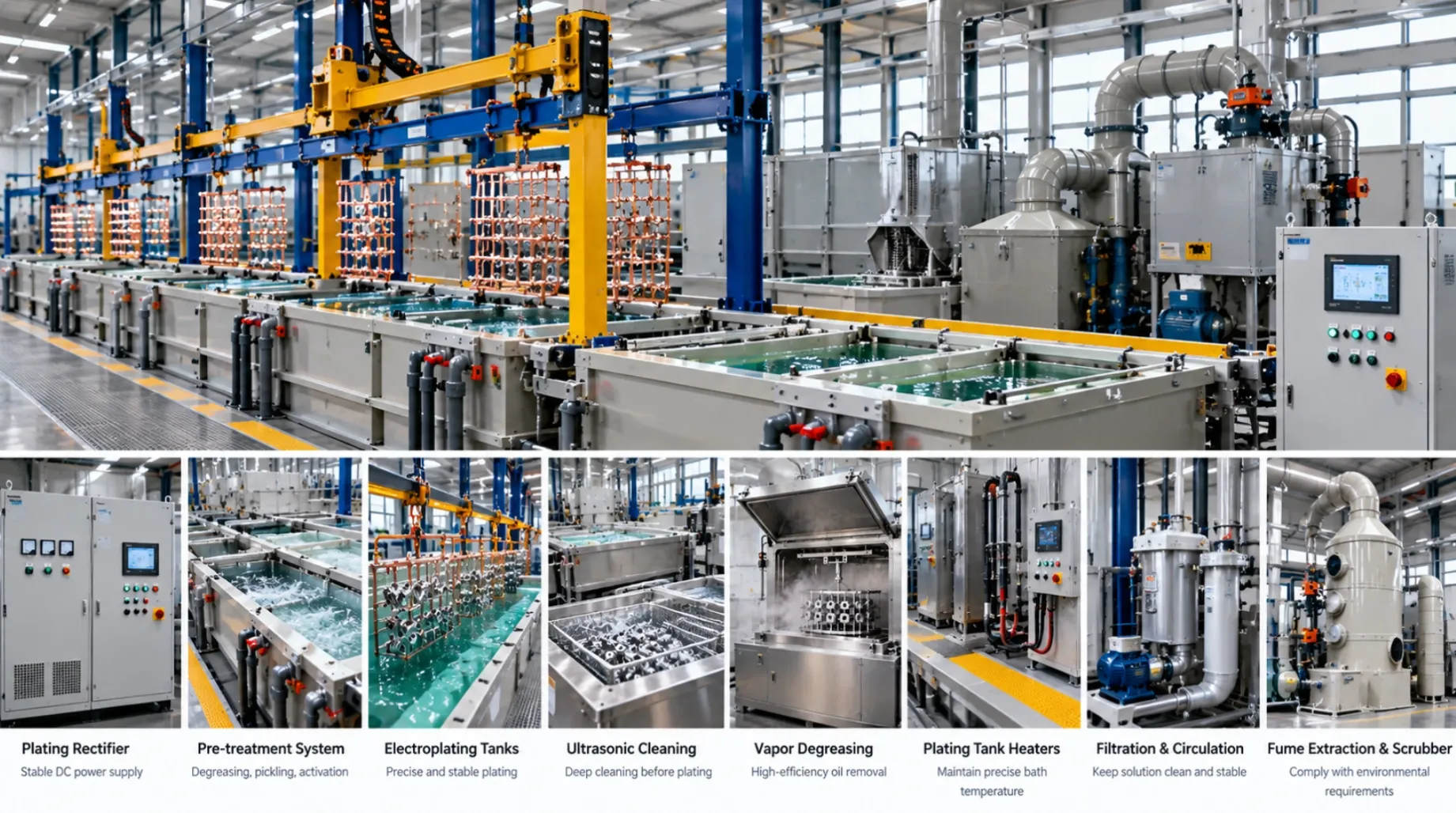
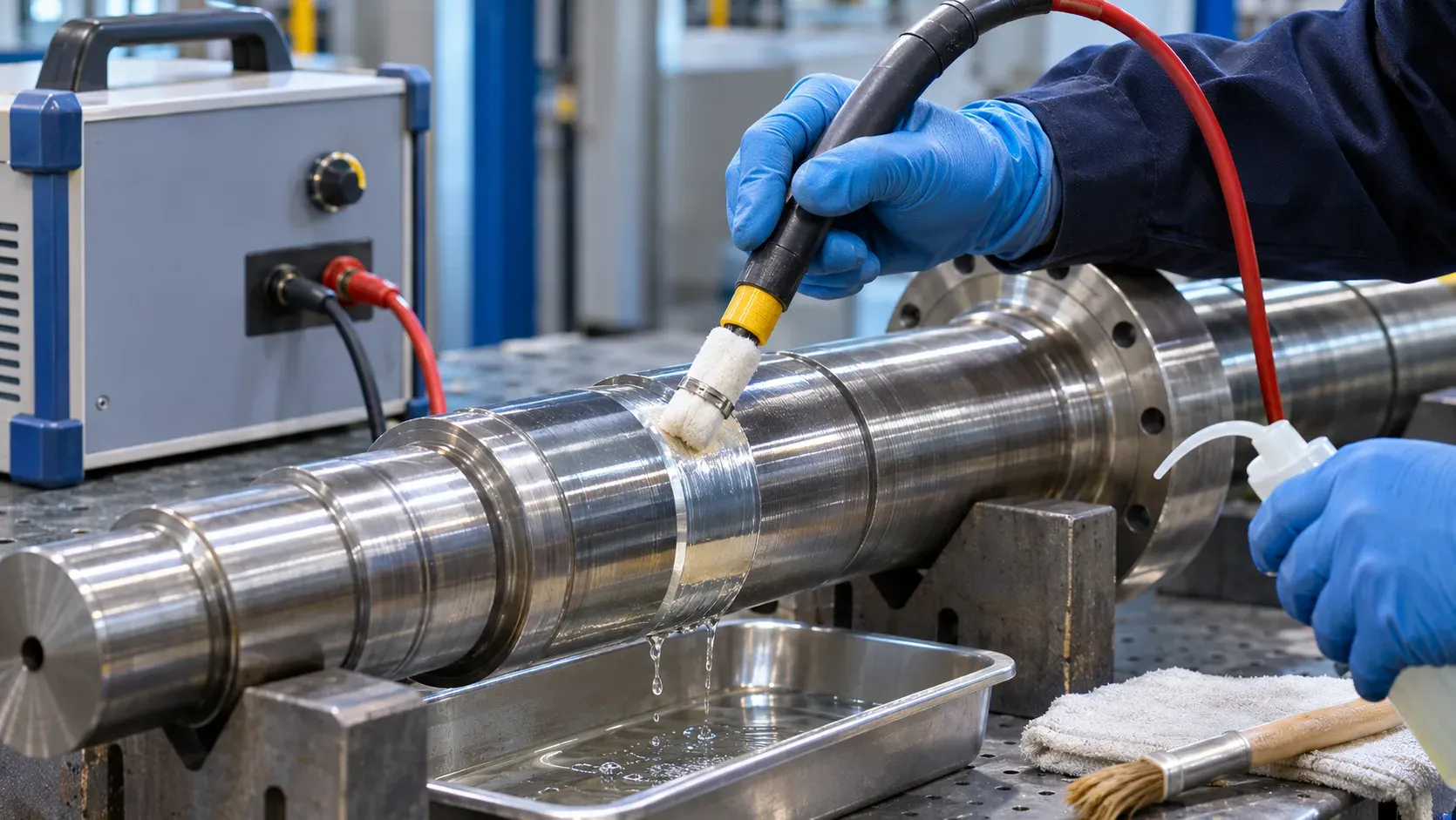
Image note: AI-generated basket and bag imagery is editorial illustration, not an ES-PRO installation, customer reference or verified electrical rating.