THE SHORT ANSWERChoose an electroplating machine in two steps: select rack, barrel or continuous handling for your workpiece, then decide which loading, transfer and process tasks need automation. Size the system around coating requirements, usable working time and accepted output. A machine name alone does not define a complete quotation.
What does an electroplating machine include?
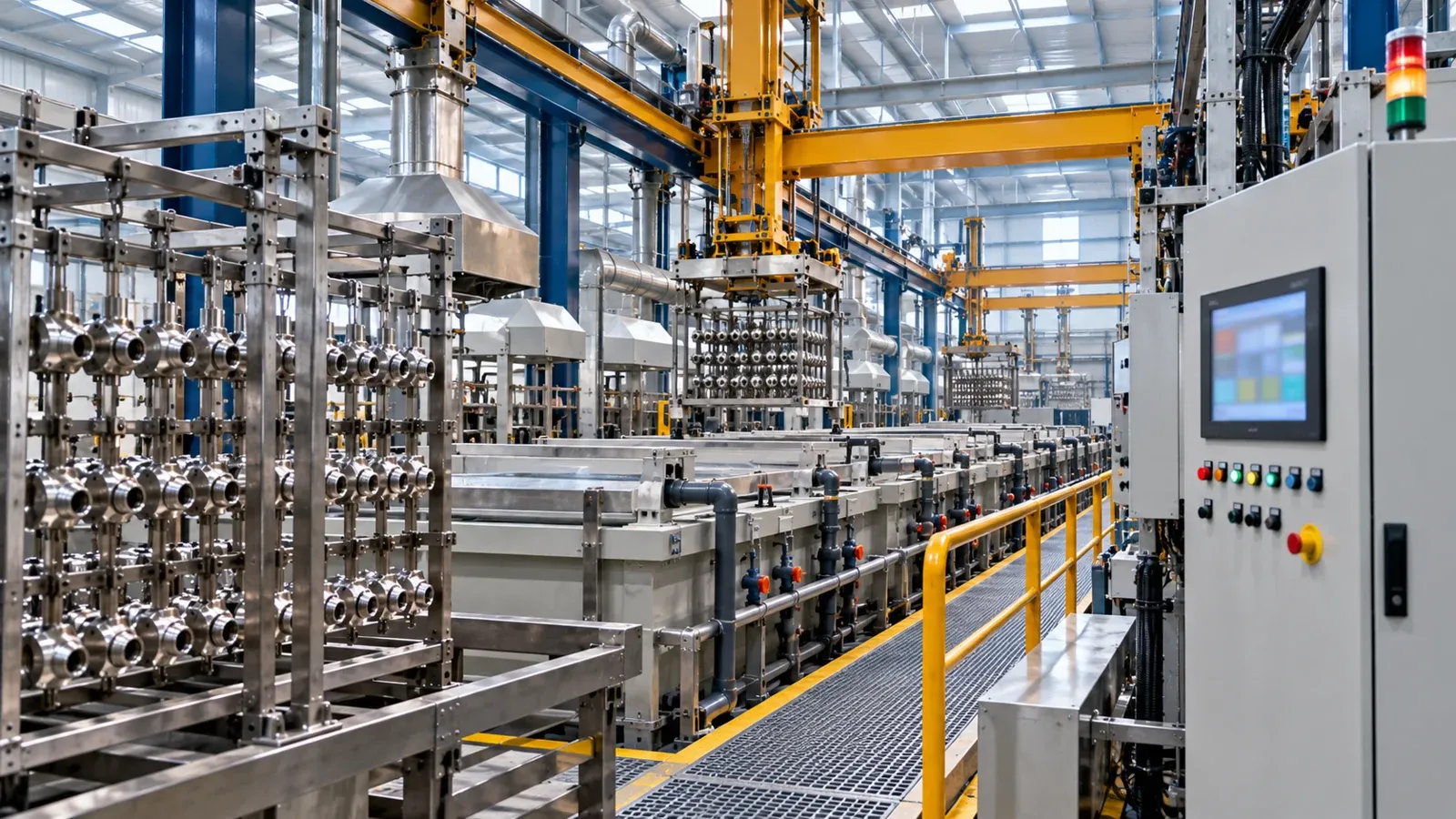
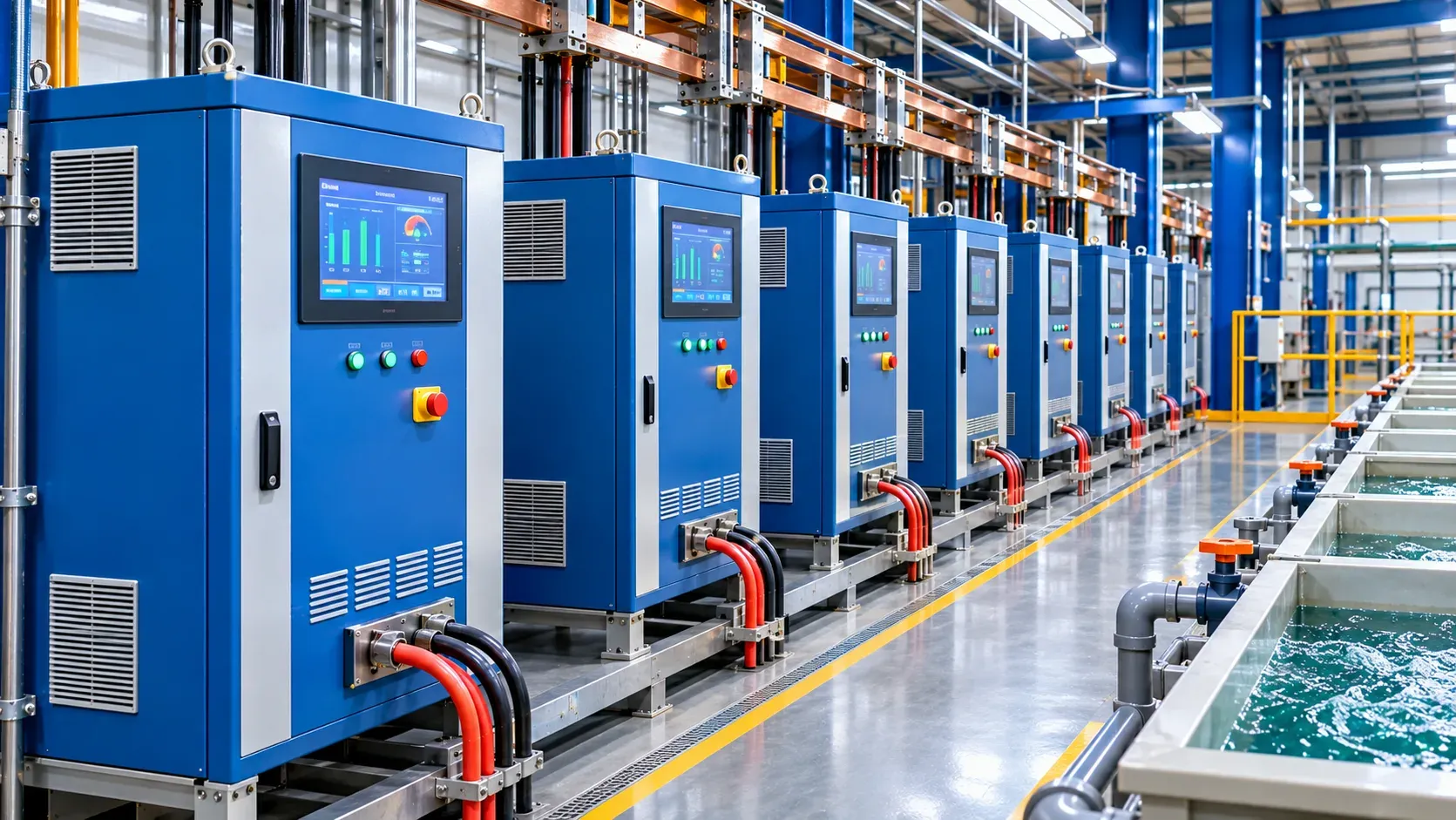
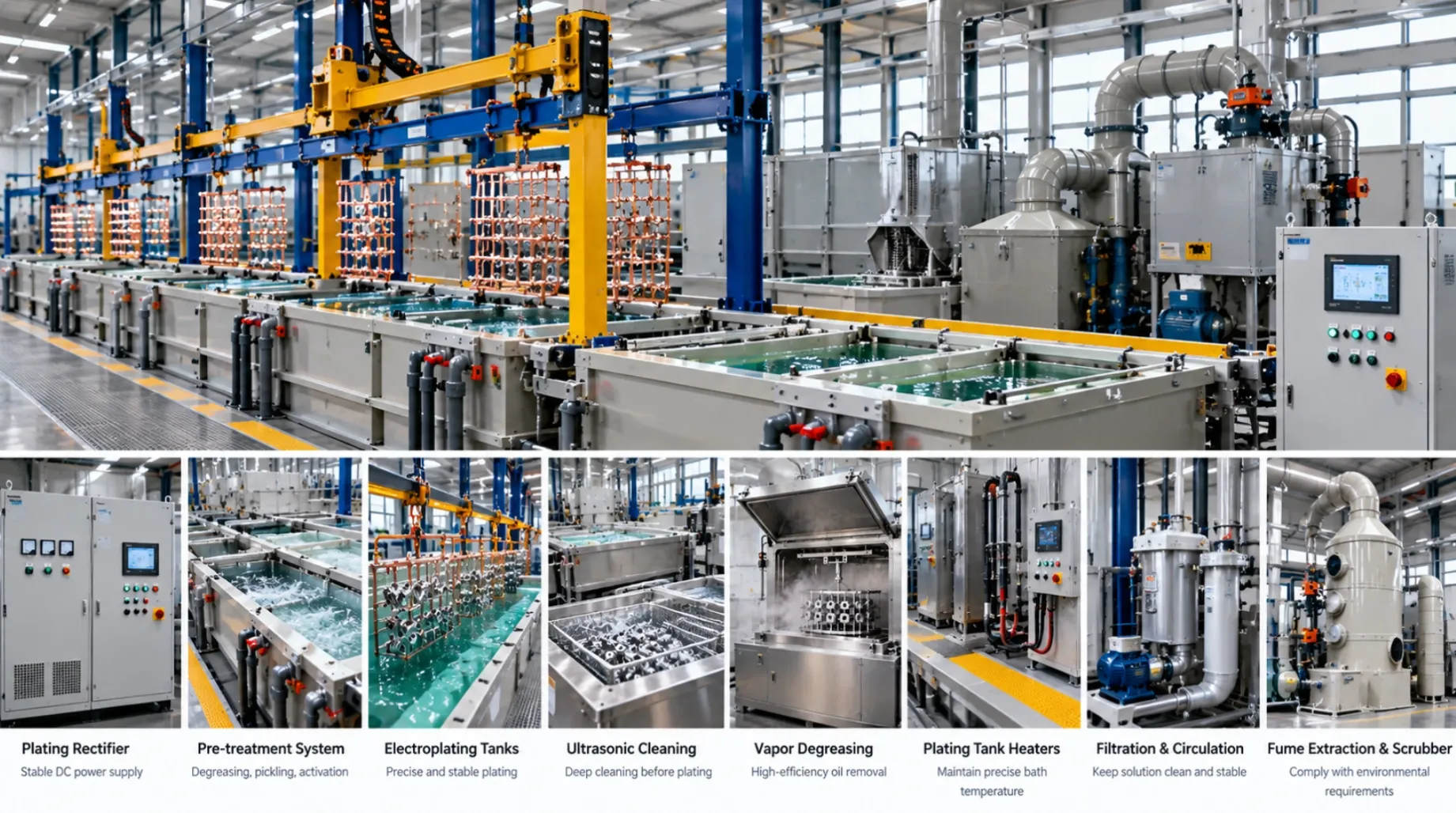
An industrial electroplating machine combines process tanks, rectifiers, workpiece handling and controls. The substrate, coating specification and chemistry supplier determine the cleaning, activation, plating, rinsing and finishing route.
Heating, cooling, filtration and agitation support the process where required. Define the interfaces for site power, water, extraction and wastewater treatment before comparing quotations.
See our equipment checklist and equipment buyer’s guide for component and system planning.
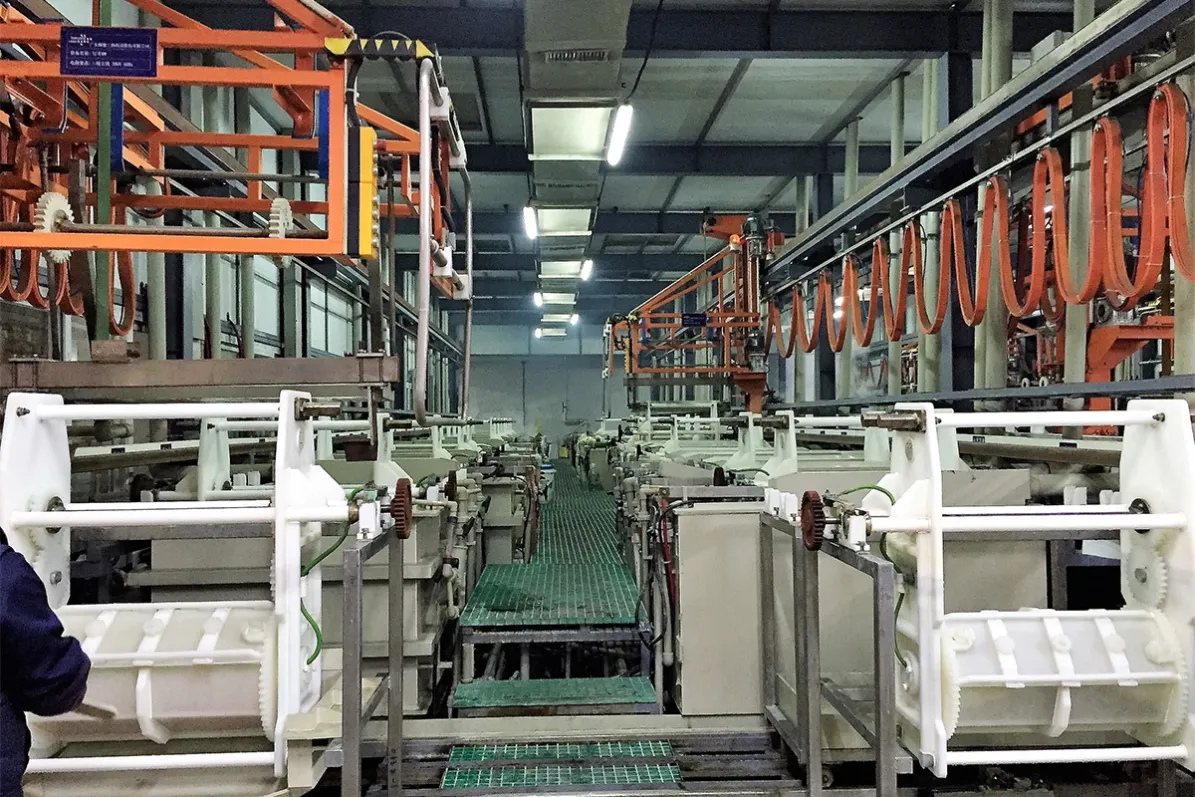
Which handling format fits your parts?
Share the largest and smallest parts, contact or tumbling restrictions, masking and acceptable surface marks. A representative drawing helps assess the loading arrangement.
Swipe sideways to see all comparison columns →
| Format | Consider for | Check before choosing |
|---|---|---|
| Rack handling | Parts that need fixed orientation or controlled contact locations; parts that should not tumble. | Rack envelope, loading method, electrical contacts, masking and drainage. |
| Barrel handling | Small bulk parts that can tolerate tumbling and part-to-part contact. | Entanglement, damage risk, retention, load size and reliable electrical contact. A sample trial may be needed. |
| Continuous / reel-to-reel | Material supplied as a continuous strip, wire or compatible carrier feed. | Feed geometry, tension, contact method, plated areas and required residence time. |
Some loose or unusual parts require another handling solution. Treat these as starting points for review. Our barrel versus rack comparison explains the batch-handling decision in more detail.
Illustrative selection: a delicate part whose visible face cannot accept random contact starts with a rack-fixture review. If operators still load and unload, automatic tank transfer does not remove those jobs. Verify contact locations and coating quality with representative samples.
Manual, semi-automatic or automatic?
Supplier labels differ. Ask for a task list showing what the operator does and what the control system does during a complete production cycle.
Swipe sideways to see all comparison columns →
| Level | Typical boundary to discuss | Buyer question |
|---|---|---|
| Manual | Operators load, transfer and follow the process sequence; lifting aids may still be used. | How are immersion time, lifting, drainage and process records controlled? |
| Semi-automatic | Some transfers or process actions are programmed. Loading, unloading or other steps remain manual. | Which exact tasks remain with the operator, and which limit output? |
| Automatic | Programmed transfer and process coordination within an agreed scope; operator and maintenance duties still remain. | What happens at a fault, recipe change or loading delay? Which actions and records are included? |
Which level should you shortlist?
- Frequently changing recipes or development work: assess manual or assisted transfer when trained operators can control immersion timing, lifting and records.
- A stable route with manual loading: assess semi-automatic transfer to assist lifting and timing. Check whether loading or another manual task limits output.
- Repeated, scheduled production: assess programmed handling with defined routes, loads and schedules. Check loading capacity, changeovers and fault recovery.
These are conditional starting points, not volume thresholds. Choose the tasks to automate before choosing a supplier's label.
How should you specify the production target?
State required accepted output per month and the unit: pieces, kilograms, metres or square metres. Add working days, shifts, product mix and the share of each part family when you know them. Leave unknown inputs open for review.
For batch work, engineers need usable rack or barrel loading and the controlling process stages. For continuous work, they need plated length or area, feed geometry and residence-time requirements. Allow for loading, changeovers, maintenance and planned stoppages.
For coatings specified by surface area, include the plated area per part or an agreed method of calculating it. Monthly square metres cannot be converted into a reliable pieces-per-hour target without part and process information.
What should the quotation itemize?
Compare suppliers on the same boundary. Record what is included, optional, provided by the customer and still awaiting design confirmation.
- Process: tank sequence, working envelope, materials, chemistry interfaces and bath services.
- Handling: racks or barrels, hoists or feed system, loading stations and transfer scope.
- Power and control: rectifiers, recipes, timing, alarms, interlocks and agreed records.
- Site services: heating, cooling, extraction, water preparation, drainage and wastewater interfaces.
- Delivery boundary: installation, commissioning, training, spare parts and acceptance tests to be agreed.
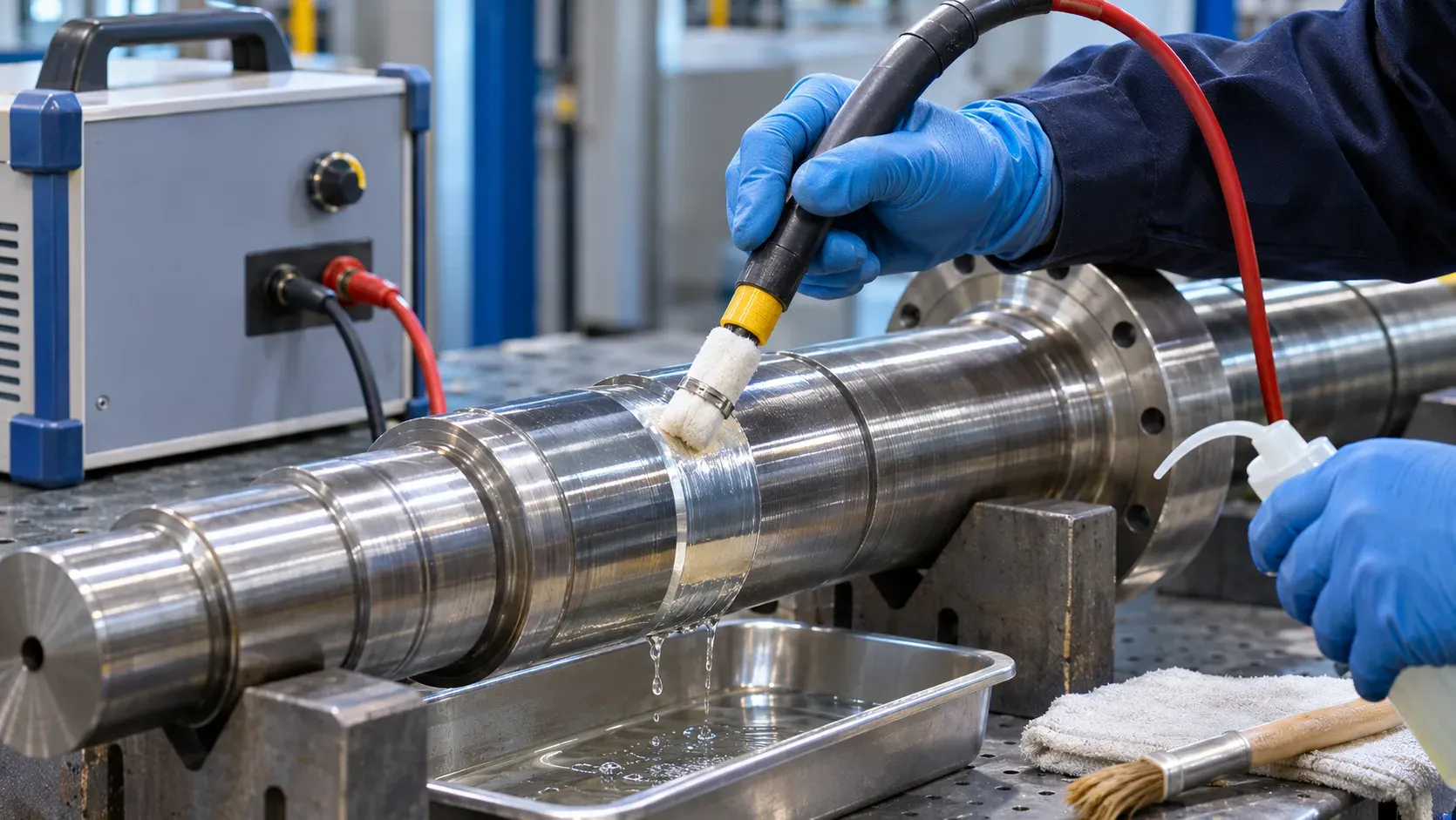
Agree how coating thickness, appearance and other acceptance criteria will be checked. ASTM B568 describes an X-ray method for coating-thickness measurement; suitability, calibration and sampling still depend on the coating/substrate combination and project requirements. An instrument alone does not certify the finished process.
Explore ES-PRO gantry plating equipment and water treatment equipment. Available configuration and supply scope require project confirmation.
Your machine-selection checklist
- Document the part family. Material, dimensions, plated surfaces and contact or tumbling restrictions.
- Define the coating requirement. Layer sequence, thickness, acceptance specification and chemistry constraints.
- Describe demand. Monthly output, units, working schedule and product mix.
- Assign tasks. Loading, transfer, process control, inspection and unloading responsibilities.
- Review the site. Country, layout, utilities, extraction, wastewater and maintenance access.
- Agree the boundary. Included equipment, customer responsibilities and evidence required at acceptance.
Introduce your company, name, email and project country. Add known technical inputs to discuss handling and equipment scope. Drawings and technical files can follow by email.
Questions You May Have:
Click a question to view the answer.
Does automatic mean no operators are needed?
No. Loading, unloading, inspection, replenishment and maintenance can remain manual. Ask the supplier to identify each operator task.
Can a barrel machine plate every small part?
No. Parts may tangle, escape retention, lose electrical contact or suffer surface damage. Review geometry and acceptable contact marks; confirm sample testing where suitability is uncertain.
Can I request a proposal before I have drawings?
Yes. Introduce your company and project location first. Add known material, dimensions and monthly demand. Drawings can follow by email; final configuration and capacity still need adequate engineering inputs.
Should I choose automation only from monthly volume?
No. Product mix, process route, operator tasks, available time and accepted output all affect the decision; monthly volume alone cannot define automation.
Are ventilation and water treatment part of the machine?
Only when explicitly included in the quotation. Define equipment and site interfaces separately and confirm the requirements at the project location.
Technical context & sources
Manufacturer context: ES-PRO gantry-line catalogue describes rack, barrel, vibration and rotary handling; electronic-packaging equipment catalogue identifies retention, deformation and contact considerations. The selection tables are editorial project-evaluation checks, not catalogue capacity or labour guarantees. Technical configuration needs engineering confirmation after the project brief.
References cover coating inspection, process education, wastewater and workplace planning. U.S. provisions identify their jurisdiction; verify requirements at your project location.
Official scope of coating-thickness measurement by X-ray spectrometry.
Read the standard scope ↗INDUSTRY ASSOCIATIONNASF FoundationProfessional education on plating equipment, chemistry and process principles.
Explore plating education ↗U.S. ENVIRONMENTAL REFERENCEEPA · Metal FinishingEffluent-guideline coverage and wastewater planning references.
Read the official guidance ↗U.S. WORKPLACE SAFETY REFERENCEOSHA · Dipping & CoatingOfficial tank and ventilation provisions under 29 CFR 1910.124.
Read the official provisions ↗Photographs: supplied ES-PRO catalogue material illustrates equipment, without attributing customer identity, production results or project-specific performance.