Specify a plating pump by its actual liquid envelope, normal and worst-case system duty, suction conditions and operating states. Select the hydraulic type, sealing arrangement and installation together with the piping and controls. Filtration circulation, liquid agitation and solution transfer may require different circuits.
Scope and limits: chemical pump selection
- Pump curves as process promises: a pump delivers a curve against a system; the process owner defines the required movement, and the circuit delivers it.
- One pump for every chemistry: shared transfer pumps between incompatible baths trade a small saving for a large contamination risk.
- Forgetting the shutdown case: maintenance and solution-change tasks decide real availability as much as running duty.
- Reading this as a pump catalogue: types and materials are families; the actual selection follows the bath and the circuit.
What jobs do pumps do on a line?
Three distinct duties, each with its own selection logic:
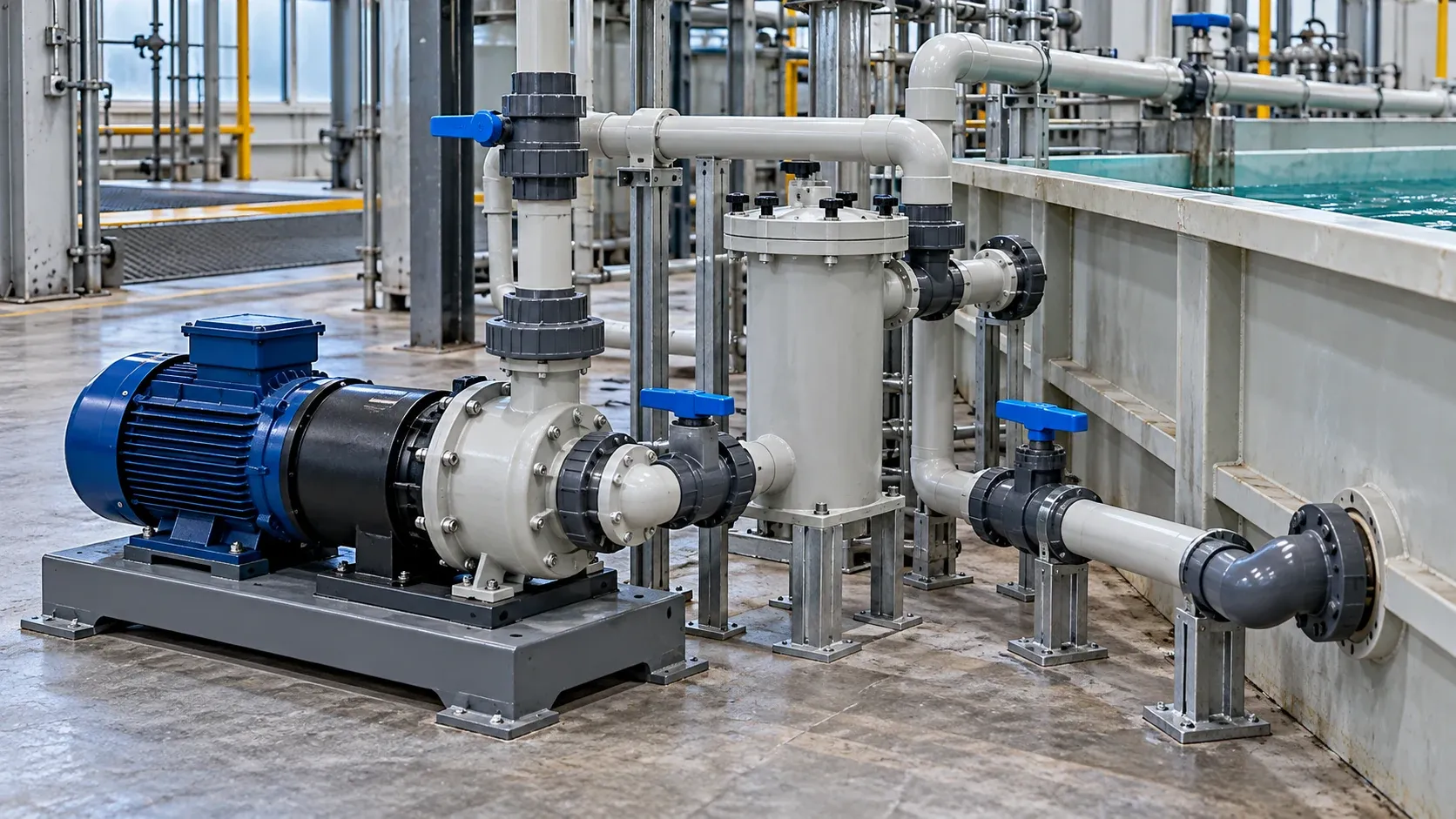
- Filtration duty: continuously circulating bath through the filter, sized for the turnover the process requires. Record the filter pressure loss in both clean and loaded states alongside the required circulation duty.
- Agitation duty: moving solution to stir the tank — eductors and circulation where the process owner specifies solution movement rather than mechanical cathode movement. Solution circulation is a liquid circuit; compressed-air agitation uses a separate air supply. Specify which movement system is required instead of treating liquid circulation and compressed air as the same duty.
- Transfer duty: filling, emptying and moving solution between tanks, make-up stations and treatment — with batch, metered or continuous duty as the actual transfer task requires.
One pump can sometimes serve two duties; conflating all three in one circuit is where designs can come unstuck, because the duties have different flow, head and control needs.
Which pump duty and suction conditions must be specified?
Flow/head selection also requires a supplied suction condition. Low source level, suction losses and vapor pressure can prevent the proposed duty from being reached:
| Duty dimension | What to specify | Why it bites |
|---|---|---|
| Flow and head | The working point for the actual circuit — and the normal and worst-case conditions, not nameplate | Filtration turnover and eductor performance both depend on real duty |
| Suction conditions | Suction liquid level (high and low), temperature-dependent vapor pressure, suction line losses, and the net positive suction head (NPSH) the installation provides versus the pump requires | Insufficient suction margin can cause cavitation; low liquid level may also cause loss of prime or dry running, depending on the installation |
| Liquid properties | Density, viscosity, solids and gases — and how they vary with temperature and bath age | Viscous or gassy liquids move the operating point; solids erode clearances |
| Circuit state | Filter element clean versus clogged, eductor and valve pressure losses, return distribution | A circuit sized for clean filters starves as they load |
| Controls | Low-level and dry-run interlocks, speed control, temperature interlocks — within the manufacturer's limits | Protection the process actually needs, wired in |
Worked check: clean and loaded filters change the operating point
Hypothetical illustration, not measured production data or recommended flow: a circuit needs at least 5 m3/h and no more than 7 m3/h. A proposed pump curve and two system curves give these assumed intersections at one speed:
| Circuit state | Assumed curve intersection | Selection record |
|---|---|---|
| Clean filter, approved valve/return state | 6 m3/h at 8 m head | Inside the illustrative flow window; suction margin, material compatibility, power and permitted operating range still need checking. |
| Filter at its defined service limit | 4 m3/h at 12 m head | Below the 5 m3/h requirement: this selection fails the loaded-filter duty even though the clean-filter point fits. |
Request the complete offered pump curve and both system curves for the actual liquid and installation, not unrelated maximum-flow and maximum-head figures. Record each intersection, units, liquid corrections, speed and permitted operating range. Review a different pump, circuit resistance, filter service criterion or controlled-speed arrangement with the responsible designer; increasing speed is not an automatic remedy because suction, power and pressure limits must also remain acceptable. The DOE pumping-system source explains the pump/system relationship; the numbers above only illustrate the decision.
What decides the pump itself?
Pump choices are made along three separate dimensions that combine — they are not a three-way pick:
| Dimension | Options | What it drives |
|---|---|---|
| Drive and sealing | Magnetic-drive (sealless) versus sealed designs | Leak paths, dry-run sensitivity, maintenance style |
| Hydraulic type | Centrifugal families and others per the duty | Flow/head character, solids handling |
| Installation | Vertical submerged, horizontal flood-suction, dry-mounted with suction lift | Suction condition, footprint, pit and access |
Chemistry still rules every dimension: wetted materials (PP, PVDF, stainless, elastomers) follow the bath, and compatibility failures are slow and expensive. Two selection notes buyers should force into the open: magnetic-drive pumps remove the shaft seal — the classic leak point — which makes them common in bath circulation, but they have their own limits with solids, dry-running and suction conditions. Vertical submerged pumps trade installation space for a flooded suction; whether that suits the tank depends on the installation, and the suction state still needs checking against the pump's requirements. Request a configuration-level evidence row with the offered model and option code, bearing/bushing and seal arrangement, all wetted materials, operating-instruction edition, relevant temperature/solids/dry-running limits, and the protective action. A family label such as magnetic drive does not establish a dry-running rating. Record an unconfirmed limit as an open selection item; do not borrow a rating from another model or bearing option.
Which installation conditions change the next selection question?
These are screening questions, not approvals for any particular pump model.
| Observed duty | Configuration question | Evidence needed before selection |
|---|---|---|
| Continuous circulation with flooded suction | Can a compatible centrifugal arrangement meet every approved circuit state? | Pump and system curves, suction margin, minimum permitted flow, materials and maintenance access. |
| Transfer with the pump above the lowest source level | Does the offered arrangement actually prime and re-prime at the proposed lift? | Exact model instructions, priming/venting arrangement and a witnessed start/restart check within its limits; a dry-mounted centrifugal pump is not automatically self-priming. |
| Air or gas can enter during transfer | What happens when liquid supply breaks or the liquid releases gas? | Offered configuration's gas-handling and dry-running limits, detection and stop/reset action; assess another arrangement where the required states are outside those limits. |
| Solids or sludge must be moved | Is the particle range and concentration permitted by this construction and hydraulic type? | Defined solids envelope, clearances/wear limits and supplier confirmation; assess a different pump family rather than assuming a clear-liquid circulation pump is suitable. |
What does the transfer circuit need beyond the pump?
Transfer selection must account for routing, destination capacity and the stopped state:
- Routing: hard-piped versus hose stations; cross-connection risks between incompatible chemistries.
- Emptying: drain-down to a safe vessel, pump-out time, and what happens to tank bottoms and sludge.
- Safety interfaces: source low-level and permitted dry-run protection, receiving capacity and high-level stop action, and where operators physically connect hoses. Assign the alarm/trip, reset and isolation owner.
- Stopping and restart: assess continued siphoning after the pump stops, reverse flow and the required shutdown isolation for the actual elevations and route. Define the witnessed safe checks with the installation designer; stopping the motor alone does not establish that transfer has stopped.
- Materials of the whole circuit: a compatible pump pushing through an incompatible hose is a failed design; our tank liner guide covers the same compatibility discipline for vessels.
The equipment buyer's guide helps assign pump circuits, utilities and retained systems to the complete line scope.
Chemical pump duty-point worksheet
Use this as a blank project worksheet. Enter actual requirements and observations; the blanks are not process limits or completed production results.
- Liquid envelope
- Record for this projectChemical identity/concentration range; normal/maximum temperature with units; density, viscosity, solids/gas content and analysis reference: ____
- How this changes the decisionDefines wetted-part compatibility, hydraulic corrections and the model operating envelope; a bath name alone is insufficient.
- Circuit and units
- Record for this projectFlow in m3/h or US gpm; total head in m or ft of the actual liquid; piping sketch, elevations and return destination: ____
- How this changes the decisionMakes duty points comparable and distinguishes head from pressure. Identify circulation, eductor duty or batch transfer separately.
- Normal and limiting states
- Record for this projectRequired flow/head at clean and end-of-service filter conditions; valve/return routes; highest/lowest source and receiving levels: ____
- How this changes the decisionDefines the system envelope and whether separate circuits or speed control are needed; use the specified filter service limit rather than an undefined blockage.
- Suction and priming
- Record for this projectAvailable NPSH calculation inputs; manufacturer NPSH requirement and agreed margin; vapor pressure, suction losses and priming/venting arrangement: ____
- How this changes the decisionChecks the worst approved level/temperature condition and whether the selected installation can prime and remain supplied.
- Materials and interfaces
- Record for this projectPump, seals/bearings, hose, valves, fittings and instruments; electrical supply, connections, supports and retained equipment IDs: ____
- How this changes the decisionPrevents a compatible pump being paired with incompatible or unsupported ancillary parts.
- Control cause and action
- Record for this projectSource low-level/dry-run and receiver high-level conditions; instrument/tag, alarm/trip, shutdown isolation, siphon/reverse-flow assessment, reset and owner: ____
- How this changes the decisionDefines protective functions and the witnessed checks; do not deliberately run a pump outside manufacturer limits to demonstrate a trip.
- Acceptance and handover
- Record for this projectAgreed duty points/tolerances, liquid and test setup, measurement locations/instruments, flow/pressure/current/leak observations, witness and sign-off owner: ____
- How this changes the decisionStates what must be demonstrated and which permitted water-test corrections or later liquid-specific verification are required.
- Operation and maintenance
- Record for this projectTransfer volume/time target or circulation schedule; drain-down and decontamination plan, access, wear parts and shutdown tolerance: ____
- How this changes the decisionSets installation access, isolation and spares decisions rather than selecting hardware from nameplate flow alone.
Copy this project worksheet
Select the text in the read-only field and copy it into your RFQ document or project notes. Complete the requirements, owner and status for each item.
Questions You May Have:
Can one circulation pump serve both the filter and the liquid-agitation eductors?
Sometimes — when the flow and head duties align and the process owner approves. Where they conflict, separate circuits avoid starving one duty to feed the other.
Why did our pump performance drop after a chemistry change?
Check liquid properties and temperature, gas entrainment, tank levels and suction losses, filter/strainer condition, valve positions and wetted-material condition against the changed chemistry. These are candidate contributors, not a frequency ranking; measurements and inspection determine which apply.
Who sizes the flow for agitation?
The process owner defines the required solution movement; the equipment side translates it into flow, eductor sizing and pump duty. Do not accept "standard turnover" as an answer where a process requirement exists.
What spares should a line hold?
That depends on the pump model's wear parts, the cost of downtime for that circuit, and delivery lead times — there is no universal list. Ask the proposal to list wear parts per pump with recommended stock levels, and decide the stocking against the line's shutdown tolerance.
Get Proposal and Demo
Introduce your project with company, name, email and project country. Technical fields are optional. Use project notes for a short summary: liquid, temperature, required flow/head, transfer destination and known open items. The form displays a 2,000-character notes allowance; send a full completed worksheet by sales email so answers are not squeezed into that field. The workpiece and other whole-line fields are optional and may be skipped. Describe your bath families, tank layout and transfer needs when available, and ask which pump circuits and spares the assessment includes.
Details can follow by sales email, or chat on WhatsApp. The quotation scope guide helps compare which circuit duties each offer includes.
Technical references
- U.S. Department of Energy — Improving Pumping System Performance, Second Edition: system duty, suction and maintenance principles. Chemical compatibility and operating limits still require the selected pump model and actual liquid envelope.
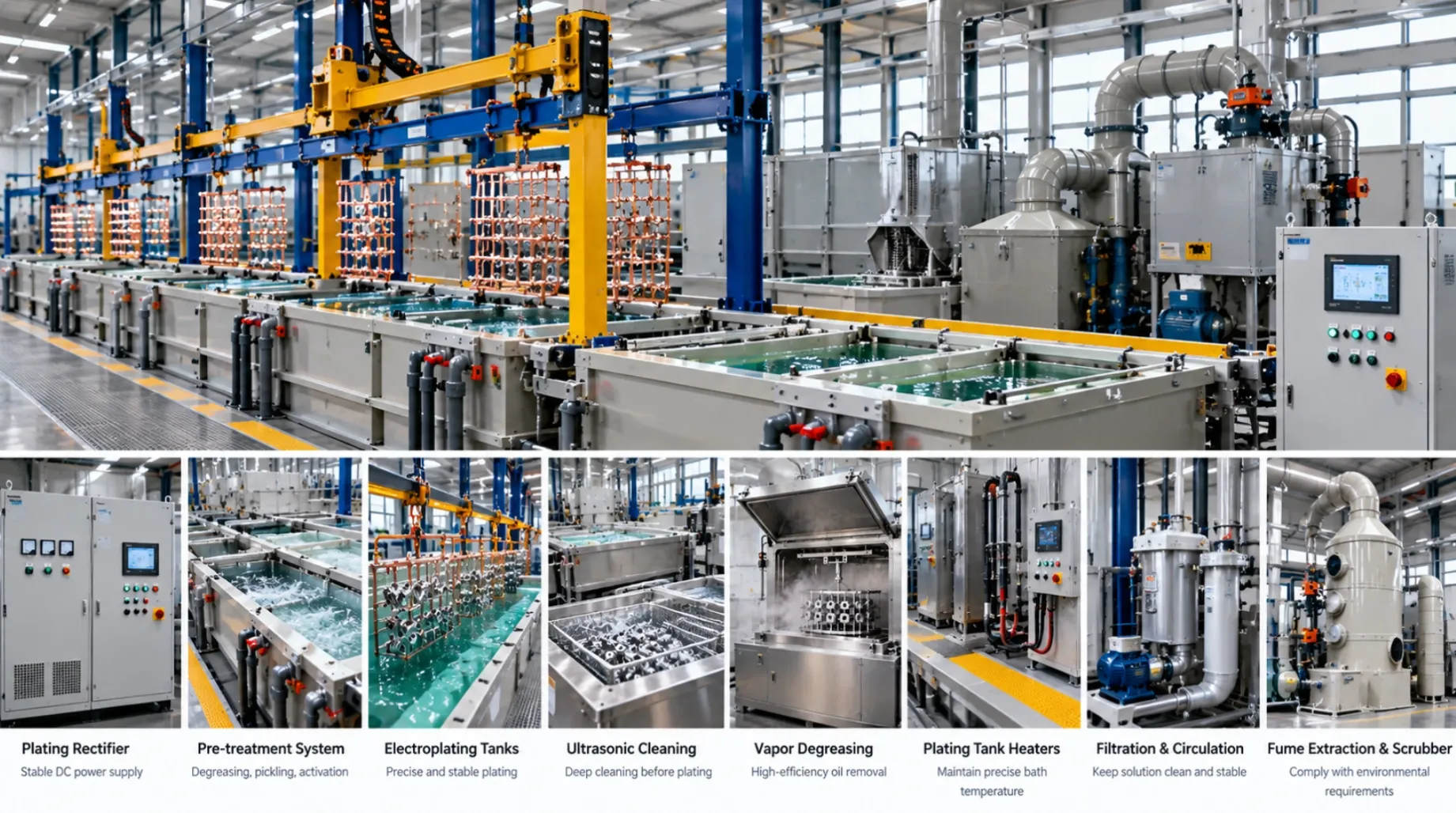
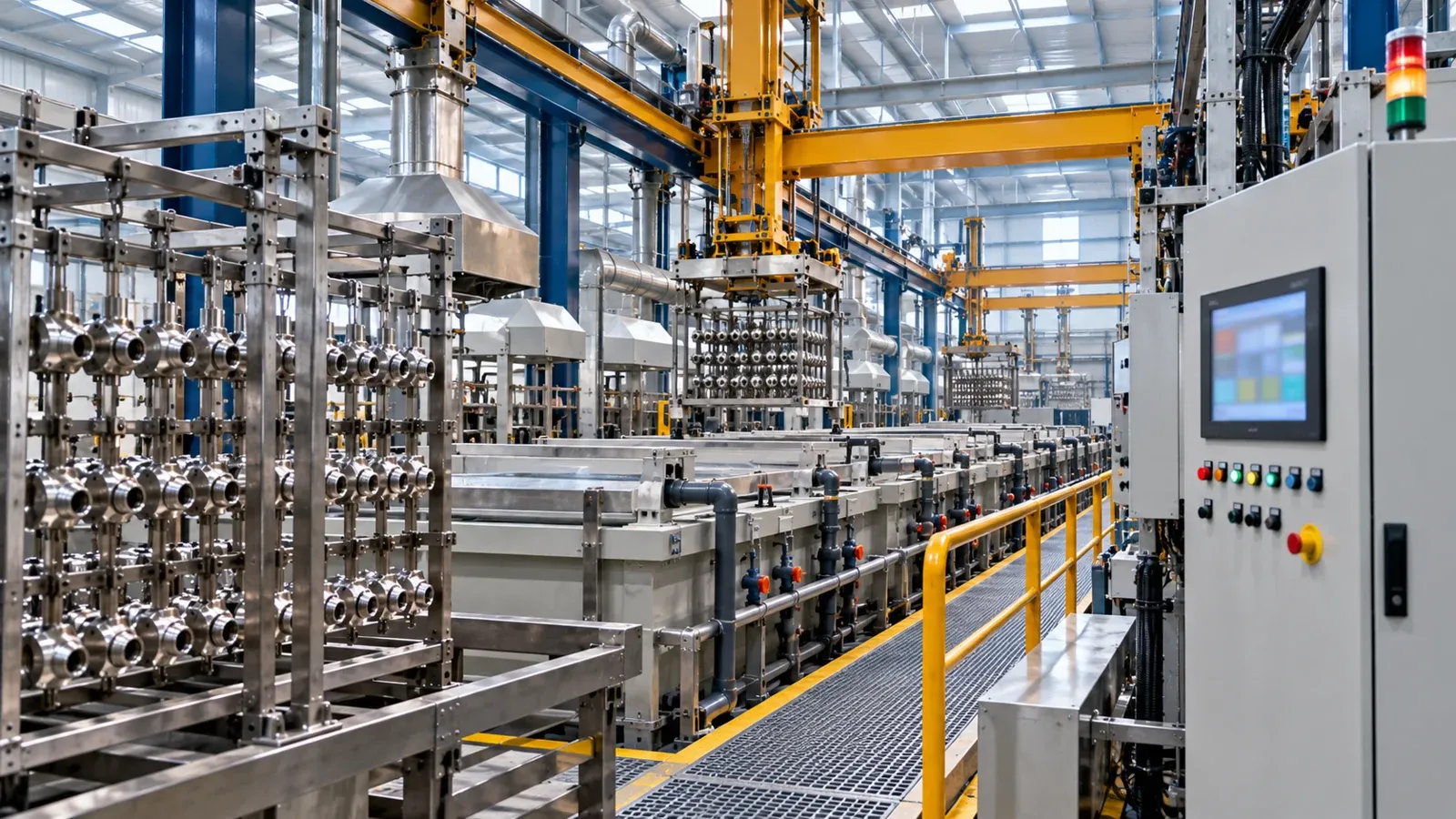
Image note: AI-generated pump and piping imagery is editorial illustration, not an ES-PRO installation, customer reference or verified pump-performance record.