
Plating Process
Selective Plating: Brush, Spot and Masked-Tank Methods
Selective plating methods: brush, spot and masked-tank routes, when selective replaces immersion, and the tooling and verification it demands.
# Selective Plating: Brush, Spot and Masked-Tank Methods
ES-PRO editorial team �� Updated 27 October 2026
Selective plating puts metal only where the drawing wants it �� a contact zone, a mating surface, a repair area �� instead of plating the whole part and masking out the rest. Three methods do this: brush tools that plate by contact, spot plating on strip, and masked-tank routes. Selective deposition trades line simplicity for tooling effort, and for many products it is the difference between gold-plating a contact and gold-plating a chassis.
What are the three methods?
Brush (selective) plating deposits through an absorbent-wrapped tool connected as the anode, moved over the prepared zone. It serves repair work and on-machine deposition inside a defined authority boundary.
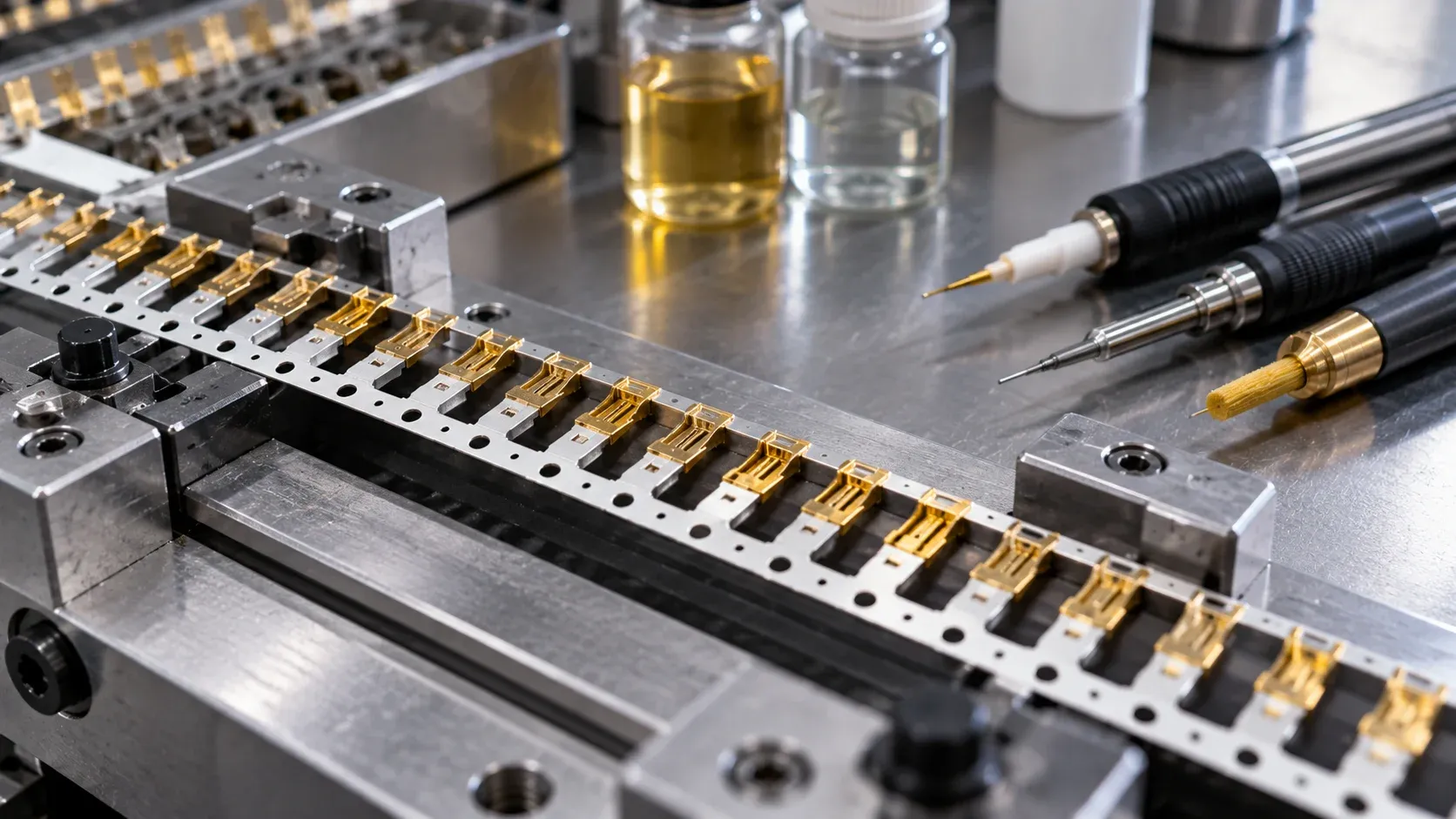
Spot plating on strip plates functional zones of stamped contacts in-line: dielectric belts or masking wheels cover the areas that must stay bare while the strip passes through the cell. It belongs to the continuous strip family, where feed handling and zone accuracy are the craft.
Masked-tank plating runs parts through immersion with plugs, caps and masking fixtures �� the masked-zone design the rack and fixture discipline owns. It is "selective" by exclusion: the line stays conventional, the tooling carries the selectivity.
When does selective replace full immersion?
Situation favors selective | Because |
|---|---|
Precious-metal economy | Gold and silver deposits only on functional zones �� our gold electronics guide shows the application |
Heat-sensitive or assembled parts | Local deposition avoids immersing the whole assembly |
Zones too small to justify full-line exposure | Spot and brush reach them without a full route |
Repair and rework | Brush tools plate installed or finished parts within defined authority |
Strip products with functional zones | Spot plating is native to the reel-to-reel format |
Full immersion keeps the advantage where uniform thickness across broad surfaces, high throughput per load, or unmasked simplicity dominates. The two approaches coexist in one plant: selective serves zones, immersion serves surfaces.
What does selective plating demand from equipment?
- Tooling and fixtures: brush tools, strip masking wheels, plug and cap fleets �� each a managed inventory with condition checks.
- Power and dosing: portable power units for brush work; cell-level control for spot plating; supply loops that keep small electrolyte volumes in their windows.
- Zone verification: coverage, thickness and adhesion verified at the zone boundary �� thickness methods per our testing guide, with the mask line's quality as a first-order inspection item.
- Records that tie zones to parts: selective work multiplies per-part variety; traceability follows the zones, not just the loads.
Where this does not fit
- Reading brush plating as an open DIY method: it is a controlled process inside a defined authority �� the repair brief owns that boundary.
- Assuming selective always saves money: masking labor and tooling costs are real; the precious-metal saving must outrun them.
- Expecting selective deposits to self-verify: zone thickness and mask-line quality need the same verification discipline as any deposit.
- Using selective to avoid rack design: masked-tank work still lives on racks and fixtures, and the rack design discipline still applies.
Questions You May Have:
Is selective plating cheaper than plating the whole part?
For precious metals on parts with small functional zones, usually yes �� the metal saving outruns masking and tooling costs. For base metals or broadly plated parts, immersion economics usually win. The deposit value, zone size and volume decide.
Can selective gold match tank-plated quality?
Deposit quality depends on the system and its control, not on the method's name. Spot-plated contacts verify against the same specification requirements as immersion work; the verification plan, not the method, settles the question.
What parts suit spot plating?
Stamped contacts and connector strips with defined functional zones are the classic case �� plated in the reel-to-reel format where zone accuracy and feed handling are designed together.
How is the boundary between plated and bare verified?
Coverage and mask-line quality by inspection, thickness in the zone by the requirement's method, and adhesion across the boundary where the requirement calls for it. Mask condition drives boundary quality, which is why plugs and belts belong on the preventive list.
Technical references
- Practice description. Selective deposition systems, tooling and verification follow the process owner's validated route and the product specification.
Get Proposal and Demo
Introduce your project with company, name, email and project country. Technical fields are optional. Describe the zones to be plated, the deposit callout and your volumes when available, and ask which selective method �� or immersion route �� the assessment recommends.
Details can follow by sales email, or chat on WhatsApp. The buyer's guide places selective formats among the line families.
Image note: AI-assisted conceptual diagrams illustrate equipment or workpiece contexts; they are not an ES-PRO installation, customer reference or evidence of coating performance.


