
Industrial Baking Equipment
Plan industrial drying or curing equipment for plated parts. Define the load, temperature profile, handling and acceptance basis before requesting an ES-PRO proposal.
In brief: Industrial baking equipment for a plating line must match the part load and the required drying, heat-treatment or coating-cure duty. Hot-air circulation and temperature control are catalog concepts; oven dimensions, temperature uniformity and energy use need a project design and test.
Send a project inquiry — mention "Industrial Baking Equipment for Plating Lines" in the message. To attach drawings or reports, use the equipment-specific email checklist below.
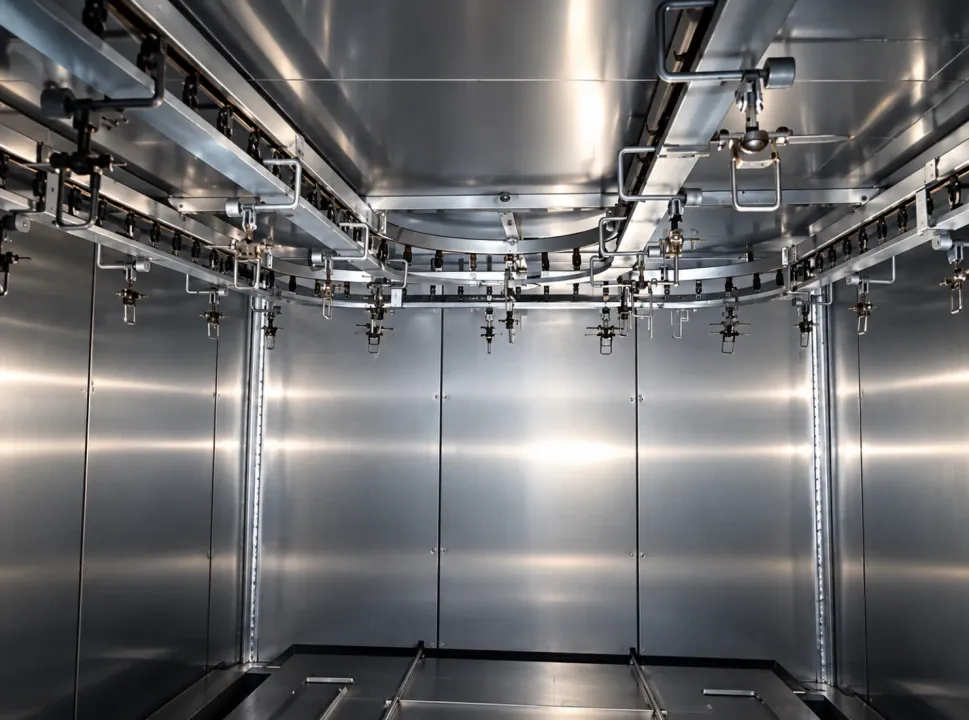
Catalog illustration: the tunnel-type chamber image gives equipment context. It is not a capacity sheet or proof of a delivered installation. View the image.
Define the thermal task first
Drying residual rinse water, curing a coating and a post-process heat treatment have different aims. State the material and coating, maximum part dimensions and mass, rack or basket arrangement, incoming moisture, required part temperature and the allowed heating and cooling sequence. If the requirement comes from a customer's specification, supply the relevant revision and measurement method. Do not assume that an air setpoint is the same as the workpiece temperature.
The ES-PRO baking catalog describes hot-air circulation, temperature control and optional dehumidification. Which heating method and options are suitable depends on the load, atmosphere and process. The source does not give a standard chamber size, temperature range, uniformity tolerance or energy figure for this page.
Choose loading and line interface
Ask whether the process needs batch loading, a conveyor or a rack transfer from the plating line. Provide the maximum load, number of loads per hour, carrier material, door opening and available floor space. Account for drainage, exhaust and maintenance access. If automation equipment transfers parts into the oven, specify the hand-off, positioning and fault behavior.
The proposal should identify chamber construction, heater and fan arrangement, airflow path, sensors, controls, safety interlocks, extraction interface and loading equipment. Mark which services and accessories are included and who provides power, ventilation, installation and commissioning.
Agree a representative acceptance test
Define the worst-case load and the location of temperature measurements on actual parts or representative test pieces. Request a recorded heating profile, hold-time definition and repeatability test appropriate to the process. Where drying is the goal, agree how residual moisture is judged; where curing is the goal, agree the coating supplier's cure criterion. Avoid accepting a claim of “uniform heating” without a method and tolerance for the loaded equipment.
Request an equipment quotation
Send part and carrier drawings, load mass, duty and target output, required temperature profile, utilities and the interface to upstream and downstream equipment. Ask for a layout, equipment schedule, thermal-control description and test plan. Any energy comparison needs the same load, cycle and measurement boundary for both options.
Email the baking-equipment brief. You can use the project inquiry form if email is unavailable; name the baking duty in the message.