Nickel plating on aluminium should be planned from the alloy, part condition, selected nickel process and validated preparation route. Define tolerance-critical areas and the required finished coating before sizing tanks or handling equipment. Electrolytic and electroless nickel projects can need different equipment duties even when the starting component is the same.
This guide helps an industrial buyer prepare a line brief. It intentionally avoids a universal pretreatment recipe: the process owner needs to assess the actual alloy, surface and coating requirement before the equipment sequence is fixed.
In this guide
Which aluminium parts will the nickel-plating line process?
Supply the alloy designation and manufacturing condition for each part family. Distinguish cast, wrought, machined and fabricated components where applicable. Include previous surface treatments, protective coatings, oils and any dissimilar-metal features.
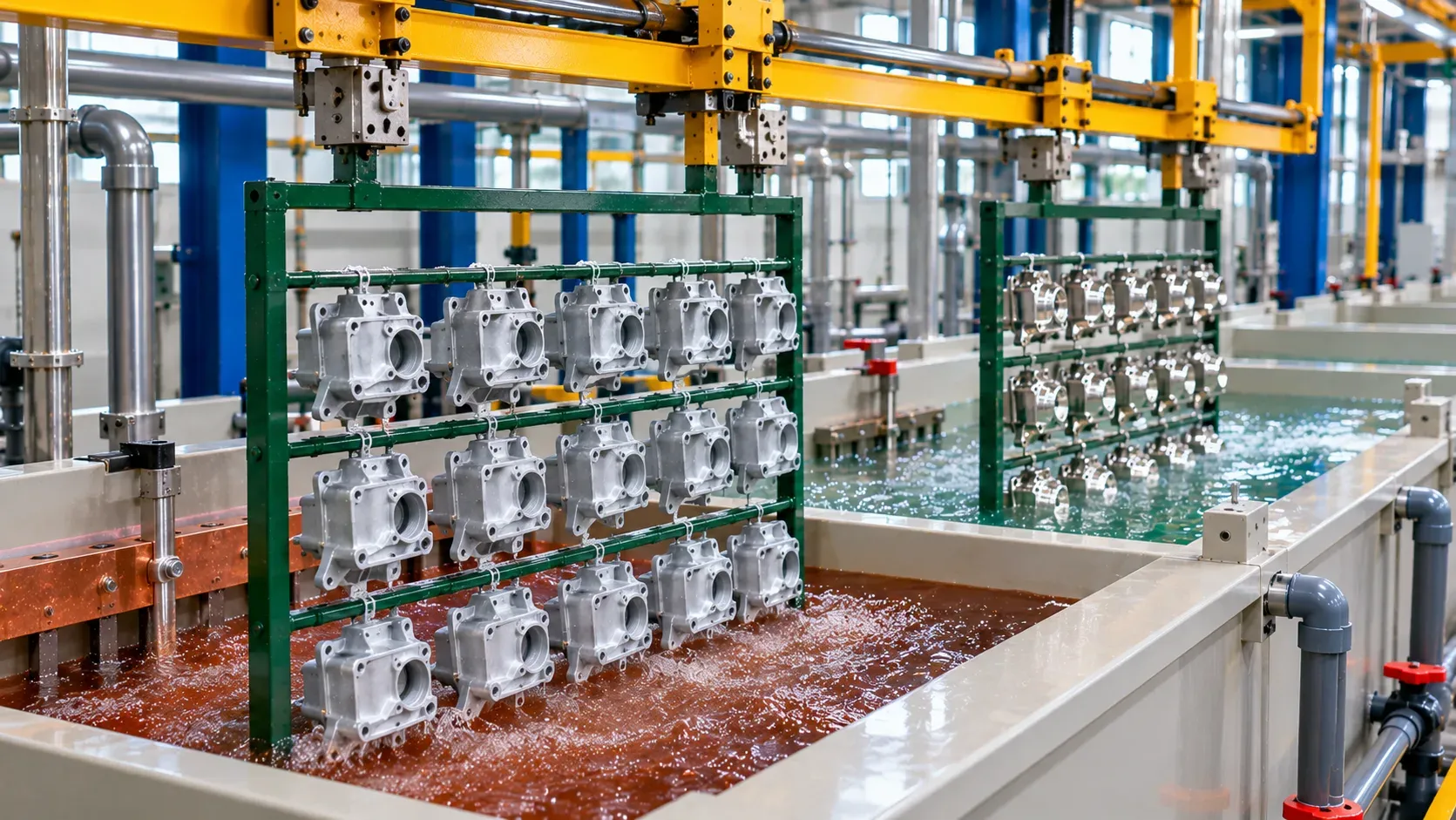
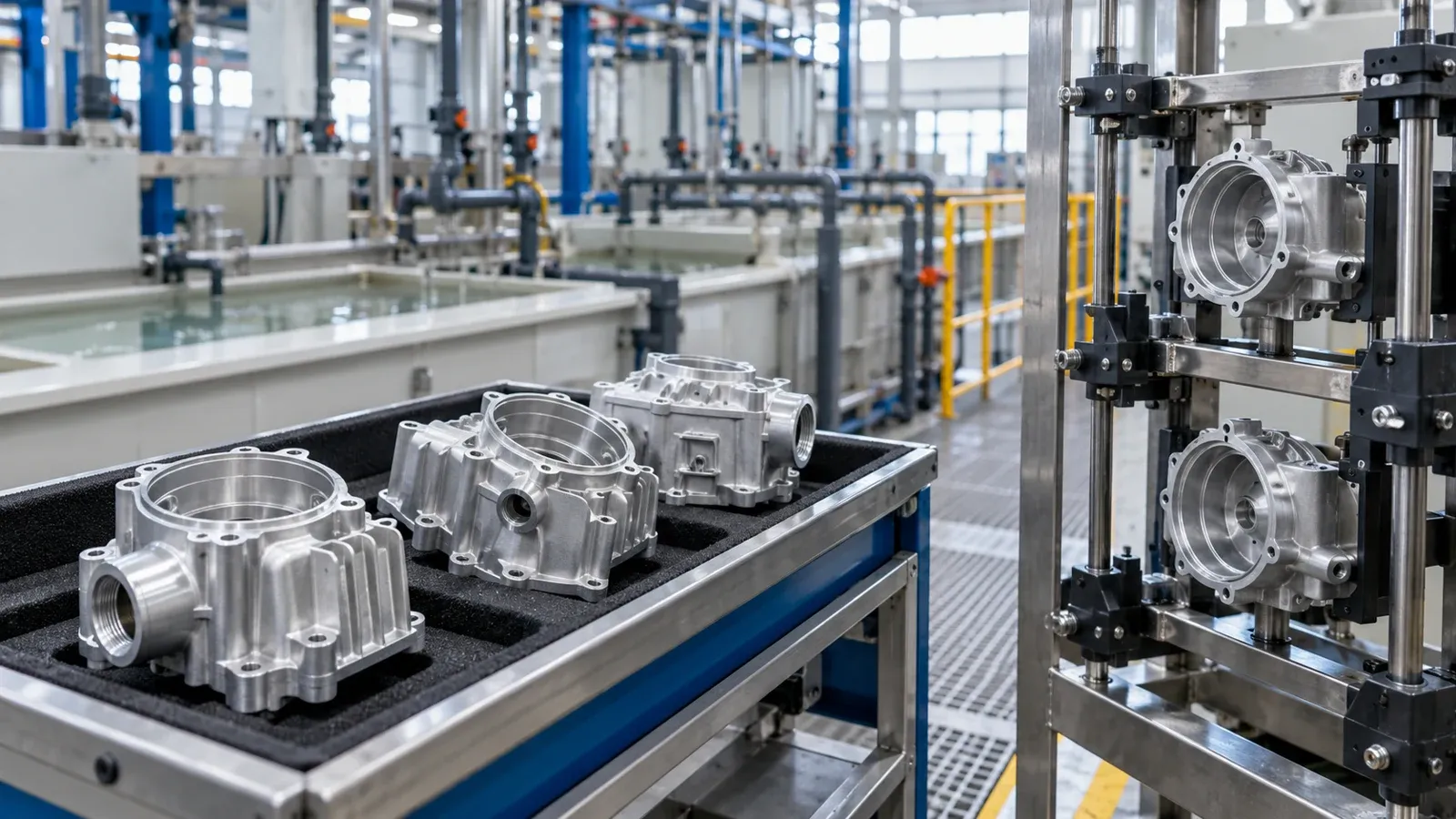
Provide representative parts or photographs together with the material record. Identify recesses, threads, internal passages and surfaces whose dimensions must remain within a finished limit. The equipment enquiry should explain how those features will be loaded, masked, drained and inspected.
An incomplete material description is a process-development question. Record it as such and ask which material or sample assessment is required. Do not select the line around an assumed alloy simply because it makes the enquiry quicker to complete.
Does the aluminium project need electrolytic or electroless nickel?
State the approved coating route and its purpose. If it remains undecided, define the functional and dimensional requirements first. The comparison in our electrolytic versus electroless nickel guide can organise that discussion without substituting for qualification of the actual parts.
For an electrolytic route, the equipment brief must address the agreed electrical duty and loading arrangement. For an electroless route, identify the approved bath-control and operating requirements. Ask suppliers to explain the differences in their proposed tank, control, circulation and support-system duties.
Selecting a bath name alone is not a complete equipment specification; identify the route that the process owner has approved.
What must be agreed before fixing aluminium nickel-plating stages?
Have the process owner approve the preparation, intermediate stages, nickel deposition and post-treatment requirements. Supply the applicable datasheets and safety information. The equipment supplier then needs a stage schedule with operating windows and the required monitoring and transfer conditions.
Ask which parts of the sequence are already qualified and which remain subject to trial. Keep provisional stages and values clearly identified in the project record. A supplier should not be asked to guarantee a result against a route that has not yet been agreed.
Also identify restrictions on waiting or transferring between stages, where these are part of the approved process. They may affect the handling schedule and workstation arrangement. Confirm those restrictions with the process owner; this article does not prescribe them.
How can aluminum preparation change the nickel line footprint?
The public ASTM B253-11(2022) record covers aluminum preparation before electrodeposition or autocatalytic deposition, including multiple conditioning and deposit/strike options. It does not select one universal zincate or strike sequence for every alloy and part condition.
Treat the approved preparation as equipment duties to assess, not a generic tank sequence to copy. A coating name does not tell the supplier which starting conditions, transition limits and verification tasks must fit the line.
| Duty to settle | Input from the process owner | Equipment consequence to review |
|---|---|---|
| Preparation by alloy/condition | Approved route, starting surface and unresolved trial work | Separate stage duties, materials and changeovers where required |
| Intermediate deposition or strike, if invoked | Approved chemistry, electrical/chemical duty and transfer requirements | Additional supplies, tank/control duties or transfer constraints in scope |
| Selected nickel route | Coating designation, bath window and controls | Electrical contact/current duties for electrolytic plating versus approved chemical-bath duties for electroless processing |
| Transfer, rinse and drainage | Approved transitions, carryover assessment and orientation | Hoist timing, rinse interfaces and access to recessed features |
| Final condition and inspection | Finished dimensions, coating condition and agreed tests | Downstream equipment/measurement tasks and release ownership |
This table does not prescribe these stages or claim all are required. Ask the supplier to mark included, excluded and provisional duties for the actual route. Do not transfer an established result from one alloy/condition to another without process-owner assessment.
A nickel-plating project brief for aluminium parts
| Requirement | Information the buyer should supply |
|---|---|
| Substrate | Alloy, manufacturing condition, material record and previous treatments |
| Coating purpose | Required appearance, wear, electrical or other drawing-level function |
| Nickel route | Electrolytic or electroless, coating designation and agreed process documents |
| Critical features | Masked areas, threads, fits, internal passages and contact restrictions |
| Handling | Dimensions, weight, part mix and proposed rack or basket arrangement |
| Production | Accepted output, working schedule and changeover expectations |
| Verification | Measurement locations, adhesion checks and customer acceptance requirements |
| Supply boundary | Main line, electrical or chemistry controls, water and installation responsibilities |
Use the table as a purchase brief. It is an original editorial checklist rather than a proven configuration or promise that every function is included in ES-PRO's standard offer.
How should aluminium nickel-plating trial parts and inspection be chosen?
Select parts that represent the real material and manufacturing condition. Include features where the coating or dimensional tolerance is difficult to assess. Record masking and contact positions so a successful result can be related to the proposed production arrangement.
Agree the inspection plan in advance. Identify the locations for coating measurements and the tests needed to assess adhesion or other specified functions. State who performs them and how the results are retained with the part identity and processing record.
For nickel-phosphorus projects, ISO 4527:2003's official record describes aqueous electroless nickel-phosphorus coatings on metal. It excludes nickel-boron, composites and ternary alloys. The record is published and under systematic review in 2026; use the agreed contract edition. This citation does not define universal thickness, heat-treatment or acceptance requirements.
How should aluminium nickel-plating line proposals be compared?
Keep the same part range, process route, accepted-output definition and supply boundary across offers. Request the loading and process assumptions behind each capacity estimate. A comparison using different coating thicknesses or different inspection limits will not describe the same production requirement.
List factory services and downstream responsibilities. Include water quality, extraction and wastewater interfaces where required by the assessed route. Our equipment checklist helps ensure that the surrounding systems are discussed alongside the main process tanks.
Questions You May Have:
Can one preparation route cover every aluminium alloy?
Do not assume it. Provide the actual alloy and manufacturing-condition list, and ask the process specialist to identify the qualification needed for each family.
Is electroless nickel automatically the right choice for aluminium?
No. Select the coating against the part's required function and acceptance criteria. Then define the equipment duties for the chosen, assessed process.
Can an existing nickel line be reused?
It needs a duty and compatibility review. Provide the existing tank schedule, controls, loading arrangement and available services before assuming that the new substrate can be accommodated.
What should I provide when coating thickness is undecided?
Provide the functional requirement and finished dimensions, and identify who will approve the coating specification. Record thickness as an unresolved input rather than assigning a generic value.
Get Proposal and Demo
Send the aluminium part and coating brief with the alloy, drawing, proposed route and accepted-output target. Ask which sample assessment and equipment demonstration are relevant. Files can follow by email to sales@electroplating-equipment.com.
For first contact, only company name, your name, email and project country are required. Phone, city and all technical fields are optional; supporting files can follow by email.