
Plating Process
Hydrogen Embrittlement Relief Baking Equipment Guide
Hydrogen embrittlement is the invisible failure mode that destroys high-strength steel parts days or weeks after plating — with no visible warning before the fracture. The hydrogen atoms that enter th
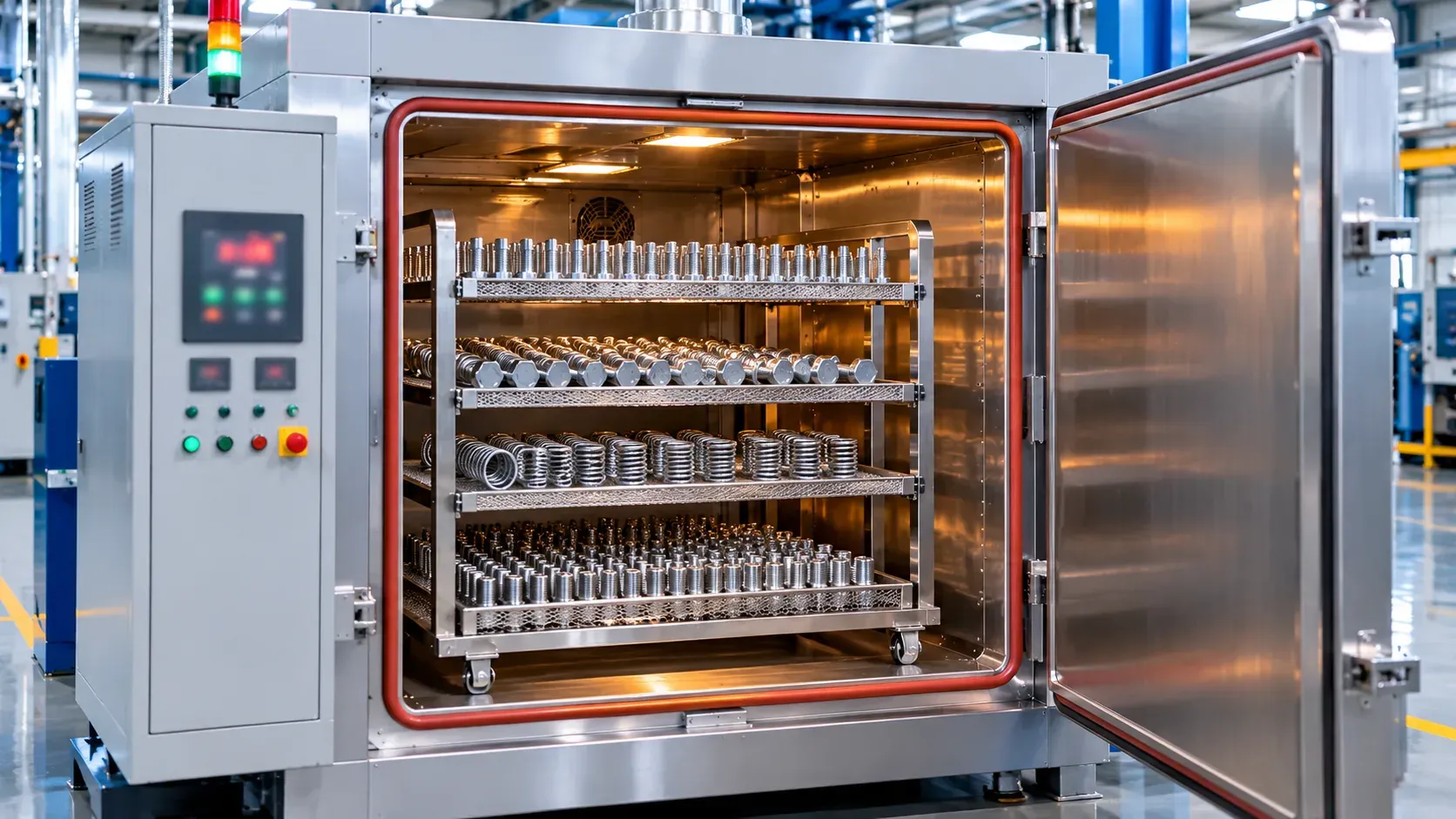
Hydrogen embrittlement is the invisible failure mode that destroys high-strength steel parts days or weeks after plating — with no visible warning before the fracture. The hydrogen atoms that enter the steel during electroplating migrate to high-stress areas and cause sudden brittle failure under loads the part would normally handle. The relief bake is the only reliable prevention, and the baking equipment specification determines whether it works.
Technical planning document — confirm baking parameters against the steel grade specification and the applicable industry standard (ISO 4042, ASTM F519, AMS 2759/9).
The mechanism in one paragraph
During electroplating, hydrogen ions are reduced at the cathode surface alongside the metal deposition. Some hydrogen atoms penetrate the steel lattice and accumulate at high-stress areas — grain boundaries, inclusions, machined surfaces. Under service load, these hydrogen atoms cause the steel to fail below its yield strength, with a brittle fracture that shows no ductility. The relief bake drives the hydrogen out of the steel before it can cause damage — it must be done within the time window before the hydrogen migrates to critical stress points.
The baking equipment specification
Item | What to specify |
|---|---|
Oven type | Forced-air convection oven with uniform temperature distribution — ±5°C across the working zone |
Temperature range | 190–220°C for standard relief bakes; some specifications require different parameters |
Timer | Programmable timer with start-record — the baking start time must be documented relative to the plating completion |
Load capacity | Sized for the production batch with parts loaded in a single layer or spaced for air circulation |
Air circulation | Forced-air circulation ensures uniform temperature across the load — static ovens have cold spots |
Data recording | Temperature and time recording for the bake — OEM auditors require the evidence |
Door interlock | Timer starts only when the door is closed and the temperature reaches the setpoint |
The baking parameters by steel strength
Tensile strength (MPa) | Temperature | Minimum duration | Maximum delay after plating |
|---|---|---|---|
1000–1200 | 190–220°C | 4 hours | 4 hours |
1200–1450 | 190–220°C | 8 hours | 2 hours |
1450–1800 | 190–220°C | 12–24 hours | 1 hour |
The "maximum delay after plating" is critical — hydrogen migrates to stress points during the delay period. If the bake starts too late, the embrittlement damage is already done and the bake cannot reverse it. This is why the baking oven must be on the line, not in a remote heat-treatment department.
Key takeaways
- Hydrogen embrittlement causes delayed brittle failure with no visible warning before the fracture.
- The relief bake drives hydrogen out of the steel — but it must start within the maximum delay window.
- Forced-air circulation and ±5°C uniformity are the critical equipment specifications.
- Temperature and time records are required by OEM auditors and industry standards.
- The baking oven must be on the plating line, not in a remote department — the delay matters.
Your next five steps
- Identify the steel grades in your product range and their tensile strengths.
- Obtain the baking parameters from the applicable industry standard (ISO 4042, ASTM F519, AMS 2759/9).
- Specify a forced-air convection oven with data recording and the correct load capacity.
- Locate the oven on the plating line to minimise the delay between plating and baking.
- Build the baking record into the traceability system for each production batch.
FAQ
Do all plated parts need a relief bake?
Only high-strength steel parts (typically above 1000 MPa tensile strength) and parts with specific customer requirements. Low-strength steel, brass, aluminum and most non-ferrous substrates do not require it.
Can we bake parts before plating instead?
A pre-plate bake removes hydrogen from previous processing (machining, pickling) but does not remove the hydrogen generated during plating. The post-plate bake is the one that matters for embrittlement prevention.
What happens if the bake starts too late?
Hydrogen migrates to high-stress areas and becomes trapped. A late bake removes some hydrogen from the bulk but cannot reverse the embrittlement damage at stress concentration points.
Image note: AI-generated editorial photography illustrates equipment or workpiece contexts; it is not an ES-PRO installation, customer reference or evidence of coating performance.


