
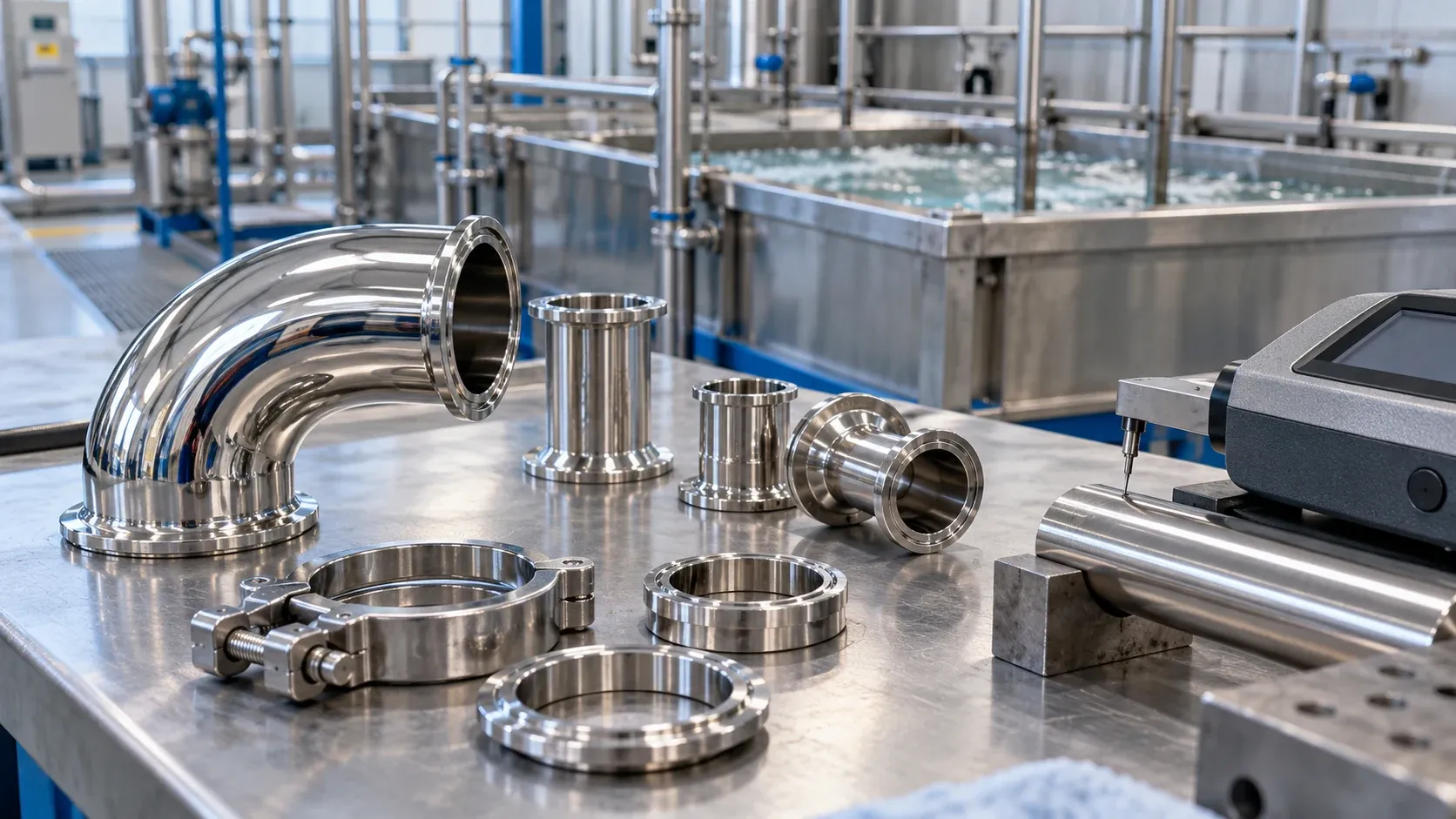
Electropolishing removes surface metal electrochemically; chemical passivation targets free iron without intentional bulk material removal. Properly specified electropolishing can itself provide a passivated stainless surface. Choose the route from the starting condition, required finish, dimensional allowance and invoked acceptance method rather than assuming the processes are interchangeable or always sequential.
Scope and limits: stainless finishing routes
- Choosing by habit or by supplier convenience: the part's tolerance, finish and corrosion requirements decide; the routes are not interchangeable line items.
- Passivating a flawed surface as a repair: chemical passivation targets free iron; it will not repair machining flaws, and damaged surfaces need their own assessment.
- Electropolishing as a dimensional-correction tool: removal follows geometry and current distribution; it is not a precision sizing operation, and deep defects survive it.
- Using this as a process recipe: nitric versus citric, electrolyte systems, current density and removal windows are process-owner decisions under the applicable standards.
What does each process do to the part?
Electropolishing is the electrochemical reverse of plating: the part is the anode, and current removes surface metal, with the removal pattern shaped by geometry, current distribution and process conditions. What it can deliver: smoothing of micro-roughness toward a brighter, more level finish (the degree depends on the starting surface and the process — it is not a guaranteed mirror); removal of the smeared, embedded surface layer machining leaves behind; removal of heat tint and scale under suitable conditions; and a passive resulting surface under recognized electropolishing practice. What it also does: remove material — so for tolerance-critical parts, the allowed removal is a specification input, verified by measurement, and electropolishing is not a tool for precision dimensional correction. The ASTM B912 public scope frames electropolished passivation; it is not a substitute for the invoked procedure.
Chemical passivation — nitric or citric acid families — dissolves free iron from the surface and strengthens the natural chromium-oxide film. It is not intended to remove base metal; critical features still require verification against the drawing and the selected process. Its appearance effect is typically minimal — the part usually keeps its existing finish rather than being changed to matte or mirror. The ASTM A967/A967M public scope identifies chemical passivation and its verification boundary.
| Decision input | Electropolishing | Chemical passivation |
|---|---|---|
| Starting surface | Assess preparation first; suitable prepared surfaces needing controlled refinement; heat tint/scale needs an explicit removal assessment | Sound surfaces with free-iron contamination as the target problem |
| Target finish | Smoother, brighter — degree process-dependent | Typically retains the existing finish |
| Allowed removal | Removal is inherent; fix the allowed amount in the specification | Not intended to remove base metal |
| Critical dimensions | Verified against the removal specification | Verify critical features against the drawing |
| To verify | Removal amount, finish, corrosion per the invoked method | Free-iron test / corrosion per the invoked method |
| Process-specific hardware | Electropolishing cell, rectifier, electrical contacts and cathodes | Chemical treatment tanks and chemistry dosing/handling |
| Shared categories to assess separately | Preparation, method-dependent heating/cooling, rinsing, drying, ventilation and actual electrolyte/waste interfaces | Preparation, method-dependent temperature control, rinsing, drying, ventilation and actual acid/waste interfaces |
Free iron and heavy scale or heat tint are not the same problem: free iron is exactly what chemical passivation targets, while heavy scale and heat tint are removal questions — which electropolishing may itself address, and which pickling may also address. Sequencing follows the starting surface and the invoked method, not a fixed order.
The British Stainless Steel Association flags sulphurised free-machining grades as a surface-finish limitation in electropolishing. Ask for the exact grade and condition, not just stainless steel. Use representative material to agree an achievable finish and acceptance criterion before sizing the line; a result on another grade does not establish the same finish.
How does the route actually get chosen?
- What must change on the surface? Smoothing, brightening, deburring-like refinement and heat-tint removal point toward electropolishing; a sound surface needing free-iron removal and corrosion assurance points toward chemical passivation alone.
- What removal can the part tolerate? Where critical dimensions are tight, the removal specification — or a no-removal route — becomes the constraint. Define before/after measurement locations and the permitted change for the trial.
- What does the contract require? The invoked specification and the customer's flow-down name the acceptance method and whether a separate passivation step is required after electropolishing or whether electropolished passivation per the recognized practice satisfies it.
So the honest answer on sequencing: pickle-first, then electropolish, then passivate is one candidate route for parts that arrive heavily scaled and need a refined finish plus a named final passivation. Other parts need only one stage, and electropolishing itself may serve as the passivating step under the applicable practice. Treat any quotation that stacks stages without tying each stage to a requirement with questions — each stage is real equipment, real chemistry and real effluent.
How do scale and dimensional allowance change the trial?
Compare two intake conditions rather than quoting from an alloy name alone. A cleaned stainless fitting with light weld discoloration needs photographs, representative samples and an agreed finish/removal trial. A fitting with adherent scale needs a separate preparation or descaling assessment: ask whether the proposed electropolishing route can remove that scale within the allowed metal loss, or whether a separate preparation stage is needed. Electropolishing can remove heat tint and scale under suitable conditions; this does not establish that every scaled part is suitable for the same cycle. Neither a photograph nor a bright surface alone proves passivation acceptance. The ASTM A380/A380M public scope distinguishes cleaning and descaling preparation from passivation; detailed requirements come from the invoked edition.
Hypothetical dimensional check, not a process setting: a shaft starts at 10.000 mm outside diameter. If each opposing surface loses 0.005 mm, the calculated outside diameter becomes 9.990 mm: 10.000 − 2 × 0.005. If its drawing minimum is 9.995 mm, that removal would violate the limit. For an internal bore, removal from opposite walls increases the bore diameter instead. Use before/after measurements at defined locations, suitable measurement uncertainty and the actual part geometry; local removal need not be uniform. These figures explain the arithmetic and are not recommended removal values or measured production results.
What evidence should the finishing trial return?
Agree these records before accepting the trial. The verification families below are alternatives or complementary checks selected for the invoked specification, alloy and surface requirement; they are not a universal test package.
| Requirement | Trial record | Effect on route or equipment |
|---|---|---|
| Surface finish | Before/after roughness such as Ra, with units (µm or µin), measurement locations, instrument and evaluation settings | Tests whether refinement is actually needed and achieved; brightness cannot substitute for the specified finish measurement. |
| Dimensions and removal | Critical outside/inside dimensions or wall thickness before/after, drawing limits, measurement method and uncertainty | Restricts permissible removal, masking and fixture/current-distribution assessment; a failed trial requires route or part-design review. |
| Free iron / passivation | Invoked document and edition, applicable test method, sample selection, observations and acceptance decision | Water immersion, humidity, copper-sulfate or other specified methods are not interchangeable on every alloy; obtain the applicable procedure rather than selecting a test by convenience. |
| Visible condition and traceability | Recorded defects/scale before treatment, after-treatment visual observations, lot/rack identity, bath/run reference, deviations and approval | Separates starting defects from treatment effects and connects accepted samples to the route proposed for production. |
What does each line look like?
Chemical passivation needs chemical tanks and handling, temperature control where the method requires, rinses, drying, and a chemistry-specific ventilation and effluent assessment — our passivation line brief walks through it. Electropolishing adds an electrical dimension: rectifiers sized for the part area, cathodes, acid systems that run warm and evolve gas, fume capture and an effluent assessment for its actual electrolyte. Whether the two share infrastructure is an integration question to verify — rinsing and some pretreatment tanks may be shareable, while the electropolishing cell and the passivation bath remain distinct stages with distinct chemistries and electrical scope. Both routes live or die by rinse discipline and water quality. Record rinse stages, water-quality requirements and permitted hold conditions in the trial plan.
Use the equipment buyer's guide to extend the selected route into a handling, power, utilities and support-equipment boundary.
Stainless route-selection and verification sheet
Use this as a blank project worksheet. Enter actual requirements and observations; the blanks are not process limits or completed production results.
- Part and starting condition
- Record for this projectAlloy/condition, lot, drawing revision, soil/free-iron concern, heat tint/scale and measured initial finish: ____
- How this changes the decisionSeparates cleaning/descaling and surface-refinement needs; chemical passivation is not a substitute for removing scale.
- Finish and dimensional boundary
- Record for this projectFinish target and units, allowed removal per surface, critical dimensions and before/after measurement locations: ____
- How this changes the decisionDetermines whether an electropolishing trial is permissible and what must be measured; removal is not a precision-sizing promise.
- Invoked requirement and route
- Record for this projectSpecification/edition, approved preparation and rinse sequence, electropolished passivation acceptance or explicitly required separate chemical passivation: ____
- How this changes the decisionConnects each proposed stage to an actual requirement and prevents adding a bath by habit.
- Representative load
- Record for this projectPart/rack arrangement, exposed area and masking where relevant, mass/envelope and worst-case geometry: ____
- How this changes the decisionChanges cell geometry, cathodes, handling and the electrical assessment for an electropolishing route.
- Recorded process conditions
- Record for this projectApproved process reference, bath identity/state, temperature, treatment time and electrical values where applicable; rinse-water requirements: ____
- How this changes the decisionMakes trial results traceable without turning this checklist into a process recipe.
- Acceptance method and sampling
- Record for this projectRequired finish/removal/dimensional limits, applicable free-iron or corrosion method, sample locations/count and source clause: ____
- How this changes the decisionDefines evidence for the specified surface function; no one generic corrosion test is assumed for all stainless alloys or routes.
- Demonstration and sign-off
- Record for this projectBefore/after results, run IDs and repeat plan, deviations/corrective action, witness and approval owner: ____
- How this changes the decisionSeparates demonstrated performance from assumptions and establishes who accepts the selected route.
- Demand and equipment boundary
- Record for this projectDemand/month and calendar; accepted parts/area per representative load; observed stage and handling times; measured versus assumed values; schedule/capacity calculation owner; retained equipment and fume/effluent owners: ____
- How this changes the decisionConnects accepted load and observed timing to the proposed schedule; parallel stages and handling constraints need a line calculation, not monthly demand divided by one bath time. Keep assumptions separate until demonstrated.
Copy this project worksheet
Select the text in the read-only field and copy it into your RFQ document or project notes. Complete the requirements, owner and status for each item.
Questions You May Have:
Does electropolishing replace passivation?
It can, where the applicable practice and contract accept electropolished passivation — ASTM B912's public scope covers passivation of stainless parts using electropolishing. Where the contract names a separate chemical passivation requirement, run the specified sequence. The requirement, not the habit, decides.
How much material does electropolishing remove?
There is no single removal value for all stainless parts. Define a permitted loss per surface and the critical before/after dimensions. The shaft example above shows why a 0.005 mm loss on each side changes diameter by 0.010 mm. The trial must measure the actual result; geometry and current distribution can make removal uneven.
Is citric passivation as good as nitric?
Citric passivation can be an acceptable alternative where the invoked specification permits it and the applicable acceptance requirements are met. Nitric and citric routes are not automatically interchangeable: compare alloy/condition, starting contamination, required verification and permitted surface change, then handling, ventilation and waste interfaces. The ASTM A967/A967M catalogue identifies both treatment families; it does not establish universal equivalence for every part.
Which records should a stainless finishing trial return?
Keep the lot and drawing revision, approved route, starting condition, bath/run identity, applicable process settings, before/after finish and critical dimensions, selected acceptance method and sampling, deviations and signed disposition. These records allow the accepted sample to be connected to a proposed production route; a polished sample without traceability does not do that.
Get Proposal and Demo
Introduce your stainless project with company, name, email and project country. Technical fields are optional. A useful process entry is: Stainless fitting; compare electropolishing and chemical passivation; finish and critical dimensions to confirm. Email completed worksheets; use project notes for a brief summary. Ask which route and line scope the assessment recommends.
Details can follow by sales email, or chat on WhatsApp. The quotation scope guide helps compare which stages each offer includes.
Technical references
- ASTM B912-26 — Passivation of Stainless Steels Using Electropolishing (ASTM catalogue) — public scope and method boundary.
- ASTM A967/A967M-25 — Chemical Passivation Treatments for Stainless Steel Parts (ASTM catalogue) — chemical passivation treatments and verification scope. The contract edition governs detailed requirements.
- British Stainless Steel Association — stainless cleaning and electropolishing — preparation categories and grade-related finish boundary.
- ASTM A380/A380M-25 — Cleaning, Descaling, Pickling, and Passivation of Stainless Steel Parts, Equipment, and Systems (ASTM catalogue) — practice framing. The contract edition governs detailed requirements.
Image note: AI-generated editorial imagery illustrates equipment or workpiece contexts; it is not an ES-PRO installation, customer reference or evidence of surface-finish or passivation acceptance.


