Oct 4, 2026Ultrasonic Cleaning
Distilled vs Deionized Water for Ultrasonic Cleaner
Tap water causes spotting and scale. See when to use distilled or deionized water in ultrasonic cleaning — and how industrial lines supply DI water.
An operator's answer to a daily question: which water goes in the tank, why tap water fails, and how production lines get pure water on tap. About a 6-minute read.
Written by Nick Wong · Engineering reviewed by Li Wang · Published 2 October 2026 · Updated 2 October 2026
Both distilled and deionized (DI) water work well in an ultrasonic cleaner, and deionized water is the standard choice for industrial lines because it is produced on-site at lower cost. Never use tap water: its dissolved minerals leave white spots on parts and build scale on the tank, heaters and transducers.
Why Tap Water Is the Wrong Choice
Tap water carries dissolved minerals — mainly calcium and magnesium — plus chlorine and whatever else the local supply adds. In an ultrasonic tank, that causes three concrete problems:
- White spots on parts. When parts dry with rinse water still on them, the dissolved minerals stay behind as a chalky film. On precision or pre-plating parts, that film is a defect that forces rework.
- Scale on the machine. Heat drives the minerals out of solution, and they plate themselves onto heater surfaces, tank walls and transducers. Scale insulates heaters, raises energy use, and — critically for ultrasonics — dampens the vibration that produces cavitation in the first place.
- Redeposition. Loose minerals and particles in the water can settle onto parts during cleaning, undoing the cleaning the cavitation just did.
Distilled vs Deionized: Reference Table
Both are "pure" water — the difference is how the impurities are removed, and what that means at industrial scale.
| Distilled water | Deionized (DI) water |
|---|---|---|
How it's made | Boiled and re-condensed; steam leaves impurities behind | Passed through ion-exchange resins (often after reverse-osmosis pre-treatment) that capture dissolved ions |
What it removes | Nearly all dissolved minerals and most non-volatile impurities | Dissolved ions — salts and minerals; with RO pre-treatment, organics as well |
Purity measure | — | Electrical resistivity; ultrapure water reaches ≈18.2 MΩ·cm at 25 °C (standard reference point), production grades lower |
At industrial volume | Impractical: energy-intensive, heavy to supply in drums for large tanks | The industrial standard: produced on-site, continuously, by an RO/DI system |
Verdict | Works in the tank, wrong cost model for production | Works in the tank and scales to production |
For the cleaning result itself, properly produced DI water and distilled water are interchangeable. The decision is economic: distillation makes sense for litres, DI generation makes sense for the hundreds or thousands of litres a production line consumes.
Field Workflow: Estimate Your DI Water Consumption
A reusable planning calculation before buying any supply option — weekly DI consumption (L) = tank volume × replacement rate + evaporation + drag-out carry-out:
- Tank volume × replacement rate — how often the bath is dumped and refilled on your maintenance schedule
- Evaporation — warm tanks evaporate continuously; heated ultrasonic baths lose water every running hour
- Drag-out carry-out — every load pulls solution out on its surfaces; that is make-up water too
Run the numbers for one week of real production and you have the decision made for you: at drum-supplied volumes, on-site RO/DI generation wins on cost per litre — and it never runs out mid-shift. Checklist to keep the water pure once you have it:
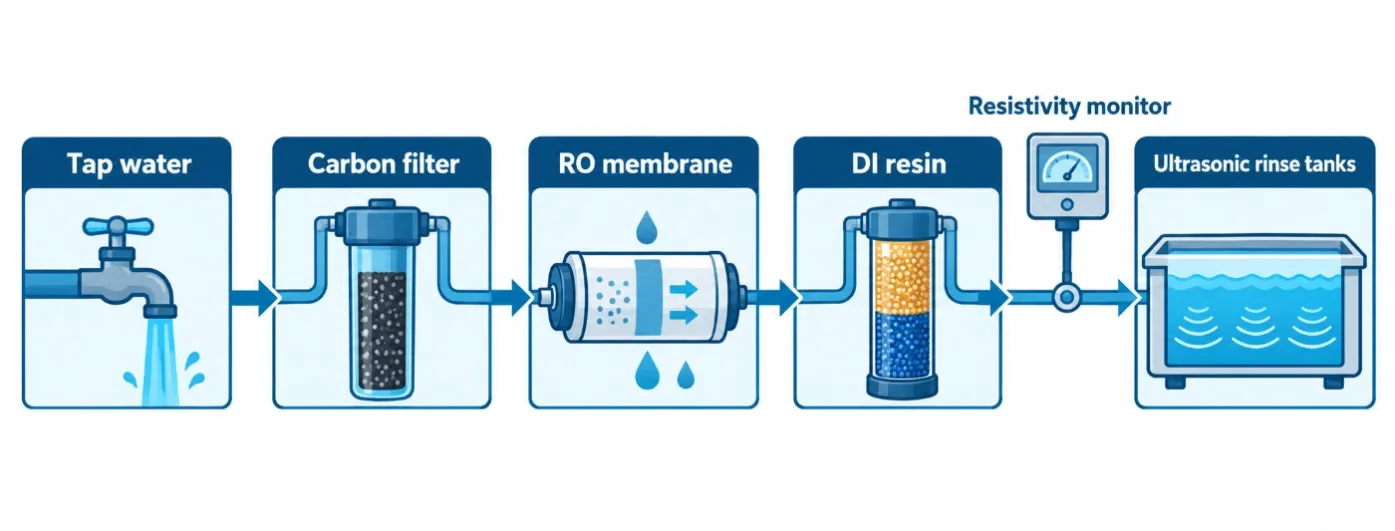
- ☐ Resistivity meter installed on the final rinse; reading logged per shift
- ☐ Rinse tanks refilled with DI only — no "topping up" from the tap
- ☐ Resin change scheduled by resistivity drop, not by calendar
- ☐ Final rinse is the cleanest water in the line, always
How Pure Water Protects the Machine
Water quality is preventive maintenance for the cleaner itself: heaters scale up and lose heat transfer, working harder for the same temperature until they fail early; transducers and tank walls accumulate mineral deposits that absorb and scatter ultrasonic energy, so cavitation weakens even though the generator runs at full power; and bath life shortens because dissolved solids accelerate solution degradation. A tank run on purified water with the right chemistry stays internally clean — which keeps cavitation efficiency, and therefore cleaning results, stable over years.
How Industrial Lines Get DI Water
Production-scale cleaning doesn't buy water — it makes it. A reverse-osmosis unit first removes the bulk of dissolved solids and organics, and ion-exchange polishing then brings the water up to the required resistivity. That RO/DI system feeds the ultrasonic wash tanks and, just as importantly, the final rinse stages, where the last water touching the part should be the purest.
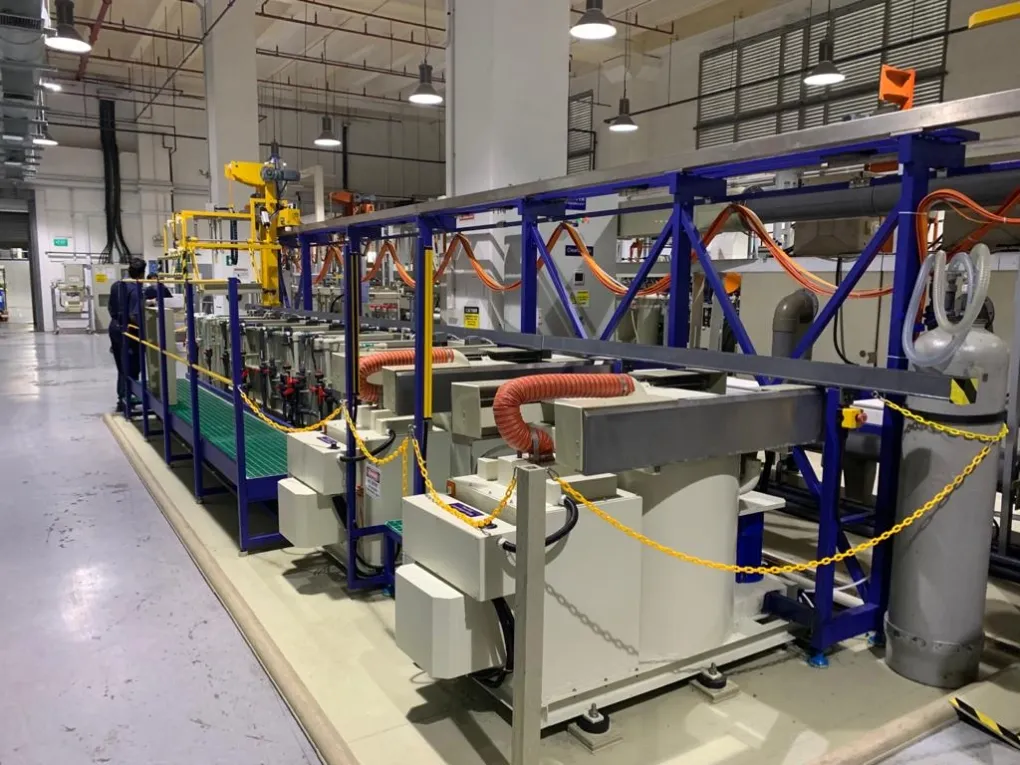
This is how DI water is built into cleaning equipment rather than hauled to it: dedicated DI water cleaning systems integrate the pure-water rinse stages directly into the cleaning line, and on-site RO / DI water systems supply both cleaning lines and general rinse-water demand. The result is spot-free drying without manual wiping — the difference between "cleaned" and "cleaned and verified".
Pure Water Is the Base — Chemistry Does the Work
One clarification that prevents a common misuse: purified water alone is not a detergent. It handles light dust and loose particles, but oils and greases need chemistry. A properly built ultrasonic bath is: DI water as the base — pure, so it leaves nothing behind and protects the tank; an ultrasonic detergent matched to the soil and substrate — alkaline degreasers for oils, specialist formulations for flux, polishing compounds or specific alloys, dosed at the supplier's recommended concentration and temperature; and a final clean DI rinse — so parts dry spot-free. And a safety rule that has no exceptions: never put flammable solvents in a standard aqueous ultrasonic tank — cavitation generates fine aerosols and heat. Solvent cleaning is a different equipment category entirely.
Standards and Evidence Boundary
References relevant to water quality in cleaning and rinsing (always the current edition):
- ASTM D1193 — Standard specification for reagent water; defines water purity grades (Type I–IV) by resistivity and contaminants, and is the common anchor when a cleaning or plating spec says "DI water rinse".
- Chemistry supplier datasheets — detergent concentration and temperature windows assume the water grade specified there.
Evidence boundary: this article states industry-general facts and the standard reference point for water purity (≈18.2 MΩ·cm at 25 °C). Specific resistivity targets for your bath come from your chemistry supplier's datasheet and your quality specification — not from this page, and no brands are recommended here.
FAQ
Can I just buy distilled water for my workshop?
For a small benchtop tank used occasionally, yes — it works and avoids scale. For production volumes, no: drum supply for large tanks is expensive and logistically fragile. On-site RO/DI generation delivers the same purity continuously at a far lower cost per litre.
Is deionized water corrosive to metal parts?
Pure water is slightly "hungry" for ions, but in practice DI water used with the correct detergent chemistry, at the right temperature and dwell time, is standard for metals across the industry. The formulation matters more than the water: match the detergent to the substrate and there is no corrosion issue.
Do I still need cleaning concentrate if I use DI water?
Yes, whenever oil or grease is involved. DI water provides the spot-free, scale-free base; the detergent provides wetting and soil removal. DI water alone is only sufficient for light particulate rinsing.
Why are my parts still spotting even with DI water?
Usually one of three causes: the rinse stage is contaminated (carry-over from earlier stages or an overdue water change), the tank or basket itself carries deposits, or parts sit too long before drying. Check rinse-water purity with a resistivity meter, keep final rinses the cleanest water in the line, and dry immediately.
Related Reading
- Pillar guide: How Does an Ultrasonic Cleaner Work? — the cavitation physics your water choice supports.
- Adjacent decision: What Is Electroplating? — where spot-free rinsing fits in the full line sequence.
- Next step: browse DI water cleaning systems and RO / DI water systems.
Diagnostic CTA: What to Send Us — and What You Get Back
If spotting, scale or water costs are eating into your cleaning line's output, send three inputs through our RFQ form:
- Tank volume and current water supply (tap / drummed / on-site)
- The symptom — spotting on parts, scale on tanks, or water bill
- Throughput — baskets per shift and dump frequency
ES-PRO returns: a water-grade recommendation per rinse stage, an RO/DI system sizing matched to your consumption calculation, a quotation, and an explicit list of open questions — we state what is missing rather than assuming it.
References & Authorities
- ASTM D1193 — Standard specification for reagent water — ASTM International.
- Chemistry supplier datasheets — detergent concentration and temperature windows assume the water grade specified by the chemistry supplier.
- Industry associations — e.g., NASF (National Association for Surface Finishing, US) and IMF (Institute of Materials Finishing, UK) publish supplementary guidance and training for the surface-finishing industry.
Standards are cited for identification; always use the current edition from the issuing body. Process parameters are governed by the datasheets for the specific chemistry.