Plating Lines & Equipment
Barrel vs Rack Plating Equipment
Barrel plating and rack plating are the two fundamental configurations for electroplating production. The choice determines your racking scope, hoist type, rectifier configuration, process chemistry a
Barrel plating and rack plating are the two fundamental configurations for electroplating production. The choice determines your racking scope, hoist type, rectifier configuration, process chemistry and labour cost. Getting it wrong means the line works but the business model does not. This guide gives you the decision framework.
Technical planning document — confirm part dimensions, production volume and finish requirements before choosing.
The decision matrix
Criterion | Barrel plating | Rack plating |
|---|---|---|
Part size | Small — fits in a barrel, typically under 100 mm and under 500 g | Any size — from jewellery to 5 m panels |
Part fragility | Must withstand tumbling contact | Any — delicate parts held fixed |
Production volume | High — thousands of parts per barrel load | Low to medium — limited by rack positions |
Part geometry | Simple shapes without threads, blind holes or sharp edges | Complex geometry — threads, recesses, selective plating |
Contact marks | No contact marks — parts tumble freely | Contact marks where racks touch the part |
Labour cost per part | Very low — one operator handles thousands | Higher — each part is individually racked |
Thickness distribution | Variable — parts tumble and current density varies | Controlled — fixed position means predictable current density |
Capital cost | Lower per unit of throughput | Higher — racks are part-specific |
The barrel plating equipment scope
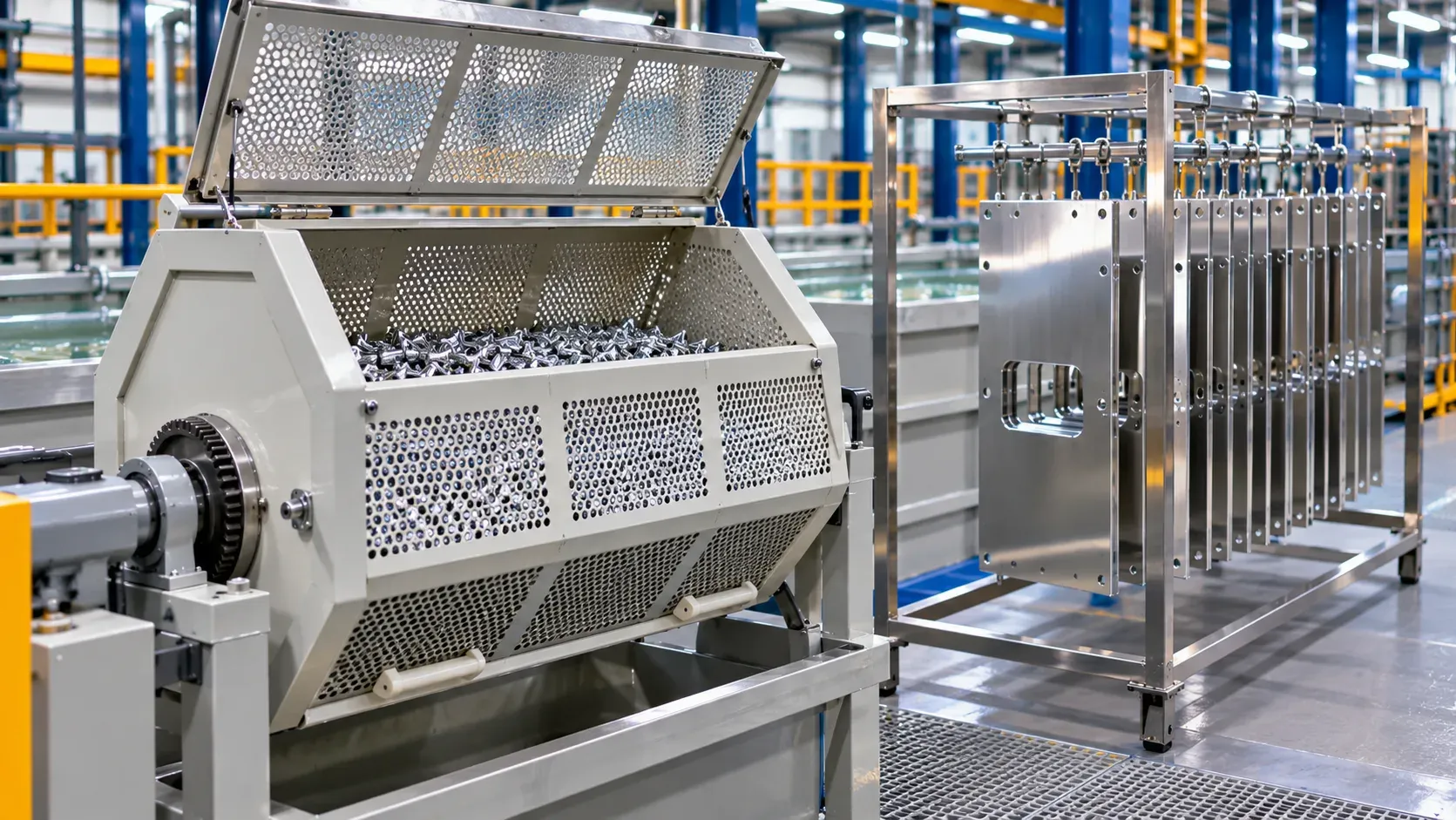
Barrel plating uses a rotating barrel (horizontal or oblique) that tumbles parts while they are immersed in the plating solution. The barrel is perforated so solution flows through and electrical contact is made through the tumbling parts themselves via dangler or bar contacts. Key equipment:
- Barrel type: Horizontal or oblique cylinders in PP, PVC or acrylic — perforated or solid with solution ports
- Barrel size: Diameter 300–600 mm, length 300–1200 mm depending on part size and throughput
- Hoist or manual handling: Automated hoists for production volumes; manual transfer for smaller operations
- Contact system: Danglers (flexible contacts inside the barrel) or bar contacts through the barrel door
- Rectifier: Higher current per barrel than per rack position — current spreads across all parts in the barrel
- Barrel rotation speed: Typically 3–10 RPM — slow enough to avoid damage, fast enough for uniform coating
The rack plating equipment scope
Rack plating holds parts in fixed positions on conductive racks. The rack design is part-specific: each part type needs a custom rack that holds the part securely, makes reliable electrical contact and positions the part for uniform current distribution. Key equipment:
- Rack design: Titanium or copper-spine racks with stainless steel spring contacts or threaded fixtures
- Rack-specific tooling: Each part type needs its own rack design — this is an ongoing tooling cost
- Automatic hoist system: Programme-controlled transfer between tanks for consistent cycle times
- Rectifier per station or shared: Current density control per rack position is possible with multi-circuit rectifiers
- Auxiliary anodes and shields: For complex parts with recesses or high-current-density areas
- Masking and plugging: For selective plating where only certain surfaces must be coated
The masking and loading guide and the racks and loading guide cover the rack-specific scope in detail.
The hybrid configuration
Many production shops run both barrel and rack lines in the same hall: barrel lines for high-volume small parts (screws, washers, connectors) and rack lines for large, fragile or selectively plated parts (brackets, shafts, housings). The shared infrastructure — rectifiers, treatment plant, fume extraction, water system — serves both. The decision is per part type, not per facility.
Key takeaways
- Barrel plating for small, robust, high-volume parts; rack plating for large, fragile or selectively plated parts.
- Barrel: no contact marks, very low labour cost, but variable thickness distribution.
- Rack: controlled thickness distribution, selective plating, but higher labour and tooling cost.
- Barrel parts must survive tumbling — threaded features and delicate geometry are excluded.
- The shared infrastructure (treatment, extraction, water) serves both configurations.
Your next five steps
- Sort your part range by size, fragility, geometry and volume.
- Assign each part family to barrel or rack based on the decision matrix.
- Size the barrel and rack equipment for the production volume per type.
- Design the shared infrastructure (treatment, water, extraction) for the combined load.
- Confirm the barrel chemistry and rack chemistry are compatible — they usually are for the same finish.
FAQ
Can barrel plating handle threaded parts?
Threads can be damaged by tumbling contact and are difficult to coat uniformly. Threaded parts are usually rack-plated or barrel-plated with thread inserts.
What is a dangler contact?
A flexible electrical contact (copper or stainless steel chain or cable) that hangs inside the barrel and maintains contact with the tumbling parts. It wears and needs periodic replacement.
Can we switch a part from barrel to rack?
Yes — the finish chemistry is usually the same. The equipment changes: a rack must be designed, the current density recalculated and the cycle time adjusted. The finish specification should not change.
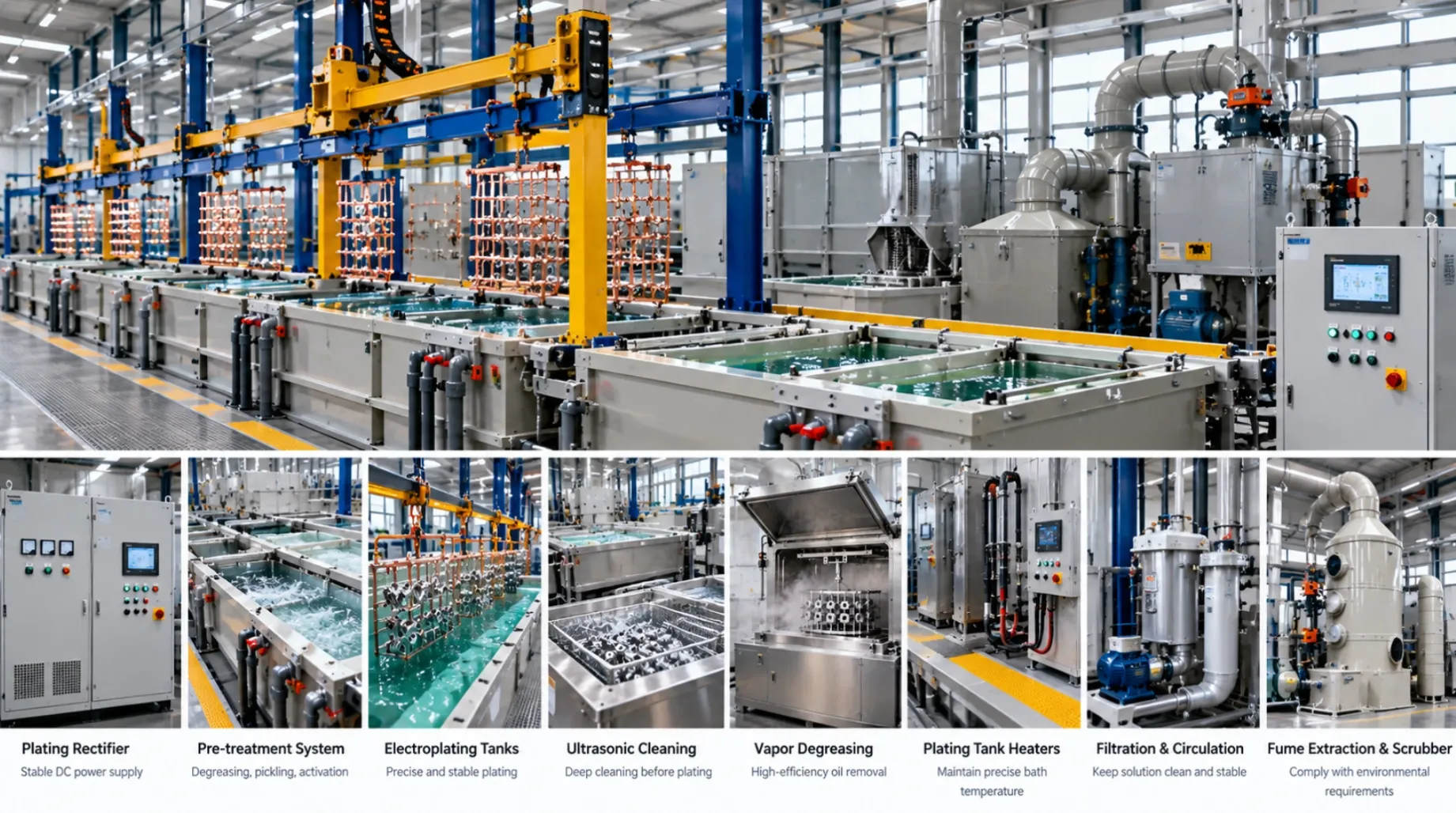
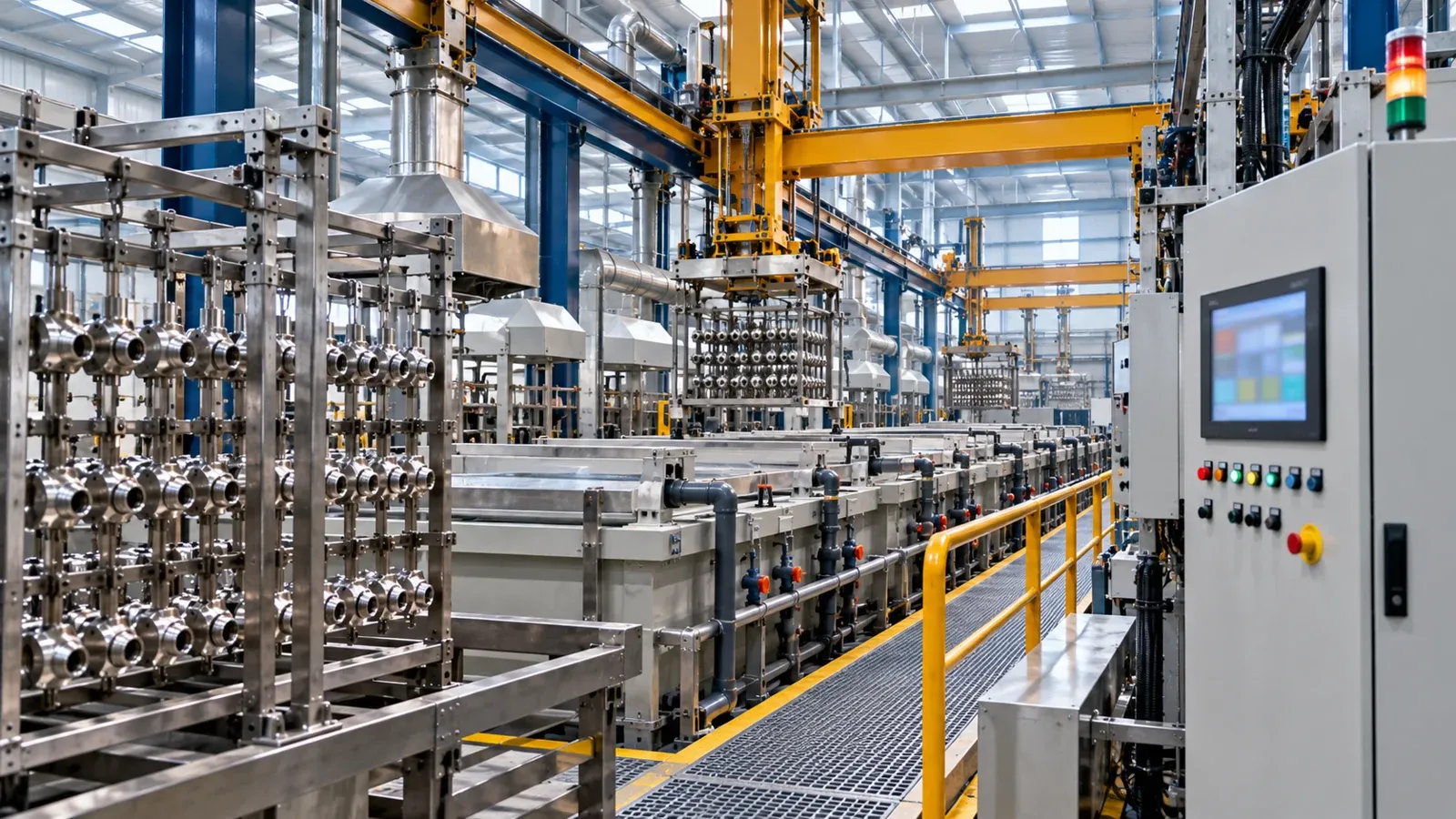
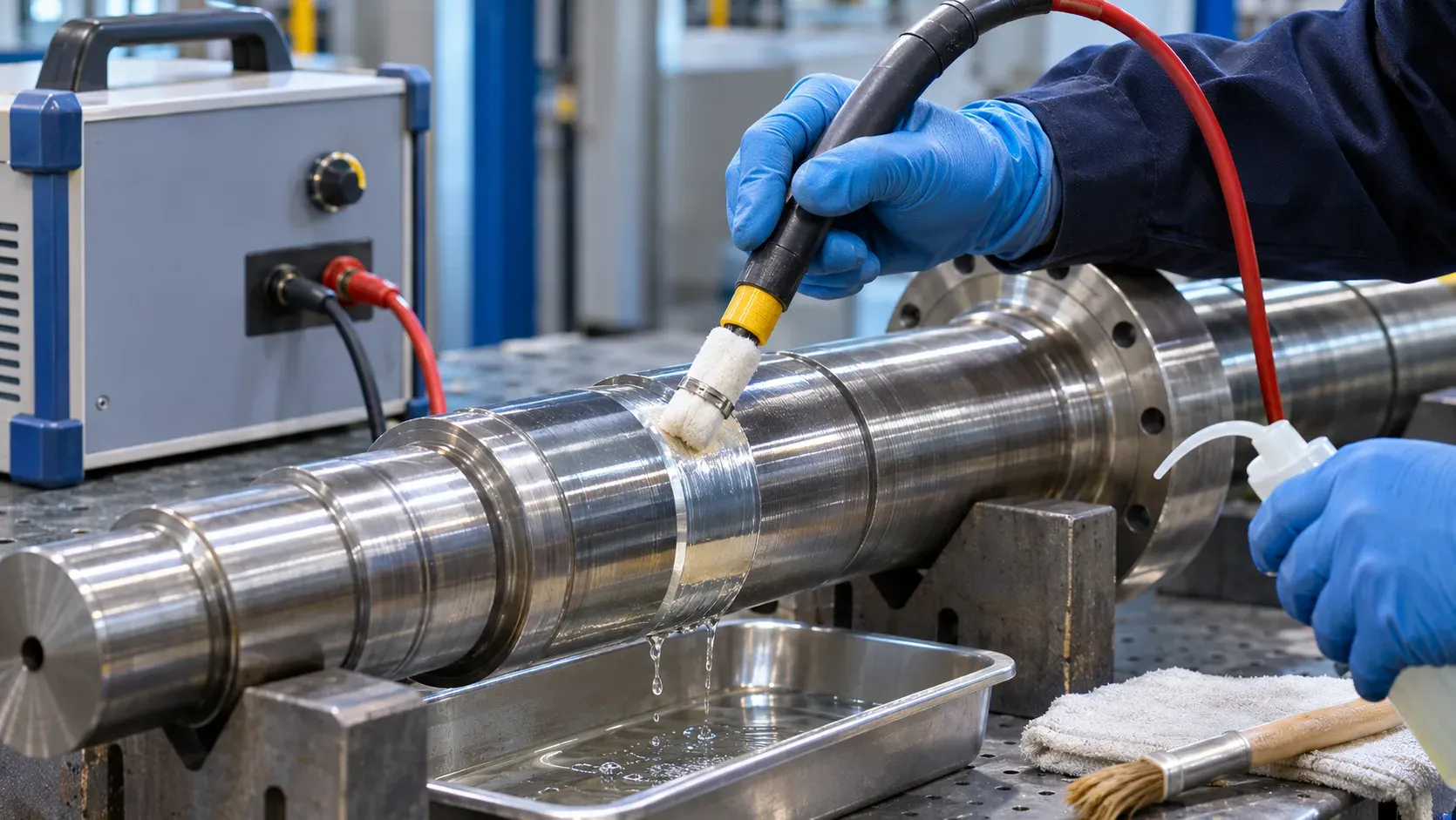
Image note: AI-generated editorial photography illustrates equipment or workpiece contexts; it is not an ES-PRO installation, customer reference or evidence of coating performance.