
Plating Process
Automotive Plating Specifications Equipment
Automotive OEM specifications are the strictest quality requirements a plating shop will encounter. They go beyond national standards to define coating thickness, adhesion, corrosion resistance, appea
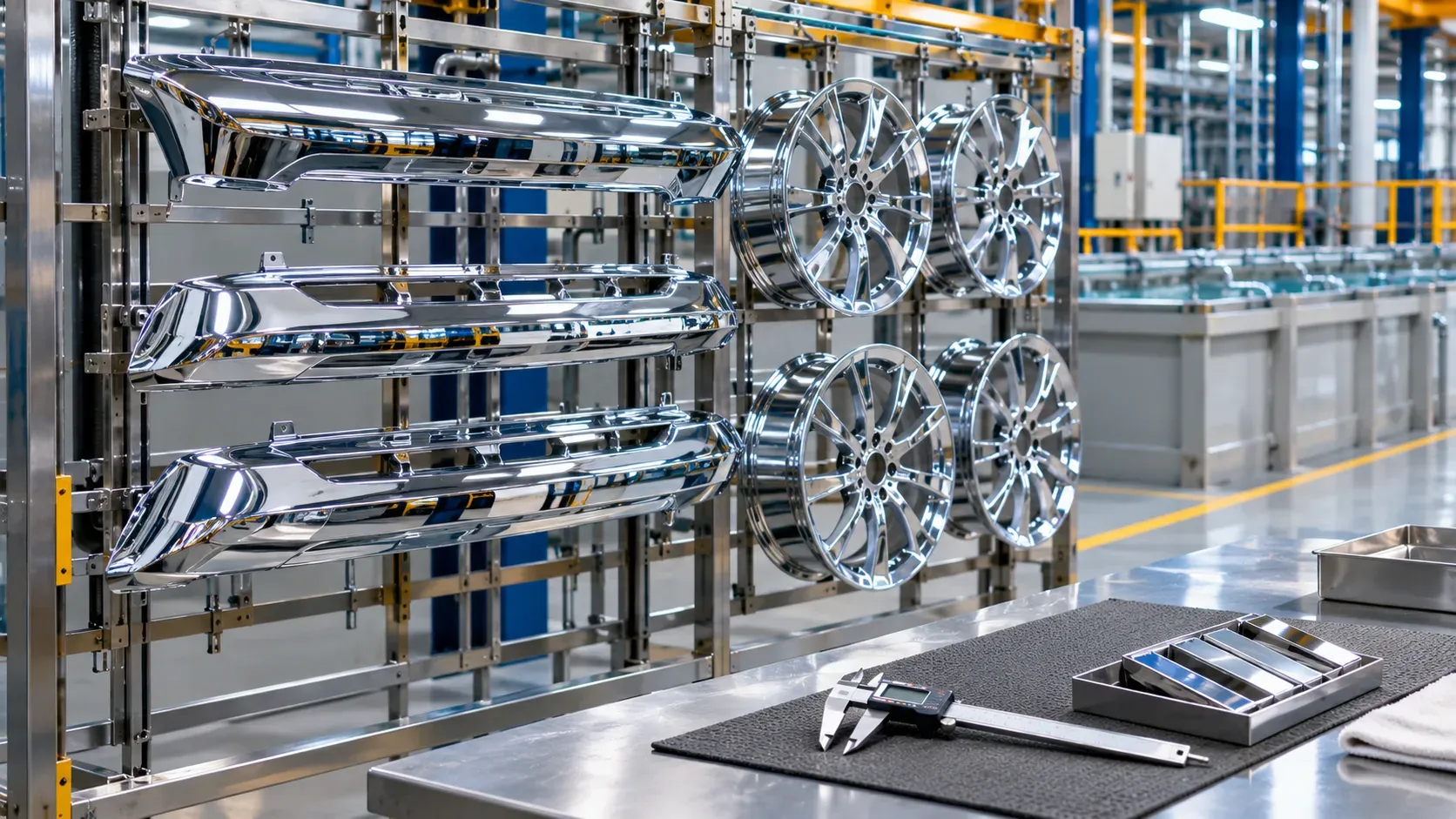
Automotive OEM specifications are the strictest quality requirements a plating shop will encounter. They go beyond national standards to define coating thickness, adhesion, corrosion resistance, appearance and traceability — and they audit the equipment that produces the coating, not just the coating itself. This guide translates automotive specifications into the equipment scope that passes an OEM audit.
Technical planning document — obtain the specific OEM specification for your customer and confirm every requirement against it.
What automotive specifications actually define
OEM coating specifications (from VW, BMW, Mercedes, Stellantis, Toyota and others) are detailed technical documents that define:
Specification area | Typical requirement | Equipment implication |
|---|---|---|
Coating system | Specific plating sequence (e.g., Cu/Ni/Cr), minimum thickness per layer | Tank count, solution chemistry, rectifier capacity per layer |
Corrosion resistance | Neutral salt spray hours (e.g., 480 h to red rust, 720 h to white rust) | Treatment plant capacity, rinse quality, bath monitoring |
Adhesion | Bend test, thermal shock, cross-hatch — zero failure allowed | Pre-treatment scope (ultrasonic, electrocleaning), activation steps |
Hydrogen embrittlement | Baking requirements for high-strength steel (≥ 1000 MPa tensile) | Baking oven with temperature control and timing records |
Thickness measurement | XRF measurement at defined points on each part | XRF instrument, measurement plan, data retention system |
Traceability | Every part linked to the rack, operator, bath analysis and process data | Control system with data logging and part-level traceability |
Audit requirements | Annual supplier audit: process documentation, FMEA, capability studies | Documented process, control charts, PM schedules |
The equipment scope that passes an OEM audit
An OEM auditor walks through your facility and asks one question per station: "Show me the evidence that this process step is under control." The equipment that answers that question includes:
- Instrumented tanks. pH, temperature, current density and conductivity monitoring with data logging and alarm history — not analogue gauges.
- Automated hoists. Programme-controlled transfer times that match the specification's process cycle, with timer records.
- Treatment plant with monitoring. Effluent pH, flow and metal concentration monitoring with sample records.
- Thickness measurement. XRF instrument for thickness measurement on every production batch.
- Baking oven with records. Temperature, time and load data for hydrogen embrittlement relief.
- Traceability system. Part-level traceability linking each part to its rack, bath, operator and test results.
The controls and traceability guide covers the documentation scope; the witness coupon guide covers the test evidence.
Hydrogen embrittlement: the automotive-specific requirement
High-strength steel parts (screws, bolts, springs with tensile strength above 1000 MPa) are susceptible to hydrogen embrittlement from cathodic plating processes. OEM specifications mandate a relief bake — typically 190–220°C for 4–24 hours depending on the steel grade and the plating process — within a defined time window after plating.
The baking oven must have: temperature control within ±5°C, uniform heating across the load, timer records and a documented loading procedure. The baking equipment guide covers the scope.
Key takeaways
- Automotive specifications audit the equipment, not just the coating — instrumented tanks and records are required.
- Traceability at the part level is mandatory: rack, operator, bath data and test results linked per part.
- Hydrogen embrittlement baking is a specification requirement for high-strength steel parts.
- XRF thickness measurement on every batch is the standard thickness verification method.
- Treatment plant monitoring is part of the audit — not just the plating tanks.
Your next five steps
- Obtain the specific OEM specification for your customer and read every requirement.
- Gap-assess your current equipment against the specification's audit requirements.
- Upgrade instrumented monitoring, traceability and thickness measurement first.
- Add the baking oven scope for hydrogen embrittlement relief if high-strength steel parts are in the range.
- Prepare the audit documentation: process FMEA, control charts and PM schedules.
FAQ
Do all OEM specifications require hydrogen embrittlement baking?
Only for high-strength steel parts (typically above 1000 MPa tensile strength). The requirement and the baking parameters depend on the steel grade and the plating process.
Can we pass an OEM audit without automated hoists?
Manual hoist systems can pass if the process records demonstrate consistent cycle times. However, automated hoists simplify the evidence because the timing is programme-controlled.
What is an FMEA in the context of plating?
A Process Failure Mode and Effects Analysis: a documented assessment of what can go wrong at each process step, its effect, and the control that prevents it. OEM auditors expect a documented FMEA for the plating process.
Image note: AI-generated editorial photography illustrates equipment or workpiece contexts; it is not an ES-PRO installation, customer reference or evidence of coating performance.


