Plating Lines & Equipment
Anodizing Rectifiers: Power Supply Inputs for the Line
Anodizing power supply inputs: how anodizing rectifiers differ from plating units, what ramp profiles and bus work decide, and the sizing inputs to brief.
# Anodizing Rectifiers: Power Supply Inputs for the Line
ES-PRO editorial team �� Updated 27 October 2026
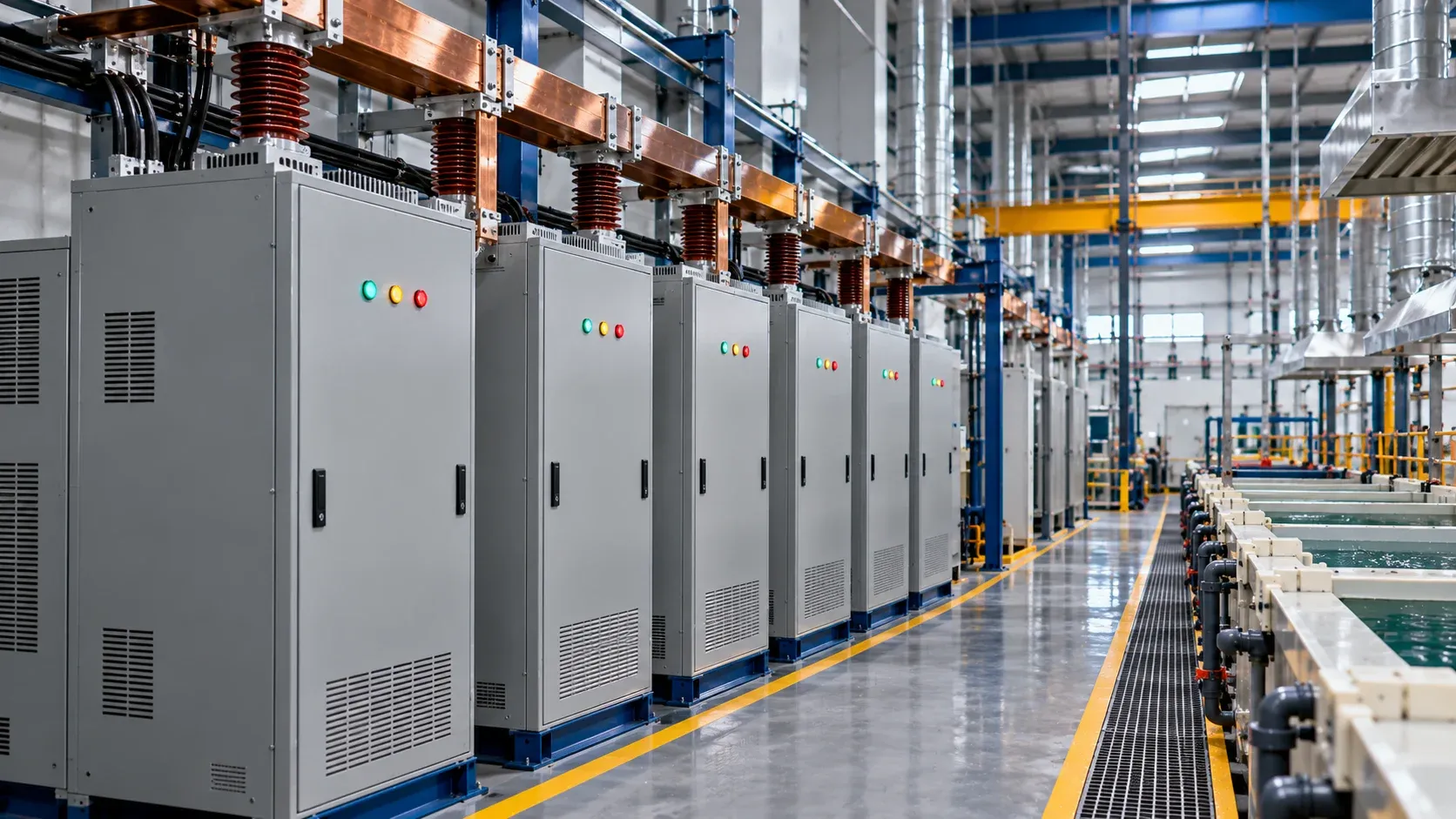
Anodizing runs at moderate DC voltage and very high total current �� the load's entire surface area carries current at once, so the power supply is sized by the whole rack, not by the part. That one fact shapes everything about anodizing power: current per tank, bus bar cross-sections, contact quality across the rack, and the ramp profiles that protect thin edges from burning while the film grows. The rectifier is a first-order quality instrument in anodizing, not a commodity on the wall.
How does anodizing power differ from plating power?
- Total current is the sizing driver. Anodizing current density applies across every wetted surface of the load; a rack of parts multiplies quickly into a large total. The tank's expected load area �� not the largest single part �� sizes the supply.
- Voltage ceilings differ by route. Decorative sulfuric work runs at modest voltage; hard anodizing pushes higher voltage and, with it, higher cooling and insulation demands.
- Ramping is part of the process. Anodizing calls for controlled current/voltage rise profiles; the control granularity to run and record them is a specification item, not a luxury.
- The bus work is the circuit. Low-voltage, high-current distribution means bus bars, joints and rack contacts carry the engineering �� resistance at any joint shows up as uneven film.
What does the brief fix?
Input | What to provide | What the proposal should clarify |
|---|---|---|
Load area | Expected rack and load areas per product family | Total current per tank; rectifier count |
Route mix | Type II, Type III, specialty routes | Voltage ceilings and cooling class per supply |
Ramp control | Profile requirements per route | Programmable profiles, recording interfaces |
Cooling | Rectifier environment, ambient conditions | Air vs water cooling and the plant-side duty that follows |
Bus work | Tank positions, distances | Bus bar routing, joint plan, connection hardware |
Controls | Line control system |
The electroplating-side selection framework lives in our rectifier RFQ guide; the anodizing brief adds the load-area and ramp inputs above.
How does power connect to the rest of the line?
Contacts and racks carry the current to the part. Rack design and contact maintenance decide how evenly the supply's output reaches each part �� the furniture is part of the circuit.
Cooling keeps the process in its window. The rectifier's losses and the process tank's heat both land on the plant's cooling and ventilation; brief them together so neither is sized as an afterthought.
Records close the loop. Ramp profiles, current and voltage curves per load are process evidence �� the control interfaces belong in the brief with the same seriousness as the ratings.
Where this does not fit
- Sizing from a nameplate habit: the load-area calculation per product family is the input; a generic kW figure is not.
- Reading this as a purchase specification: ratings, cooling class and interfaces belong to the supplier's engineering against your loads.
- Ignoring bus work until installation: high-current distribution at low voltage is engineered, not improvised �� route it on the layout drawing early.
- Expecting power quality to fix contact problems: a rectifier cannot compensate for a corroded rack contact; the circuit includes the furniture.
Questions You May Have:
Why is our anodized coating uneven across the rack?
Current distribution is the usual suspect: contact quality, rack geometry and part placement shape where current enters �� the supply only delivers what the circuit accepts. Verify the furniture and bus joints before blaming the rectifier.
Should we choose air-cooled or water-cooled rectifiers?
It follows from the plant's environment, space and cooling capability. Water cooling moves the heat to a utility; air cooling moves it to the room's ventilation. Both are workable �� brief the plant side honestly and let the assessment decide.
Can one rectifier serve two tanks?
Occasionally, with engineered switching and interlocks �� but sharing introduces scheduling coupling and failure dependencies between tanks. Assess the production pattern first; independence is often worth the second unit.
What does ramp control actually do?
The controlled rise of current and voltage during the start of anodizing manages heat and film formation on thin edges and sharp features �� the classic burn-prone zones. Profiles per route are why control granularity belongs in the specification.
Technical references
- Practice description. Ratings, cooling classes and control interfaces follow the supplier's engineering against the loads and routes the brief defines.
Get Proposal and Demo
Introduce your anodizing project with company, name, email and project country. Technical fields are optional. Describe the load areas, route mix and plant cooling capability when available, and ask which power configuration the assessment recommends.
Details can follow by sales email, or chat on WhatsApp. The Type II guide covers the process the supply serves.
Image note: AI-assisted conceptual diagrams illustrate equipment or workpiece contexts; they are not an ES-PRO installation, customer reference or evidence of coating performance.