
Plating Process
Aluminium Anodizing Types Equipment
Anodizing aluminum is not one process — it is a family of electrolytic processes with different equipment scopes, coating properties and applications. Type II sulfuric anodizing, hard anodizing (Type
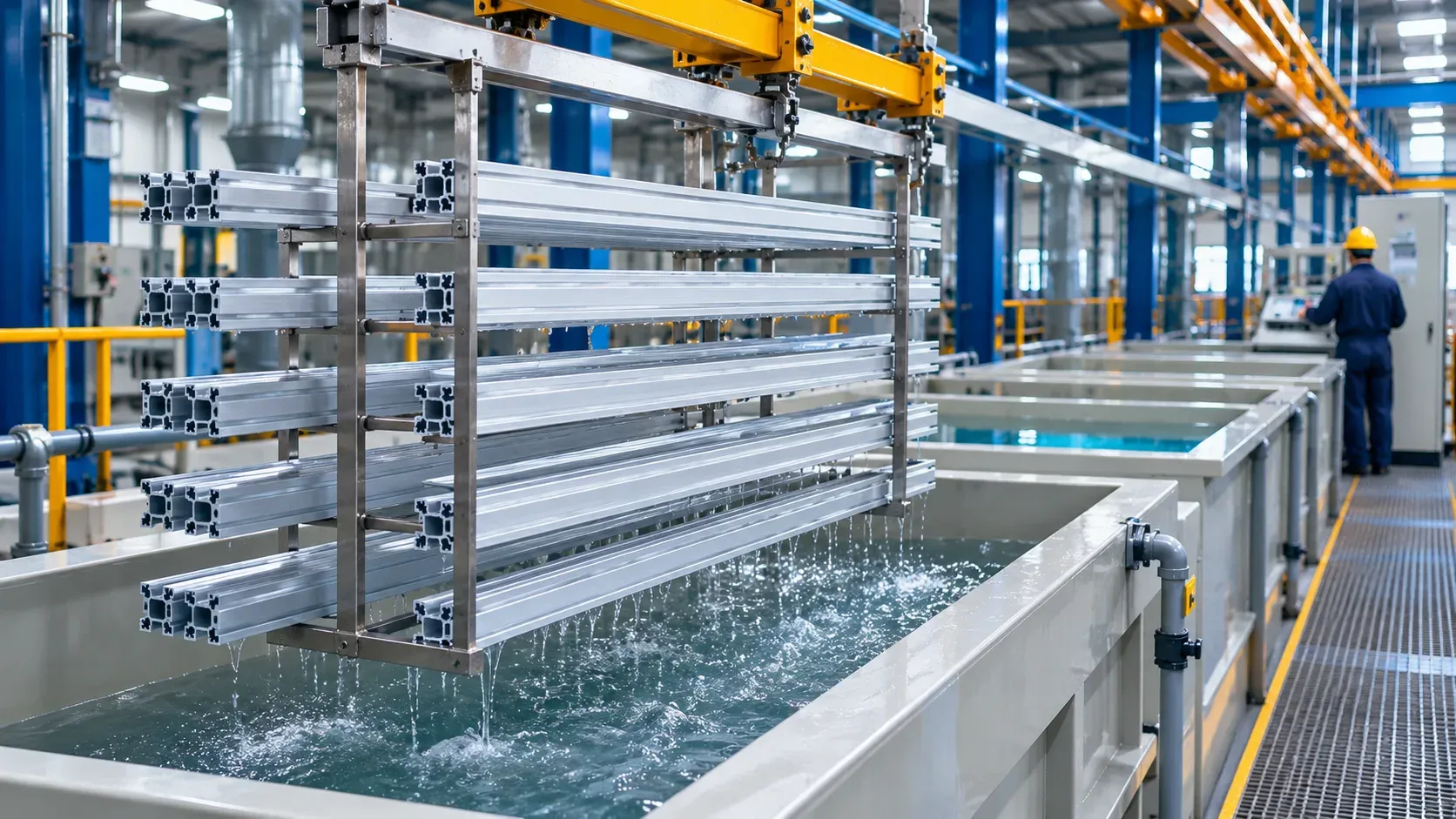
Anodizing aluminum is not one process — it is a family of electrolytic processes with different equipment scopes, coating properties and applications. Type II sulfuric anodizing, hard anodizing (Type III), chromic acid anodizing and thin-film anodizing each need different tank conditions, rectifier ratings, temperature control and effluent treatment. This guide maps the four types to equipment scopes.
Technical planning document — confirm chemistry parameters with your anodizing chemical supplier.
The four anodizing types
Type | Electrolyte | Temperature | Current density | Coating thickness | Application |
|---|---|---|---|---|---|
Type II (sulfuric) | 15–20% H₂SO₄ | 18–22°C | 1.2–1.8 A/dm² | 5–25 µm | General decorative and protective |
Type III (hard) | 10–15% H₂SO₄ | 0–5°C (refrigerated) | 2.5–4.0 A/dm² | 25–150 µm | Wear resistance, insulation |
Chromic | 3–5% CrO₃ | 35–40°C | 0.3–0.5 A/dm² | 2–8 µm | Aerospace — minimal fatigue impact |
Thin-film / phosphoric | 3–12% H₃PO₄ | Room | 0.6–1.2 A/dm² | < 1 µm | Pre-adhesion for bonding and plating |
What differs in equipment scope
Equipment | Type II | Type III (hard) | Chromic |
|---|---|---|---|
Tank material | PP or 316L stainless with cathodes | PP or 316L stainless | PVC or lined steel (chromic acid attacks PP) |
Temperature control | Cooling to 18–22°C (chiller or cooling coils) | Refrigerated cooling to 0–5°C — the biggest cost differentiator | Heating to 35–40°C |
Rectifier | Constant current at 1.2–1.8 A/dm²; standard ripple spec | Higher current density; pulse capability may improve coating quality | Lower current; voltage control to prevent burning |
Fume extraction | Standard acid extraction | Standard acid extraction | Cr(VI) mist extraction and scrubbers mandatory |
Effluent treatment | Aluminum and acid neutralisation | Aluminum and acid neutralisation at higher loads | Cr(VI) reduction before discharge |
Cathodes | Aluminum or lead | Aluminum | Lead or stainless |
Hard anodizing: the temperature is the process
Hard anodizing produces thick, dense coatings (25–150 µm) with hardness up to 400–500 HV. The key difference from Type II is the operating temperature: 0–5°C instead of 18–22°C. At low temperature, the oxide layer forms dense and non-porous rather than soft and porous.
The refrigeration system is the single biggest equipment investment for a hard anodizing line. Chiller capacity must handle the heat generated by the anodising current (typically 2–4 kW per m² of loaded area) plus the ambient heat load. A chiller undersized for the load cannot maintain the 0–5°C window, and the coating will be soft instead of hard.
Chromic anodizing: the authorisation question
Chromic acid anodising is used in aerospace where minimal fatigue strength reduction is critical. The chromic acid electrolyte is inside the REACH authorisation regime — the same conversation as hexavalent chrome plating. Buyers should evaluate sulfuric-tartaric acid anodising (STAA) as a chromic acid alternative; the equipment scope is similar to Type II but the electrolyte chemistry differs.
Key takeaways
- Type II sulfuric is the general-purpose anodising process with the simplest equipment scope.
- Hard anodizing requires refrigerated cooling to 0–5°C — the chiller is the biggest equipment investment.
- Chromic anodizing is inside the REACH authorisation regime — STAA is the alternative being adopted.
- Rectifier type: constant current mode is standard for all anodising types.
- Each type needs different cathode materials, electrolyte chemistry and effluent treatment.
Your next five steps
- Identify the anodising type your application requires: Type II, Type III, chromic or thin-film.
- Size the chiller for Type III hard anodizing — it is the largest single equipment item.
- Confirm the electrolyte chemistry and cathode material with your supplier.
- Define the rectifier specification: constant current mode at the recommended current density.
- Scope the effluent treatment: aluminum plus acid for Type II/III; Cr(VI) reduction for chromic.
FAQ
Can one line do both Type II and Type III hard anodizing?
The same tank geometry and rectifier can serve both if the cooling system can reach both temperature windows (18–22°C and 0–5°C). The chiller must be sized for the harder duty.
Why is chromic anodizing used in aerospace?
The chromic acid process produces a thin coating that minimises fatigue strength reduction — critical for aerospace structural parts. Sulfuric-tartaric acid anodising (STAA) is the accepted alternative in many specifications.
What happens if the hard anodizing temperature rises above 5°C?
The coating becomes porous and soft instead of dense and hard. The refrigeration system must maintain the 0–5°C window under full production load.
Send your aluminum alloys and anodising requirements by sales email, or discuss the project on WhatsApp.
Image note: AI-generated editorial photography illustrates equipment or workpiece contexts; it is not an ES-PRO installation, customer reference or evidence of coating performance.


