
Material Notes
Plating Line Stops and Restarts by Rack Position
Account for every plating rack after an unplanned stop. Record the last verified stage, exposure and release decision, and specify the controls to test.
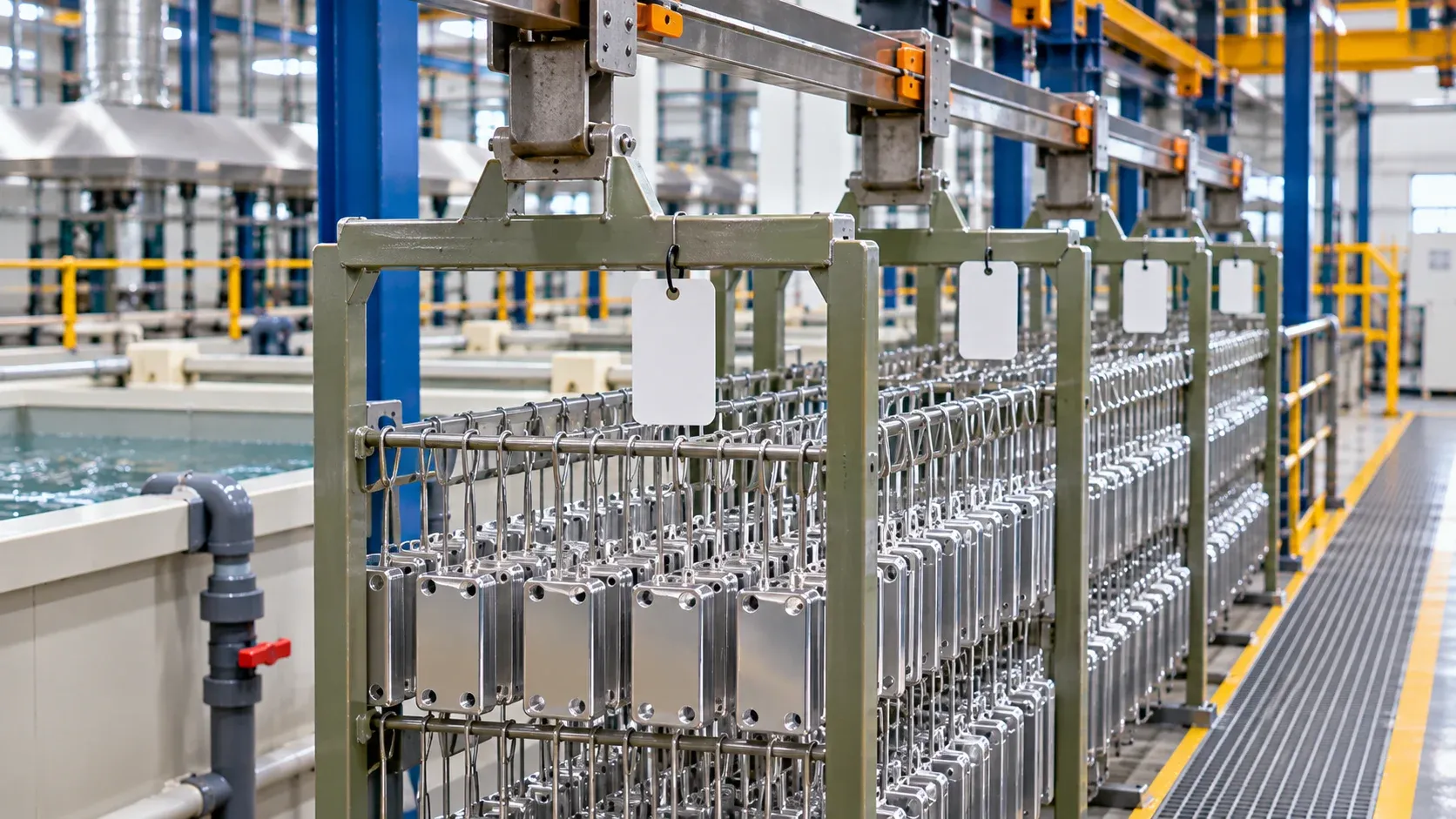
After an unplanned plating-line stop, account for every affected rack before releasing the next load. Record each rack's physical position, last verified stage and elapsed exposure. Put any uncertain history into the plant's quality review. Resume production under the approved recovery procedure and keep disposition tied to the original rack and lot.
ES-PRO editorial team · Updated 11 November 2026
This is a production and purchasing guide. Plant personnel use the approved emergency, equipment and process procedures for the actual stop. The buyer's job is to specify what the control system and records must show so the authorized team can make a defensible decision.
Separate physical position from completed work
A rack found above a rinse may have completed its last dip, may have been lifted early, or may have reached that position during an approved intervention. A position sensor identifies location. A stage-completion record identifies which operation actually finished. Compare the two before treating a rack as ready for the next stage.
Agree what time each event represents. A command to start a move, proof that the rack reached the station, and confirmation that the stage completed are different events. Capture an independent manual observation when authorized staff can establish one safely. Keep it attributable and timestamped.
Rack field | What to enter | Decision it supports |
|---|---|---|
Rack and lot | ID, part family and loaded quantity | Trace affected pieces |
Last verified operation | Station, start/finish evidence and record source | Distinguish a completed stage from an attempted one |
Position at interruption | Confirmed location or unknown status | Identify conflicting sensor and operator evidence |
Exposure or delay | Known interval or unverified gap | Apply the approved process or quality disposition |
Release authority | Hold, approved continuation or other disposition, with owner | Prevent silent release of affected parts |
Work through a stop with three racks
Imagine a hoist stop during a nickel route. Rack 17 is confirmed in a rinse with a recorded prior stage completion. Rack 18 remains in the nickel bath and its elapsed time is uncertain. Rack 19 has entered preparation and the controller shows a transfer request without proof that the move completed.
The quality owner reviews the three histories separately. Rack 17 can be evaluated against the approved rinse and transfer limits using its recorded timing. Rack 18 needs the plant's process disposition because its exposure is uncertain. Rack 19 needs position reconciliation before the system can assign a known stage. The record preserves all three decisions even if the line later completes an approved restart.
For a quotation, ask the supplier to demonstrate the information the operator would see in this scenario. The demonstration should include a restart with one unknown position, one missing stage-completion signal and one operator-entered observation. The outcome to check is whether the system exposes the gap and records the decision.
Define the controls and acceptance evidence
Start with the controls and traceability guide. For this use case, require a view of all affected racks, a way to identify uncertain histories, a release-authority record and an export linked to the event and lots. Agree what data must survive loss of power or communication and how to show that the clock and station identities remain consistent.
Ask the supplier to state where manual intervention and controller recovery meet. A legitimate manual action may change the rack's physical state. The next event should reflect the authorized action and show the rack's verified state. Use the plating line layout guide to connect that recovery sequence with the actual station and access layout.
Add the event reconstruction to the acceptance portion of the line setup brief so the recovery scope appears in the quotation.
Copy a stop reconciliation sheet
Record event ID · last reliable time · rack ID · part lot · current position · last verified stage · uncertain interval · affected quantity · disposition · approver. Reconcile the number of physical racks to the number with dispositions before closing the event. Keep a separate list of unresolved racks that need follow-up.
Define the quality release point for the first post-recovery load. The acceptance plan can require a specific first-load inspection and comparison against the normal record. Leave process limits to the approved route. Carry out recovery demonstrations with controlled signals or a safe, approved test setup.
Ask for a readback after the event closes. Pick one held lot and reconstruct its position, missing information and approval from the export alone. Repeat with a released lot. This exposes records that look complete on the operator screen but lose the link between the stop, the rack and the final decision.
FAQ
Does a normal controller status release the interrupted lots?
Use the controller status for equipment readiness. Release each affected lot through the agreed process and quality disposition.
What if the rack location and the event log disagree?
Record both observations and their timing. Hold the affected history for the authorized team to reconcile.
Should we include a simulated stop in equipment acceptance?
Include a representative, controlled scenario when the purchase relies on traceable recovery. Agree the expected records and dispositions before the test.
Discuss line recovery requirements
Share an example stop and the records your team needs. Include the routes, rack IDs and the evidence used to release work. Send details by sales email, or discuss the project on WhatsApp.
Image note: AI-generated editorial photography illustrates equipment or workpiece contexts; it is not an ES-PRO installation, customer reference or evidence of coating performance.